A Solar Choice broker will help you, at no charge, decide what size solar energy installation best suits your needs and budget. In the meantime, we hope the following article will assist you in making the right decision.
There are a number of factors to consider in deciding what size system best suits your needs and budget.
How to calculate the size of solar system for your home
1. Look at your energy bill
The best place to start is by taking a look at your most recent energy bills. Most energy companies have a graph on the back of your bill which sets out your average daily energy consumption. An energy efficient Australian three bedroom home, with an average sized family and reasonable use of air conditioning, will usually have an average daily consumption of around 12kWh to 16kWh.
Now depending on where you are in Australia and how much day light you receive on average per day, a 1kW solar power system will usually produce around 4kWh to 5kWh of energy per day. So the general rule is that a 3kW solar energy installation will usually be enough to cover all the power needs for an energy efficient average Australian home.
If however you live alone, or maybe are a retired elderly couple, your household energy needs will be significantly less. Usually a 2kW solar power installation will cover most if not all of your energy needs.
But a 1kW solar power system can effectively become a 3kW or 4kW system depending on what feed in tariff is offered by your State or Territory, and how much energy you use (see below).
2. Calculate your federal government Solar Credits rebate
The Federal Government issues certificates for each megawatt-hour (MWh) of electricity expected to produced over the course of a solar system’s lifetime (a nominal 15 years, although systems actually typically go on functioning for 25 or 30). For the first 1.5kWh of a system, there is a REC multiplier available.
REC/STCs are sold on a market, and their price fluctuates (initially about $40, but have fallen as low as $18-20.) You can see current prices on the Clean Energy Council website.
3. Determine if you are eligible for a solar feed-in tariff in your state
A solar power feed in tariff, or reward scheme, gives you financial credit for the energy your solar panels feed back into the main grid. (Read about the current state-by-state Solar Feed-in Tariffs.)
For example, if you are at work during the day when the sun is shining and with only your fridge running at home, a 1kW solar power system will be feeding more energy into the grid than what you are using. A calculating device installed at your meter keeps a tally every 30mins throughout the day of this surplus energy, and credits your account. Obviously your solar panels don’t work in darkness, so at night there will be no power from your solar energy system going back into the grid. Every three months your energy company looks at the “for and against” tally, and either issues you a bill or – if you are ahead on the tally – a credit to your account for which you can elect to receive a cheque. Wouldn’t that be nice to receive in the mail from your energy company?!
Read about the different types of Solar Feed-in Tariff and Solar Buyback schemes available in Australia and how to take advantage of them.
How do I get started with solar power?
We hope the above points are helpful to you. Take 30 seconds to complete our online request for a quote comparison, or feel free to give your Solar Choice broker a call on 1300 78 72 73 to further discuss what size installation best suits your budget and energy needs. Remember, you don’t have to pay us anything at any stage. If you accept one of the discount quotes we broker for you, then the installer pays us a small commission on the value of the installation.
Written by Angus Gemmell
Managing director, Solar Choice


{ 49 comments }
Thanks … very helpful!
No one is telling the potential worth in dollars of the Feed in Tariff to thr Victorian Grid. Will it be capped at a value of $600 p.a.for systems less than 3.2 k.w.h. Some adverts say you could save $180 p.a. with a 1kw solar panel array (power into your house). Would you then add the two figures for a maximum annual saving, potentially $780p.a.? What is the math on what you can earn/save, please.
David,
A 1kW solar panel system produces on average 4-5kW hours per day. A 3.2kW solar power system would produce approx 14.4kW hours per day.
To calculate how much a solar energy system will earn you in real terms/$, imagine you were away overseas for a year, and all appliances in your home are turned off. For a 3.2kW system, 365 days x 14.4kW hours is 5,256kW hours. Victoria’s solar feed in tariff rewards you at 60c per kW hour. So 60c x 5,256 works out at $3,153.60 per year.
That is the maximum amount a 3.2kW solar energy system can earn for you with the solar feed in tariff in Victoria, and for 1kW the figure would be $1,051.20. How much you actually earn depends on how much energy you take from the grid, and of course there is a great variance in individual energy use. Have a look at your energy bill and work backwards from these figures.
Your new bi-directional meter keeps a tally every 30mins on whether your solar panels are producing more energy than you are drawing from the grid. If you come out ahead for that 30min period, you are rewarded at the premium rate of 60c per kWhour for that surplus amount only. So the more you can maximise the amount you are ahead during daylight hours by running an energy efficient home, the more your panels will reduce your bill and earn you credit.
If one is to install a solar system now. Will the providers up your rate because they are loosing revenue? Or disguise it as a new rate rise to think one is saving something which gives a false saving? This may occur unless we are self certificant.
Since the solar panel don’t work in darkness and they don’t store the energy itself, then what energy are we using at night?
Helen,
you are using power from the grid at night, unless you have a batter pack in which case it is the power from the solar panel.
@Helen
Hi Helen,
I can help you with this one, “Since the solar panel don’t work in darkness and they don’t store the energy itself, then what energy are we using at night?”
On a grid feed system, your electricity is taken as per normal from the grid. Your new electricity meter that is installed, winds back when you are generating electricity and goes forward when you are using electricity.
Val,
The short answer is no. Any increase in market rates for electricity will result in proportional increases in the feed-in reward rate. The main benefits for a stand-alone system are if the costs of connecting to the grid is prohibitive or if you need a back up battery system in times of blackout.
Helen,
Just to expand slightly on Glen’s comment, a solar energy system doesn’t provide your house with electricity. It simply adds electricity on to the grid you are connected to. You will still be using energy from the grid if you have a solar energy system installed, but the amount of energy your panels generates is measured at your meter box and minused from your bills.
When you are generating more than you are using, your meter winds backwards, and you are compensated at a premium rate in most states for this. This is known as the feed-in reward rate.
The thing that really annoys me is the fact that we are still connected to a grid. Why are people not realising that you have the potential to produce all your own electricity and not be a slave to the power companies. They say that producing green energy is more expensive and hence the consumer must pay more. So all that green energy that gets pumped into the grid is charged to other consumers at what rate exactly? Want to save the planet? Then break free from corporate greed
I’d love to hear comments from someone who has actually had the solar electricity panels installed.
Hi Gerald.
I’m currently exploring the grid-connect thing and am running across hidden pitfalls.. eg. The chit-chat about the feed-in discount, etc. sounds good, but they DON’T tell you that it only relates to the unit-price of electricity, and does NOT count the the ‘service charge’, which has just gone up about 14% and is set to double in the next 18 months. (I’m currently paying about as much for the service charge as for the power!) And there’s no accounting for the GST component.
I mention all this because I lived with solar (and later also hydro) power from 1982 to 2001, and gained a LOT of experience.
GETTING the power is relatively easy; the problem lies in the storage. Batteries and their maintenance are always a nuisance, though I must say part of my problems were due to using old traction batteries from the tip. (free!) A friend of mine who bought proper (though second-hand) deep-cycle batteries replaced them recently after 26 (mostly trouble-free) years. She’s also using my old panels (second-hand in 1982 for $6 per watt), and they’re still producing just over 85% of their rated power!
If you can afford to commercially grid-connect, you can afford top-shelf INDUSTRIAL deep-cycle batteries like the ones used in forklifts, etc, which should last forever. And if you keep your system under 50 volts (ie: panels NOT connected in series as per grid -connect) then you can do it all yourself instead paying some rip-off merchant inflated prices for the donkey-work.
And unless I get a much better deal than I’ve been hearing that’s the way I’ll go, and bugger the FIT. Instead of paying up to $14 per watt, you can buy panels (eg ebay ~ but you need to be careful) for as little as $2 per watt. I’ve done the arithmetic, and reckon I can set up a stand-alone 3kw system (in Victoria) for about $7500 to $8000.
There are many other hints and innovations that make such a system more practical, and you’re welcome to contact me if you want to discuss them.
So just how reliable are these systems (inverter and PV panels) ?
Do you have to purchase the meter from the power company or is it part of the install ?
Do you have to climb on the roof and wash the panels or they become less efficent with age due to dis-coloration.
Can you get adjusting panels to accomodate the lower angle of the winter sun
Hi Greg. The minimum standard for reliability is established by the Clean Energy Council and the BCSE accreditations, which all installers on the Solar Choice network maintain and abide by. This ensures the proper international standards for construction of the panels and inverters has been verified, and they have been tested to various temperature, weather and output controls. 25 operational warranties exist on the panels and 5 year operational warranties on the inverters. Manufacturers warranties differ from installer to installer, but are a good standard to test various quotes by.
The meter must be purchased from the power company as the costs and arrangements differ based on the supplier, and a level 2 qualified electrician needs to carry out the work.
The panels do require a wash down occasionally, depending of course on how much dust/salt build-up they are exposed to. In reality a strong enough downpour of rain will carry out this work for you.
Here is an article on various types of solar tracking, including the adjustable tilt frames you’ve mentioned: http://www.solarchoice.net.au/blog/solar-trackers.html
We are moving to Northern NSW near Yamba, this year to build a new house. We would like to put in solar with the right amount of panels for a family of 5 max at any one time. House will be approx 30 sqs in brick/rock/glass/tile roof. We would like to know what to look into NOW, – blogs, websites, feedback etc for the best solar system in NSW so we can choose the right system for us and build it with the house. Anyone have any ideas where to start. I am very ignorant of the workings of this at this time but intend to be fully informed.
Hi Claire,
We are also in the same boat – moving to north coast in a couple months and wish to put solar on our house before we get there. Would be interested in any information you receive.
You can get the same information tailored to your interests if you can fill out the short form in the link below.
Click Here
We are moving to Northern NSW near Yamba, this year to build a new house. We would like to put in solar with the right amount of panels for a family of 5 max at any one time. House will be approx 28 sqs physical rooms and 35 under rooflines in brick/rock/glass/tile roof. We would like to know what to look into NOW, – blogs, websites, feedback etc for the best solar system in NSW so we can choose the right system for us and build it with the house. Anyone have any ideas where to start. I am very ignorant of the workings of this at this time but intend to be fully informed. Please feel free to email us. Thanks
Start by building with blocks, sand in all openings of the blocks. PUT INSULATION on the OUTSIDE 2 INCH OR MORE SOLD FOAM, concrete floors with as much tile as you can, porches over as many of your openings as possible. Use high rated windows and doors installed with foam and foam in ever crack inside and out. The more overhang of the roof you have the better. Look at concrete home building systems. By doing this your home becomes a huge icebox with the heat and cold STORED INSIDE, IN ALL THE CONCRETE.
Hi Rick,
Good points. We often point out that the first step in ensuring you’re getting the best out of your solar PV system is to make sure that your home energy use is as low as possible, which means utilise passive solar design techniques (such as insulation and thermal mass in concrete as you’ve described), and then use your electricity wisely–don’t squander it.
It doesn’t appear that there are any rebates if the system is installed in a holiday house. Is this correct?
Hi Allan,
No this is not correct, except if you are a Victorian. All of the standard rebates including the REC solar credits and feed-in tariff are completely eligible for a holiday house in NSW, Qld and SA. Infact, there are substantial benefits to installing solar panels on your holiday home, particularly if you live in Qld or SA. For an indepth discussion of this, please see our article; Putting solar cells on your holiday home – a nice little earner.
In Victoria, however, holiday homes are not eligible for the Victorian Government solar feed in tariff, although installations will still recieve the REC bonus and the market rate of electricity. Assuming you are a Victorian, thanks for pointing this out. I’ve made a correction to our post.
Here are the relevant quotations and links on this matter:
REC solar credits (applies nationally): No reference is made to occupying or residing at the premise, nor to holiday homes. See Definition of and eligible premises in SGU owners guide.
NSW: eligible premises must be “owned or occupied”, not owned and occupied. See FAQ answer; Can I install a solar photovoltaic (PV) system or wind turbine up to 10 kilowatts on a neighbour’s roof and receive a credit under the Solar Bonus Scheme?
Victoria: “The premium solar feed-in tariff cannot be claimed for holiday homes”. See FAQ answer; Who is eligible for the premium rate?
Queensland: No reference is made to occupying or residing at the premise, nor to holiday homes. See FAQ answer; Who is eligible to receive the bonus?
South Australia: No reference is made to occupying or residing at the premise, nor to holiday homes. See FAQ answer; Who is eligible?
Kobad Bhavnagri
Solar Energy Consultant
Solar Choice Pty Ltd
Hi,
The author has done a great work. I appreciate his work.I am highly oblige for this because it helps me a lot.
What happens in a blackout? These are common in my region (1-2 times pA). During the day, when a 2kW system is producing 8-10kWhrs, it may cover the household use – but it may not. Can I wire my house so ‘essential’ services (fridges, TVs) are fed? If not, where does my unused power go? Obviously, no benefit at night.
Usually the inverter will shut down and the power being generated by your panel will be wasted, unless you have a battery to store the energy and direct it to your house-hold essentials. Thus, if blackouts are common in your area then you might want to consider a battery pack sized for your essentials during the night when the sun is not shining. And yes, we can help you in refining your criterion and connecting you with an appropriate installer.
Hi, we are going to build a 3 bedroom cottage at Palana, Flinders Island, House roof dimensions 17m x 8.5. Tasmania. We are a retired couple, Could you please help us in determining an estimate of installing a system that would also feed electricity back into the system. We are connected to the grid. Also, can you assist us in what currently is the situation as to how much is paid to us in feeding the ‘over-load’ and as to what rebates are available (federal and tasmanian state). Thank you
Carita Bathman
Hi Carita,
Wow. Sorry for the very delayed reply. I hope we’ve already been in touch with you. For a price quote comparison, please see this page:
http://www.solarchoice.net.au/request-quote-comparison.php
Thanks!
Hi, I’m on OFFPEAK Hotwater currently. How would that fit in with a,say, 1.5kwh System? Is it all under that ‘one’ System or would there also be Domestic/offpeak? Thank you, Werner
You would simply get paid the Feed-in-Tariff (FiT) rate for your state for the amount of electricity that you generate (or generation minus consumption if you live in a net-FiT state).
thankyou so much for all this information. it has been very hard to find any, anywhere else. just wanting to know though how to decide which company to use? other than by price how do you find out who is reputable and who is not. everyone says they are and no one else is, off course.
Thanks for info. We are in NSW, and own our own home. We are thinking of putting in solar. However, we are moving overseas mid next year, and renting our house while we are away. Is there a way to credit the electricity our panels will produce to us, while our tenants pay for the electricity they use?
Not that we have heard of.
good
just startig out on investigating solar power
Exploring Solar Panel Installation costs
Hello David,
We’d be happy to help you out. Please give us a ring on 1300 78 72 73 or fill out an online quote comparison request here.
hey can u plz help me out with a few of my questions
1- for producing 1kw of electricity what should be the size(area/dimensions) of solar panel?
2- how to calculate efficiency of solar panel? and when i know the efficiency,how to calculate the area of solar panel? and therefore how to calculate its cost?
Hi Swapnil,
Thank you for the questions.
1. The area that your solar panels will take up depends on the efficiency of the the solar panel brand and model that you have installed. For example, if you went with Suntech Ad+ (190W) solar panels (a fairly standard panel for Australia), you would need about 6 panels to make assemble a system that is a little bit more than 1kW (it is impossible to get exactly 1kW). The solar array would take up about 7.6 square meters on your roof if you lay them flat (the best option), but possibly more if you have to/want to tilt them at an angle for greater efficiency (because you then need to be careful that the panels don’t shade one another.)
2. Different solar panels have different rated efficiencies, so you don’t need to calculate the efficiency of the panels themselves. For example, the efficiency of the SunTech modules I mentioned above is 14.9%. This means that the panel can use 14.9% of the sunlight that falls on the panel. If the efficiency is lower, if means that the panel can not use as much sunlight. In effect, the biggest difference with regard to the efficiency of a solar panel is the amount of space that it takes on your roof. Less efficient panels need more space.
Please remember that the solar panels are not the only part of the system, and the efficiency of the panels is not the only part of efficiency of a system. You also need to think about the inverter, the orientation and tilt angle of the panels, the wiring, and any possible shading that might happen as a result of nearby trees.
A Solar Choice broker can help you to decide what size of system would be best for your home and energy usage. Please fill out our form to get a comparison of solar quotes from installers in your area of Australia, or give us a call on 1300 78 72 73.
what happens if you get the Q.L.D government solar panel grant and you sell the house
Hi Marley,
The Queensland Solar Bonus Scheme Feed-in Tariff is available to both those who install a new system as well as those who operate existing systems. This means that if you sell your home, the following owner will be eligible to receive the Feed-in Tariff.
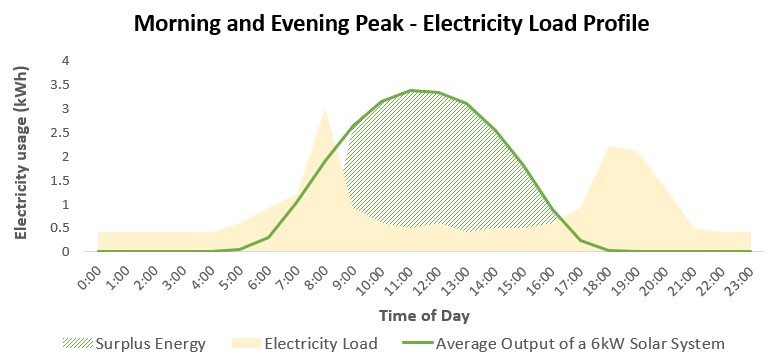
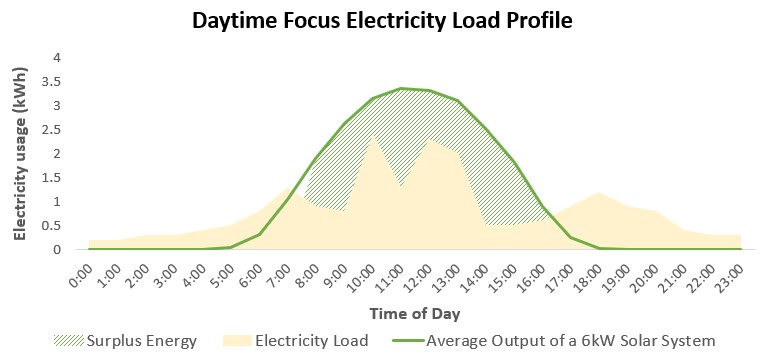
The comments at the top of the page are not quite correct! If the average daily usage is 12 -16 kw hrs per day not ALL of that consumption is in daylight hours?? You can only generate electricity while the sun is up! You first need to asses what the avge daytime consumption is before you can work out the size of the system you need??
Hi Chris,
Thanks for the comment. The comments at the top of the article refer to a situation where the owner of the installed system lives in a state with a Solar Feed-in Tariff or 1-for-1 Solar Buyback. Provided one of these 2 schemes is in place, the time that the solar electricity is used is not important.
You would be correct, however, if you were thinking a state where no Solar Feed-in incentive scheme exists. In NSW and most of WA, for example, it only makes sense to install a solar system if you are planning on using the power during daylight hours.
I regret having solar power panels installed.When the companys are trumping up business they make it sound so good. If I invested my hard earned $’s I would be far aheadI feel we have just wasted $12,000. The salespeople don’t explain enough. We had advice from several avenues before deciding to have 3 kw system installed.
I guess the goverment or electricity company will lower the rates for the buy back soon and one will be further behind. The way we are going it will take us 20 years to get back our money at $1 per day Ha!!
Hello Pauline,
Sorry to hear that your system’s performance is not meeting your expectations.
I’ll need to ask a few questions to assist in troubleshooting:
-When are you using your electricity? If you are using electricity during the day when the sun is shining and your system is producing power, you will not see any credits on your bill because you are using the power directly. This means you are saving money from avoiding the need to purchase electricity from your electricity retailer in the first place.
-How much electricity (in kilowatt-hours or kWh) is your system producing on average? You should be able to find this out by looking at either your electricity meter, or on your monitoring equipment (via your inverter) if you have one. A 3kW system in central Queensland should produce approximately 12kWh per day.
HI , I have installed a 1.5 kw inverter with 8 , 190kw panels and am very happy, so I want to upgrade to a 3kw inverter. Will I need more panels? Thanks, Lester.
Hi Lester,
You currently have 1.2kW worth of solar panels with a 1.5kW inverter. I’m glad to hear this is working out for you. However, upgrading to a 3kW inverter would not be a wise idea at all unless you are planning on at least doubling the size of your solar panel array–i.e. 2.4kW, preferably more. 3kW inverters function optimally when there is 3kW of solar power flowing into them. Generally speaking, the further the gap between inverter and solar panel array capacity, the greater the efficiency loss. Read more about solar inverter efficiency.
Hi,
When the solar PV is installed how, what, when and more importantly who buys the excess energy. If I am currently with an electricity supplier do I stay with them and ask them to buy my excess? How does this part of the arrangement work out?
Hi Karen,
You don’t have to stay with your current installer, in fact, as a resident of NSW it’s worth your while to shop around. We have have a number of installers on our network who work with niche energy retailers, these retailers give solar PV customers a much better deal on the energy they feed back to the grid than some of the bigger names in the business. I can see you filled in our quote comparison form, someone will be in contact with you shortly to discuss your project – feel free to quiz them on anything you want to know!
Thanks for the comment, Home Solar Systems. I have used strikethrough for all the outdated information and included links to more up-to-date entries on the same topics.
-James Martin
Comments on this entry are closed.