What angle and orientation are best for solar panels in Australia?
Solar panels are installed differently based on their geographic locations throughout the world. The premise behind this is simple; the sun is in a different place in the sky, and solar panels should face it as squarely as is reasonably possible throughout the day.
The ideal situation is when the sun is hitting the panels at a perfectly perpendicular angle (90°). This maximizes the amount of energy striking the panels and being produced. The two factors that such an angle is controlled by are the orientation (North/South/East/West) and the angle of the panels from the surface of the earth.
Compare solar & battery storage quotes from installers in your area!
Compare Solar & Battery Quotes
Tilting
The tilt involves primarily the angle that the panels are facing up into the sky. On a flat roof, the tilt is 0°, whereas if the angles were to be facing a wall, it would be 90°.
According to the Your Home Technical Manual the ideal tilt angle for a solar PV array depends on the building’s electrical load profile (i.e. when you use electricity during the day). The below description refers to tilt frames, but its recommendations are worth bearing in mind when considering installing a panel array on a roof without tilt frames.
As a rule of thumb, if the main loads are in winter months when solar availability is reduced, tilt angles should be more vertical (approximately equal to latitude plus 15°) to maximise exposure to the low winter sun. If major loads are cooling and refrigeration the tilt angle should be reduced (approximately latitude minus 10°) to maximise output during summer. For grid connect systems the summer optimum angle should be used to maximise annual output of the modules.
So if you have heavy summer AC loads in your home or business, the ideal would be to tilt the panels your latitude minus 10°. If your winter heating loads are supplied by electricity (as opposed to gas or wood), on the other hand, then tilting your panels back at latitude plus 15° would be better. If the loads are roughly equal in summer and winter, tilting the panels at latitude should be fine.
In effect, however, most grid-connected solar systems are likely to be installed at whatever angle the roof happens to be tilted at (unless the roof is completely flat, in which case the panels should be given a slight tilt). This is because the additional cost of tilt frames is not always justified by the additional solar system energy yields – it may be more cost-effective (space permitting) to simply add an additional solar panel or two.
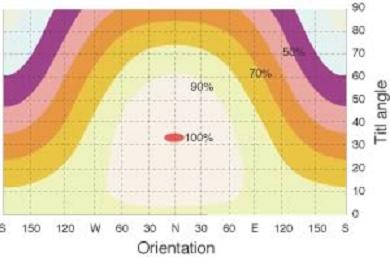
Efficiency of solar systems at different tilt angles and orientations for Sydney.
Orientation
Australia, being in the southern hemisphere, experiences a sun that is predominantly coming at us from the north. There is of course deviance throughout the seasons, but ideally solar panels should be facing as close to true north as possible to reduce the impact that the winter seasons have on energy yields. Once again referring to the graph above, one can see that even northeasterly and northwesterly facing panels will be largely operating at around the 90% of their rated outputs. However, once angles start approaching east-northeast or west-northwest orientation, the numbers start reducing rapidly.
A directly east or west facing panel will never operate at better than 85% of its rated output. To put this in perspective, rather than generating the usual 4.5kWh average daily energy per 1kW of solar, the system will only produce 3.835kWh. For example, a 3kW system would lose a full 2kWh a day if it were facing more east or west than north. This translates into a reduction in the amount of savings that would other be possible.
Read more: East vs West orientation for solar panels; which side is better?
Read more: Can you install solar panels on a south-facing roof?
When tilt frames are a justifiable expense
So we can see that both of these factors are important in their own right. What the majority of houses and installations need to remember is that a combination of a not so great orientation and a poor tilt will add on to one another, making the consideration of both factors the only reasonable way forward. Tilt frames that counteract a sub-optimal tilt and orientation will cost you a little extra. How much will depend on how many panels make up the system, and how the installer sources and prices the labour and parts required.
The bottom line is that the bigger a system is, the more justifiable that expense becomes – especially on a flat roof. In the ideal scenario, the cost of a tilt frame will be paid for with the increased efficiency and day-to-day output of your system. Shopping around to get a number of quotes is the best way to find a reasonable price for the frames.
Compare solar & battery storage quotes for your area
Compare Solar & Battery Quotes
© 2017 Solar Choice Pty Ltd
Top image via Your Home Technical Manual

- Tesla Wall Charger (Gen 3): An Independent EV Charger Review by Solar Choice - 16 April, 2024
- Compare Solar Feed-in Tariffs – State by State - 12 April, 2024
- Which electricity retailer offers the best solar feed-in tariff? - 12 April, 2024



Hi,
we want to install solar panels on a north/south facing roof in Blantyre/Malawi. Blantyre is at 15 degrees south, almost at the same latitude than Darwin in Australia.
We are considering to install solar panels on the north and south facing side of the roof. The roof is tilted at about 15 degrees. There is no shading from either side. I presume that there is no great difference in solar radiation. Is that right?
Could you please let us know the difference in energy production between the north and south facing sides of the roof. Is there a formula one can use for the calculation?
Thank you
Hi Volker,
Thanks for the comment. You can check out our article about south-facing solar panels here, but in a nutshell, if you’re in the tropics and your roof pitch isn’t extreme (yours isn’t) then it shouldn’t be a big problem.
If you’re looking for an calculator that will help you estimate the output from the system array you’ve described, try out the PVWatts calculator.
Hi i have a 3kw system with 11panels facing west tilted can i tilt the two on the southern end side up to face north i cant tilt any of the other one they will shade each other or do they have to be all be tilted the same Thanks
Hi Allan,
Unless you’ve got microinverters, I definitely wouldn’t recommend tilting only some of the panels. If you’ve got a single, central inverter (as most systems do), then you could run into issues with system output, as best practice is for all panels in a ‘string’ to be at the same angle & orientation.
Hope this helps!
Sorry the later half of my comment is a bit confusing. What She said to me over the phone is that a configuration of 9 north facing panels and 9 west facing panel produces more output during the day than 14 north facing panels 4 west facing panels. Mentioned that only 4 panels facing west would not produce enough startup power for the inverter thus making the 4 panels useless. Unit on a cloudy day produces 13-15 kw and on sunny non cloudy day 19-21 kw.
Thanks dev
Hi Dev,
Generally speaking, it’s better to have all of your panels facing north, although there is sometimes an argument for having west-facing panels – although this is generally the preferred fall-back in the case that there is no north-facing roof space available.
You can get some estimates on expected output for your system under both scenarios using PVWatts, a calculator tool from the USA’s National Renewable Energy Laboratory (NREL) which also works for Australia. You’ll have to model the scenarios in chunks because it doesn’t allow for multi-direction solar arrays.
Hope this helps.
Hi, I just got a 4.77kw with 18x265w panels install in Sydney. It was a cloudy day and I could not see the angle of the sun. I have no solar experience. The installer told me that he wanted 9 out of the 18 panels to be installed west ( different to what they had. In the diagram they had 12 panels facing north) facing to which I said That I would prefer to have as much facing north as possible as there were space to put another 5-6 panels north facing on the roof but on a lower level to the 9 panels facing north(doulble story level). Lower level panels would have one or two panels shaded until 10.30am but would have full sun after that He told me that west facing panel are better especially during summer months. Not knowing anything about solar I said you are the expert do what you think is good. After reading your article regarding having panels facing north I rang them up and complained. I was informed by the manager is that having 9 panels west facing is better than just having 3 or 4 facing west would not have sufficient startup power for the west facing panel and what they did was right. I am confused. Are they correct. Does having 9 panels facing west make much difference to the output?
Thank You
Your link to the “Your Home Technical Manual website” is broken but the LDF can also be found at http://www.livingsmartqld.com.au/modules/energy/PDFs/PhotovoltaicSystems.pdf
You also quote their text, then immediately summarise it with the tilt angles reversed. I’m surprised no-one else has noticed.
Hi Moz,
Quite frankly, we’re quite surprised as well – a glaring, egregious typo if there ever was one. We’ve just corrected it and also added in the PDF link – thanks for pointing it out.
hi. I have a marine buoy I’m kitting out with a 12V system for a research experiment. the buoy will swing, pitch and spin, so, 2-3 sides will always be shaded. I was going to have a solar panel on all 4 sides. What would be the best wiring to maximise charge? 1 MPPT and just a blocking diode on ech panel? Or 4 MPPTs? Then what? Thanks heaps….
Hi Charlie,
We deal mainly in residential and commercial rooftop solar PV so can’t really answer your question with confidence (although other readers here are welcome to give it a go).
My quick thoughts would be that if you have only 1 MPPT, it would be tricky to have 4 panels all facing in different directions and still get the output you desire. Your idea for bypass diodes might not be a bad one, but we’d recommend getting advice from an electrician rather than us.
Best of luck!
Q:
What do you do with solar pane orientation if it is in location close to the equator where the sun location will be 6 months south and 6 months north.
Please advice.
Hi Kharbat,
In the tropics it makes sense to lay the panels close to flat, although at least a slight angle (5-10%) should be maintained so that the panels can still ‘self-clean’ in the rain.
Hope this helps!
Hi,
Can you provide a link to a website where you can put in your address to get the roof image in the winter in NSW to check best positions for installing new solar panels? Thanks. Sharon
Hi Sharon,
Nearmap is a great service for that type of thing, but unfortunately it’s a very expensive service. However, you can sign up for a 30 day free trial if you only need to use it once. Google maps may help you to do the same thing, but it’s not as up to date as Nearmap (which may not be a problem in your case).
You can also try out PVWatts, which is great for estimating solar output for a given home – but it doesn’t take into account shading from nearby objects.
Hope this helps!
Can I installed array panels facing north?
Hi Sabet.
Generally speaking, if you’re in the southern hemisphere, a north is the preferred direction for a stationary solar array. All other factors being equal, a north-facing array will produce more energy than a west or east-facing array. If you’re in the northern hemisphere, south is the preferred orientation.
Hi,
We had the Solar panels installed from 2 different companies. 1.5KW from each company totaling 3KW.
Reg. the Inverter installed by the Company#1; it stops working on and off; it works for 2-5 minutes and then it goes into Alert or Alarm mode, producing zero power for the next 2-5 minutes. The Cycle gets repeated throughout the day. There was very low power generation from this particular Inverter. When we complained to the Company#1, they said the problem was with the Grid not their Inverter. We reported to Integral and they said there is nothing wrong with the grid.
The Inverter from Company#2 is working fine. When we showed that to the Company#1 the, they simply ignore it.
Can I just swap the Inverter myself. I am loosing a huge money as the unit price I am paid was 60cents.
Please advise.
thanks
We can’t advise changing out the inverter yourself unless you’re an accredited solar installer, but we do know of a company that specialises in this sort of service. Their name is Solar Safe and you can find out more info about them here.
Hi, am asking for the formula that can be used to calculate angle of tilt in southern hemisphere by taking latitude into consideration
We have a 3.5 kw system with 13 panels. Our next door neighbour has a smaller system and gets money back in the grid. We still pay a quarterly bill over $300. Do you know how we can check what is going wrong?.
We paid over $10,000 for our system, get back 44 cents are in Sunny Queensland and don’t know why our bill is so different when both ours and our neighbours are faced the same direction, with no shade.
Appreciate your reply
Hi Jodie,
Do you have an inverter that you can check? The first thing you’d want to know is whether the system is producing as much electricity as you’d expect it to – at least around 10kWh per day on average throughout the year.
Hi, what is your view on having solar panels laid flat rather than tilted on a flat roof facing due north?
Hi John,
Flat or near flat tilt angle is optimal for locations in the tropics because the sun will sometimes be to the north of the solar array, sometimes to the south depending on the season. But even in non-tropical locations it may on occasion make sense to lay the panels flat as opposed to propping them up on tilt frames. Some examples might be if you have limited roof space or if you are on a tight budget – tilt frames do usually increase installation costs by about 10-12%. Interestingly, the loss in laying your solar panels flat if you live in Sydney (for example) is also about 11-12%. The impact increases as you go further away from the equator – e.g. Victoria and Tasmania would lose more than 11-12% so tilt frames might be worth the investment.
One other thing to keep in mind with flat panels is that they do not self-clean as well as tilted panels – dust has a higher chance of accumulating and impeding electricity production. In contrast, the dust will generally wash off of tilted solar panels whenever it rains. We’ve seen figures showing the drop in performance due to dust accumulation as between 5-10%.
I have a 6kw being 24 panels on a flat roof in Adeliade
they sy in summer it should be left flat
in winter bring them to 32 degrees
now a question would it work better if one set of 12 panels were at 0 the other at 32 getting the best of both
it a hard process to adjust 12 panels every time
Hi Bob,
Interesting question. I’m not sure about panels being laid flat for the summer in non-tropical regions, however–if you’re anywhere outside of the tropics, some degree of tilt is preferable, even in the summertime. This is because the sun is always between you and the equator in a non-tropic region, whereas the sun will ‘move’ to the south or north of you if you are in the tropics, depending on the season and your exact location.
If anything, you would want to set up the 2 arrays on a summer-optimised tilt and a winter-optimised tilt. But as we note in the article above, homes tend to have more electricity demand during the summer months, when they run AC units. The case might be different if you have electric heating in your place, however.
We recommend playing with some of the options on NREL’s PV Watts calculator tool, which you can access here. Let us know if you have any questions. (And make sure you put the azimuth at 0 degrees if you’re in Australia and north-facing! The default in the calculator is 180 degrees, which is for systems in the northern hemisphere.)
Hi Chris
We are looking at getting a 10kW Solar System installed.
Our house runs N/S so we don’t have a north facing roof.
I read articles on this website stating that “the West is the new North” so we were keen to get panel on our West facing roof.
The Solar company we are talking to is recommending a 50/50 split between our West and East roofs.
I have always heard that the East roof is that last place you want to install panels.
We use most of our electricity on weekdays from 1500-2100 as my partner and I work and our kids are at Uni.
We did enquire about getting a battery storage solution installed within 5 years once the price of these comes down. The Solar company advised that a W50/E50 split between W and E would be best for the battery backup, however I am concerned that this would not work the best for our current needs (and up to 5 years in to the future before we get the battery storage solution).
I was hoping for a more W80/E20 or W70/E30 split
Could you please give me your recommendation?
Thanks in advance
Hans
Hi Hans,
Congratulations! You seem to have educated yourself quite well on the topic of going solar and are asking some very smart and pertinent questions.
If it comes down to a choice between East and West for solar panels, we do generally recommend that West is the better option, as afternoon is when homes tend to consume more electricity during the day, which makes the panels more useful. In your case, it definitely makes sense for you to have most of the panels West-facing since you know you’re home and therefore likely using more electricity from mid afternoon onwards.
If you can, start looking in more detail at your electricity usage now to get a clearer idea of what amount you’re actually using–knowing this will inform you in selecting the best system size for your needs. (Also check out our articles on how to get the most out of your solar system.)
A 50-50 split system may indeed generate (slightly) more power in total throughout the day, but the key to taking most advantage of a system these days is to consume as much of the electricity it generates as possible (‘self-consumption’), which means making sure you can take advantage of whatever power it generates while it is being generated. In your case, I think the W80/E20 split would probably be a better option than 50-50, because whatever excess solar power is generated in the morning (when you’re not using it) will simply be exported to the grid to earn you only around 8¢/kWh (actual rate depends on your state & electricity retailer), whereas consuming it yourself will save you 20-30¢/kWh on your power bill (again, depending on how much you pay for electricity).
The US National Renewable Energy Laboratory has an excellent tool called PV Watts which is great to play around with to learn about how output from various system sizes & layouts will differ. Definitely check it out. The only slightly inconvenient thing is that in order to model output from a split system you’ll have to treat each side as a separate system and then add up the total output.
Best of luck!
Thanks for your info.
hi we have 3.3 inverter 12 panels on a small tin roof house on the Gippsland lakes in Vic. The panels are North west facing and seem to miss the late afternoon sunlight – can another 3 – 4 panels be installed / added to the array with too much drama to catch the western sun?
Hi Kevin,
Whether you can add more panels will depend on your inverter and how many Maximum Power Point Tracker (MPPT) inputs it has. What is the total capacity of your solar panel array (different panel brands have different wattages)? You’d also need to make sure that your total panel capacity doesn’t exceed the maximum allowable capacity of the inverter.
Hi Jarrah,
I am having difficulty finding a standard for placements of solar panels on sheet metal roofing, namely;
Solar panels extending past the roof line.
We have 16 panels on a N/E facing roof with 4 of these panels extending past the roof hip. At the time of installation I was assured that this was ok, but now I’m not sure as another installer has told me differently. We have room on our roof the reposition the 4 panels in question.
Is there an Australian Standard for this.
Regards,
Rob.
Hi Rob,
We’ve checked around to get some answers for you on this. The short of it is that the panels should really not be hanging off the roof at all. Most mounting frames and their standards suggest that panels are set back from the edge of the roof for access purposes and for wind rating.
You should have been given a product manual (and if you weren’t you should be able to look it up online) and your installer should have verified the wind rating compliance of the solar modules.
You could probably look into having the panels moved–as long as there isn’t some other reason that the installer decided to put them there (even though they really shouldn’t have). For example, was there shading on the area where you’re thinking about relocating the panels to?
Best of luck!
I have a strange roof. Several years ago we attempted to install solar panel on our roof but there was limited space on the north roof (maybe 3 panels). We thought 3 panels would be a waste of time so the installers advised us to install 9 panels on the west facing roof of the extension- a 1.6 Kw system. I didn’t realise at the time but the roof pitch is only around 10 degrees – a double whammy! Result – very poor solar.
I wondered if you could advise the most cost effective thing to do now. I could
1) install another 4 panels on the west roof of the main house with 45 degree pitch. (will the solar loss be any different to 10 degrees pitch)
2) add a frame to tilt the current 9 panels to 30-35 degrees
Thanks for any advice you can give me
Hi Kim,
Wow–tricky situation there. Let’s start by saying that unless you have microinverters or DC-DC power optimisers, it’s best not to split your solar arrays up too much. That being said, if you already have a centralised inverter, you’ll want to look first at whether or not it has the capacity to take on any additional panels, and if it does, whether or not that new string can be connected to its own input in the inverter–one separate from the input which your existing panels are plugged into.
To answer your questions about whether a 10degree or 45 degree pitch would be better. I’ve consulted the PVWatts tool and it appears that the 45degree pitch is unequivocally better than 10. You can play around with options on this tool yourself (very useful) to get some idea about how to best proceed.
Best of luck with your system!
Hi,
I am looking at getting a 3.0kw system in stalled on my house. The roof faces due East and has a pitch of approximately 12 degrees. The installer has advised that I will only lose about 6% efficiency compared to if the roof faced due North. Is this correct or is he under estimating the efficiency loss? From what I have read elsewhere the actual loss could be as high as 15%.
Hi Rory,
By my calculations, you’re looking at an efficiency loss of about 10% with that tilt and orientation compared to due north at optimum tilt. The estimation you’ve received is just shy of this, so probably a bit too optimistic.
In any case, a 10% efficiency loss isn’t too bad, although it’s important to keep in mind that it’s never a bad idea to make more conservative guesses.
If you’re still looking for a system, give us a ring on 1300 78 72 73 or fill out the form to the right of this page.
Hi,
Please, what are the physical features that identifies amorphous silicon solar panels and how can one measure the short circuit current of a solar panel?
Hi Joel,
Amorphous panels have a metallic blackish colour to them in most cases, but can also have a purplish-hue. Check out Q-Cells ‘Q.Smart’ panels for an example.
As for testing open circuit voltage, for safety reasons I’d recommend consulting a professional electrician.
Best of luck!
Some of the threads relate to the issue of placing the panels in a way that maximises energy production when the household needs it -generally in the evening (e.g. tilting west). Isn’t that a somewhat pointless exercise as the reality is that most households use power when the sun isn’t even shining? So unless you can capture the power and store it for later use the system is rather pointless?
Are there solar installers out there that will also install battery systems that release power at night? Otherwise it seems like a lot of money to produce power for an empty home (ie. when I am at work).
Hi Frank,
There are a few installers on our network who can offer installations with battery storage. However, due to high cost of current battery storage solutions this is not offered in the first instance. An appropriately sized solar PV system can help to offset some of the costs associated with day time energy use from white goods and other items that are plugged in constantly.
Solar PV systems may not be for everyone and our Solar Brokers are here to talk customers through their options, helping them make a well informed decision of installer and have advised customers in the past that their current energy consumption patterns may mean that the ROI from a system may not make it a viable solution.
Hello.
My Dad just had a [non-Solar Choice installer] 3kw micro-inverter put on his shed two weeks ago.At its best all it puts out is 1.3kw & 9.5 kwa.It faces almost true West.About 10 to 20 deg towards the North.Should it put out more Watts than this.We live in Perth.
Hi Chris,
The output of your father solar PV system will depend on the panels and not the inverter size, the panels will be add up to 3kW at the most. The installer you mentioned is not on our network so we are unsure of their practices, however, some installers will recommend installing a larger than required inverter so you can ‘add-on’ later. If your father lives by himself he would potentially only need a 1.5kW – 2kW system, unless he is running air conditioning.
If you find out how many panels he has and the wattage you can add them together and divide by 1000 to get the system size (e.g. 8 panels x 220 watts = 1,760, divided by 1000 = 1.7kW). If you think the system is under performing a good installer will come out and check the problem for you.
Hope this helps.
Hi, I have just had a 6kw system installed. Orientated at 309 degrees. (51 degrees west of north)
10 panels are laid flat on the NW(309 degrees compass magnetic) side on a 2 degee roof pitch and 14 panels are laid flat on the SE (139 degrees Compass magnetic ) side on the 2 degee roof pitch. Should I tilt the panels? and if so what pitch? What would I gain by Tilting them?
Regards John
Hi John,
In an ideal world panels would orientated due north with a tilt a few degrees below the line of latitude. Straying off the due north orientation isn’t a major issue but it will reduce your output by a few percent.
If you have panels located on a number of different roof spaces at difference angles it may be worth while investing in a dual phase inverter or additional inverters to ensure that low performing strings do not lower the performance of the whole system.
We hope this helps
I have a solar system, 16 panels @190 watts per panel and 3kw inverter. 7 panels face north and 9 panels face west. According to the electrician they are wired even 8/8, which means 1 panel facing west is linked with 7 facing north. A neighbour has 15 panels @205 watts per panel all facing west, and a 2.5 inverter, his system produces on average 3 – 4 kws more than mine. There is no room for all the panels on my roof to face north, would it be better if they all faced west.
Hi Gus,
Your Solar PV system will only work as well as the worst performing panel. The west facing panels will be lowering the output of your north facing panels in the morning which could lead to the reduction you’re seeing, if your panels are older than your neighbour this will reduce their performance slightly but not to the level you’re seeing. This issue could be rectified quite easily, if you have a dual input inverter the 7 north facing panels could be wired separately from the 9 west facing panels.
If you don’t have a dual input inverter then moving all the panels to the west might be your best option. Some installer have a clause in their contract that states they will move panels for free if they’re not performing as well as they could be, so check your paper work.
Hope this helps
I am v-interested in your comment to Jane above: ‘While placing your panels on a North facing roof is generally the best option, it may be that you have excessive shading on the Northern roof or your energy use behaviour means generating into the evening is a better option for you (west facing panels give you that little bit longer in the evening).’
We are thinking of splitting a 3kw system 50 North facing and 50 West facing. Our electricity supplier no longer offer a feed in tariff so we want to produce at the times we consume. If we have 1.5kw facing north we will probably produce at least as much as we use during the peak time of 11am-3pm. However, we estimate that orienting the remaining 1.5kw to face west will produce when we are more likely to need it more in the afternoon and evening time, ie. dinner and cooling/heating time, but only up to about 800w or maybe up to 1.3kw (taking account of the efficiency loss).
Can you advise if there is graph or curve that plots the hour by hour production of North facing panels together with West facing? Maybe we should opt for one or the other, but not a split system?
Hi Jason,
I’m afraid we don’t have any graphs that show the hour by hour production of North versus West facing panels, a good installer will be able to give you more information about what’s the best set up to meet your needs. Without seeing your roof it would be difficult to advise exactly what would be possible. We do have customers who have split their system across two roofs or others who have decided after speaking with ourselves and their installer that the single roof option is best for them.
To get you started you could complete our Solar Quote Comparison, not only will it give you instant quotes for up to three installers in your area but one of our solar brokers will be allocated to you and can access exactly what might be feasible. The form is located to the right hand side of our page and takes about a minute to fill in.
We look forward to helping you soon.
We wish to have solar panels installed on our house in Melb The house faces North (a single fronted Edwardian house with a roof tilted at a steep angle. We are unable to place them on the west side because of a chimney, so they have to go on the east side. A friend has told us that we should have tilted panels but the company we are dealing with say this is unnecessary and would look ridiculous Who is right?
Hi Margaret,
Without seeing your house we couldn’t confirm which would be the best option for you, it may be the steep slant on you roof is at the optimum angle for solar PV. If you want a second opinion you would be more than welcome to fill in our free Solar Quote Comparison, you’ll get quotes for up to 7 installers in your area so will be able to see if the quote you’ve received already is a good price. All of the installers on our network are Clean Energy Council Accredited, so you know you’re getting one of the good guys and not a cowboy, plus you’re allocated your own personal Solar Broker who can help you make an informed decision.
Hope that helps and we look forward to helping you soon.
hi guys, i’m building a carport/shed for a battery bank and a solar aray. I was wondering if you know what angle would be the best to direct it for a place called Kogan? (Search Google Maps and in the search bar copy and paste: -27.009202,150.686374) I’ll be building it facing north.. just trying to figure out a good all-year angle to pitch roof. We’ll only be running 80amps of solar panels to 800amps worth of battery in 12V. Thank you in advance.
Jason
Hi Jason,
Sounds like an interesting project, generally speaking the optimum angle for your solar panels is the same as your line of latitude. In you case it would be around 27 degrees.
The exact installation set up is normally determined by our installer when on site, as they can take into account different factors that effect your property specifically.
Hope that helps
thank you very much for your reply
Hi Chris. I’m the above article it says the general formula should be your latitude minus 10 degress, get in this comment you said the angle should be the same as your latitude. From the graph it seems that keeping it close to the latitude is optimum, so where did the minus 10 degress come from?
Please advise
Pete
Hi Pete,
I’ve just clarified some of the text in the article – the ‘minus 10 degrees’ aspect comes into play where homes have heavier cooling loads in summer than they do electric heating loads in winter. Since good chunks of Australia use AC during the summer months, latitude minus 10 degrees is a pretty safe number to use.
I should also point out that this article was originally published in 2010 (and has now racked up over 200 comments – wow!), and since then solar PV system prices have come down significantly, which means that it’s not as important to try to squeeze every last drop of energy out of a system through perfect tilt angle – sometimes it’s more cost-effective just to add on an extra panel!
To reflect this, I’ve updated the article above with the following text:
Hope you find this helpful!
Hi, Chris:
We are about to have a solar system installed on our roof. The sales man came to inspect our house and said both North and West roof can be used. We prefered North but he recommended West. We are single story house and both our east and west side neighbours are double story. But we don’t think that would affect. May I ask for some advise from you?
Thanks heaps
Hi Jane,
Without having a roof top view of your property or understanding your energy usage, it wouldn’t be possible to advise exactly why the installer has suggested West instead of North. A good installer should be willing to explain their advise to you, and you can check your contract as some installers have a clause that allows free relocation if the panels are not operating at their optimum level.
While placing your panels on a North facing roof is generally the best option, it may be that you have excessive shading on the Northern roof or your energy use behaviour means generating into the evening is a better option for you (west facing panels give you that little bit longer in the evening).
If you’re still not sure and haven’t installed as yet you can still complete our Solar Quote Comparison form. You’ll get 7 quotes from installers who operate in your local area, they may also be able to come and view your property and give you a second opinion.
We hope this helps.
Hi Chris
I had solar panels installed at my home a year ago. I drew a diagram indicating where I wanted the panels for the best sun – as I have a mountain and trees behind the house. The installer disregarded my request, advising they were the experts on positioning. I’ve patiently waited, and now am sure that throughout the year, their positioning is wrong. How much would I be looking at to have them relocated as per my initial advice? Would this be worth my cost – as I have made minimal from them to date, and outlayed quite a bit.
Thanks
Hi Nigel,
As your request is unusual we don’t have a set price as advised by our installers for relocating panels. If you feel that the performance is not what it should be relocation may be covered by the installers ‘Performance Warranty’ which last around 10 years, you may need to send them pictures or other evidence of the shading issue. I would recommend this as your first port of call as it will potentially cost you nothing and ensure your warranties remain intact.
Alternatively, you could get a second opinion from another installer, depending on their workload they may be able to relocate your panels and will be able to advise you of the cost. As a final option if the relocation involves no major work (the addition of cables etc) you may be able to employ a general trades person to do the job for you, in this instance I would look carefully at your Warranties to ensure that this does not make them invalid.
We hope this helps.
Hi,
We are in the process of changing the roof of our carport/shed at the end of our block. We thought it may be a good idea to get your advice as to how to construct the roof of the carport in a way that will be optimum for the installation of solar panels.
The roof of the house faces north eat but we want to install the panels on top of the car port instead.
Thanks in advance.
Chris
Hi Chris,
It’s hard to say without seeing the roof of your house and making sure nothing nearby is going to cause a shading issue.
As long as there’s no shading, it’s best to make sure the roof of the carport faces north. You can then use the formula in the above article (your latitude minus 10 degrees) to find the optimum tilt angle of the array.
If you’re looking for an installer, request a quote comparison to compare the offerings from solar installers in your area–some of them should be able to install on a carport roof.
I believe Jarrah Harburn has taken that graph (unreferenced) from Your Home Technical Manual, for latitude 35°S. It does not describe “Solar Panel Tilt and Orientation in Australia” in general as the title might lead one to believe. Optimum tilt angle is different for different latitudes. The paragraph above on “Tilting” seems plain wrong.
I would check other sources for more reliable information.
Hi Jessica. Thanks for pointing that out. We have updated the article.
Been looking up some weather statistics and solar curves etc. I was recently advised that I should face a solar hot water system West above all else in WA as the sun spends more time there. Having studies solar movement and thermal dynamics I was sceptical about this advice however it wouldn’t be the first time that real life data had contradicted academic conclusions. Your study suggests tilt angle being important when selecting roof directions where East or West is the decision. Your website also mentions that cloud cover plays a major part, (which is logical), the BOM has data here http://www.bom.gov.au/jsp/ncc/climate_averages/cloud/index.jsp?maptype=1&period=win#maps .
This BOM boils down to Perth having consistently clear skies according to their ranking both in the morning and afternoon. The borders of cloud cover close in on us in the afternoon in fact in the Winter, Autumn and Spring suggesting that we have clearer skies in the Morning.
Have you come across any data to support that I should be using my West elevation when my East elevation is flatter? I am planning to install a tank on the ground so there will be a pump to compensate for any effects with water syphoning that having the panel flat may cause.
I’m also planning to have an extra panel installed making this a 3 panel system with a 300litre tank to compensate for not being North and hopefully give me more hot water out of summer.
The system I am currently going with is from Solagain (not the ones who gave me the West direction advice).
Thanks, Gary
Hi Gary,
We have a lot more knowledge about solar PV than we do solar hot water, so I can’t confidently give you an answer here. Good luck in your investigations.
On a side note, you might find this information useful: The BOM has recently come out with ‘minute by minute’ solar irradiation data for all over Australia. If for no other reason, it would probably be interesting to have a look and see what’s going on sun-wise where you are. Read more here.
hi, I am installing a 5kw system in sunny brisbane the pitch of my roof is aprox 15 deg rap over roof type rectangular shape, with one side facing roughly NW the other opposite that. The roof receives sun all day with a few hours of part shade at northerly end in the morning.
can fit the twenty panels towards the other end no problem.
as i have recently had an inspection they talked me out of using tilt frames whats your opinion should they not be at 27 deg in brisbane and is it going to make that much difference, will save us $2000 and bring the overall cost to $12500. Cheers Mark
Hi Mark,
Since the price of solar PV has come down so much in the last few years (it’s now about 1/4 what it was 4 years ago), it’s not imperative to get tilt frames to ensure a ‘perfect’ tilt angle, because payback periods are generally shorter. And $12500 is a standard price for a decent quality system these days. What brands of components are going to be used?
Hi,
firstly thank you for the informative website, it is quite useful.
I live in Brisbane & have recently signed up to have solar panels installed (prior to the cut-off). What was discussed on the phone to have done is not matching up with what’s been provided in contract (haven’t signed anything yet).
http://imageshack.us/photo/my-images/28/img1279pf.jpg/
Blue outlines solar panels. As you can see, that section of the roof is facing west-southerly direction. Additionally next door have large palm trees which would cause shading issue in the evening. Both of which I understand is far from ideal.
I want the panels (10 in total) on both northside facing sections & northeast section, which is what was discussed on the phone. I understand north facing would be more ideal. What kind of problems do both scenarios pose? And do you know whether or not I would be able to change installers & still obtain the 0.44 feed-in tariff if I do (I have already received Energex application confirmation, but it does have installer details on it)?
Much thanks for any assistance.
Hi Neil,
You should be able to change the the panel array orientation details no problem–the form you submitted only asks for the inverter capacity. This is the figure that cannot be changed if you want to maintain eligibility for the 44c FiT rate. As far as changing the installer is concerned, that is a bit more of a grey area and would have to be discussed with Energex. However, I am under the impression that changing installer is not as big an issue as changing the inverter size.
I would recommend having the orientation changed to your northerly roof as opposed to the southwesterly one, as long as there is no shading on your north-facing roof. Why was the southwesterly roof recommend to you by your installer?
I am in the process of having a shed built and I am considering installing solar panels. The shed dimensions are 9.0 X 6.5 meters with a gable roof. The pitch of the roof will be 15 degrees. The roof will be North facing. Would it be better to have the roof pitch angle changed now before ordering the shed or would 15 degrees be OK. My longitude and latitude are :- 33.7833 S,115.9833E
Hi Les,
The ideal angle would be around 30 degrees but you’ll only see about a 10% drop in efficiency with the 15 degree tilt. If it’s easy for you to order/build a shed with a 30 degree pitch, however, we’d recommend doing so. North-facing is best for orientation, however, so you’re all right on that front. Best of luck!
Hello Jarrah, marvellous site, thanks.
Are their any diagrams of tilt frames available? Would be nice to be able to easily change the tilt three or four times a year.
Bernie
Hi Bernie,
Thanks for the comment. Unfortunately we haven’t got any diagrams available. However, http://www.suncalc.net/ is a great (and free!) tool that you can play with to determine the angles that the tilt frames should be set at for optimum performance throughout the year–if you are interested in readjusting them regularly.
Hope this was helpful!
G’day, excellent feedback so thought i would ask a question. We re having a 5.5kw sytem installed, 30 panels in total. We are considering placing 12 panels on the side that faces East & 18 panels on the side that faces West. We have a 2 storey house so no problem with shading. We live in Maryborough QLD. Does that type of arrangement make sense or should we try to put all the panels on the West side. The inverter is dual input. Also the roof pitch is 15 degrees and we weren’t going to use tilt frames.
Hi Tim,
If you can fit all the panels on the northern aspect, do that. That’s the best option. If you can’t fit them all there, then put as many as you can on the north-facing roof, and the remainder on the western roof. Make sure that the two ‘strings’ of panels (north and west) feed into the separate inputs. Your installer should know to do this anyhow, though. Good luck with your system!
RE my email I forgot to mention that it is a flat roof. Thanks, Lee
I am looking at having solar system installed on an out bulding. I have been told that it is structurely sound. The building runs north east to south west. The panels will be on tilt frames and will be parallel to the building, ie facing north east. Is it possible and would it make much difference if they were set on an angle to the building and faced true north? I have been told that because they will be fitting Multi Crystalline panels they will operate at peak efficiencly regardless. Thank you for your help. Lee
Hi Lee.
Thanks for visiting our site. Since it’s a flat roof, it might be worthwhile using tilt frames and facing the panels due north, but only if there’s enough space on the roof to avoid the panels shading each other throughout the day and you don’t have to reduce the size of the array in to switch the orientation.
As far as the claim about multicrystalline silicon solar panels being better in indirect light than other types of panels, amorphous silicon panels are actually better at soaking up such diffuse sunlight. The problem is that they also tend to have a lowe overall efficiency (light–>usable power) than crystalline modules, so you might need more of them to get the same amount of power.
In the end, efficiencies and total system yield will depend on the products you use and the arrangement of the array. SMA’s Sunny Design tool is good, free tool available for download from their website if you’re keen to experiment more with different arrangements and products. Check it out!
If you haven’t gone and signed a contract yet, fill out the form to the right of this page to initiate a dialogue with one of our brokers or call us on 1300787273. Our services are free to our customers.
As the available Nth facing roof on our property 60 k Nth Brisbane does not permit more than 8 panels , I am considering a 12 panel (each 245 wt) -3kw system with tilt frames facing NNW (ie 345deg T) on our patio roof.
The roof area is about 4.3 m wide (east to west) and 9.2 m long (north to south). this roof is in full sun now (mid May) from 8.30 Am to 4.00 Pm.
Is it satisfactory to fit 3 rows of 4 panels OR 4 rows of 3 panels tilted at about 30deg in this situation. What spacing from front of one row to front of next would be needed. Beam spacing supporting roof is 840mm by 11 spaces (ie 12 beams)
Could this panel setup be connected to a SMA 3000HF inverter.
Hi Bob,
One of our brokers would be happy to give you some personalised advice after having a look at some aerial photos of your roof(s) on Google Earth/Nearmap. Request a Quote Comparison to initiate a dialogue (our services are 100% free to our customers).
As far as the arrangement of the panels is concerned, either 3 rows of 4 or 4 rows of 3 would be theoretically possible–they can be arranged in strings in any case, as long as there’s no shading.
Hope to hear from you soon!
I am thinking of installing a 3kW system. I have a choice of installing them on my roof facing only a few degrees off north or on the eastern side. The problem is at the moment in winter the shade of neighbours tree cast on the north side from about 12pm and eastern side from about 1pm so both roof is pretty much all in shade by 2pm. I am just wondering if getting the panels is going to be good idea and if it is, which side should I put them on to get the most efficiency?
Hi Cheng,
If you’re likely to get shade for more than half the day, as you’ve indicated, it probably wouldn’t be worthwhile to install panels–the shade problem will have a significant impact on your return on investment and your system payback period. Have you spoken to to your neighbour about perhaps trimming the tree?
We use a program called Nearmaps to look at the roofs of our customers and determine their suitability for solar power. We are more than happy to give you some advice if you’re interested–our services are free to our customers, and we definitely won’t push you towards getting a system if it wouldn’t be worthwhile for you. Fill out the form to the right of the page or give us a ring on 1300 78 72 73 to initiate a dialogue with one of our brokers.
Hi
I live in Clare SA & the only available roof is on the west facing about 250 degrees at an angle of about 7 degrees. I’m looking at installing a 5kW system to assist in our electricity usuage which averages about 42 kWh per day. I’ve received 2 quotes, but still not sure if it is worth the expense and because of the orientation. Any help would be greatly appreciated.
Rob
It could potentially be a worthwhile investment to put in a system on your roof, even though the orientation is less than ideal. The main reason for this is the fact that your roof’s tilt angle is so slight–it is almost flat. This is an advantage for you, as if it had a steeper incline, it would probably not be economically worthwhile. The relative flatness of the roof also means that it wouldn’t be too much of a chore to install tilt frames to take better advantage of the sun.
I am thinking of a 5kw system on a roof pitch of 11 degrees and facing north. I have noticed that panels are all rectangle and have the short side top and bottom.
My question is dose it matter if the long side is down (flip panel 90 degrees) will it effect the efficiencies.
Hi Len,
Thanks for commenting.
Generally speaking, the only reason someone would need to put solar panels lengthwise across their roof would be to make the most of the space on a narrow roof, or to avoid potential shading problems. Orientating the panels in a different direction will not have a significant impact on their efficiency.
HI There,
I have a North / South facing block with my tin roof (27 deg angle) facing almost due east and west. The installer says that East is the best side to fit the panels. Would it be benifitial to try and tilt them north (considering shadowing on other panels)? I realise that after about 1 – 2pm the panels won’t have any direct sunlight due to being on the other side of the roof pitch. Any advice would be greatly appreciated.
Matt
Hi Matt,
Thanks for the comment. Generally speaking, the engineering and construction costs involved in changing the orientation of solar arrays from east/west to north cancel out the financial benefit of the additional power that could be generated. You could look into having the system split into two separate arrays (one on the east roof, one on the west) to take advantage of the power of the sun throughout the day–this would be possible if you have an inverter with dual maximum power point tracking (MPPT)–which are standard with most quality inverters these days.
Also keep in mind that depending on what state you live in, it makes more sense to have more panels on the west-facing roof because the afternoon is when electricity starts to get expensive. If you do not have a solar feed-in tariff in the state in which you live, you will want your solar panels to be producing when power prices are higher, so you don’t have to purchase as much electricity from the grid.
Hi
My gable roof ridge runs north-south, therefore the panels will have to go on the east and/or west sides. I live at Nambucca Heads, NSW (Lat between 30S – 31S)
One of the quotes I’m considering involves putting more panels on the roof rather than spending that money on the tilt-frames. The end cost is similar and the panels will sit flat on the tiles.
Initially, I would have 7 panels on the east-facing roof and 7 panels on the west-facing roof with a dual-input invertor.
From reading your notes above I assume you would not think this is an acceptable strategy?
regards
Shane :)
Hi Shane,
Thanks for the comment.
Splitting panel arrays onto east and west-facing parts of the roof is not a bad strategy, especially considering how much the price of solar PV systems has come down in the past few years.
Peter Location Moruya NSW Latitude
Hi I purchased a 2.475 KW system.It was installed at a tilt of 17degrees
facing north west.
At best the system output is 1975 watt on a very sunny day.There is a 35 meter cable run from the
panels to inverter. An efficiency of about 80%
What is the optimum tilt for my location and do you think the cable run is to long?
I know this depends on the size cable which to me looks like a 6 – 8 mm cable.
Hi Peter.
Thanks for commenting on our blog. The production from your system does not sound like it is as good as it could be, but it sounds like there are are reasonable explanations as to why this is the case.
Your system capacity is approximately 2.5kW. Multiplied by 0.8 for voltage drop/efficiency loss through the wires, and maximum system output would be only 2kW. Once common considerations such as inverter efficiency, heat derating for the solar panels and inverter, and dust on the panel surface are factored in, the actual capacity of the system would have a maximum output of anywhere from 1.5-2kW. (I can’t say exactly though as I don’t know the details of your system.)
More important than instantaneous output of your solar array is the daily average total output (which should be higher in summer and lower in winter). This is the number that is important in calculating how much money you will save on your electricity bills, and this is the number on which payback periods are usually calculated. What did your system installer tell you that you would be able to expect from your system in terms of power output per day? If the installer’s estimate was too high from the outset (e.g. if you were told that your system would produce 2.5 * 5 sun hours = 12.5kWh per day), then the problem may not be with your system itself but with the information that you were given.
Hope you find this useful.
Hi, I live in Seymour Victoria (north of Melbourne) and I am considering installing 4 – 4.5kw solar system. The problem is that my roof area is either 45 degrees or 10 degrees. The majority of area that is being considered is on the 10 degree roof facing 15 degree west of north. Would I need to install tilt mounting frames to ensure efficiency or should I consider ground mounted panels?
Hi Pete,
Tilt frames may be worth the investment on the 10 degree roof. Ground-mounting, however, can be more expensive and is usually only worth the investment for those who have no other option. Please fill out the form to the right of the page to initiate a dialogue with one of our brokers. Our service is free to customers.
Hi Pete,
Tilt frames may be worth the investment on the 10 degree roof. Ground-mounting, however, can be more expensive and is usually only worth the investment for those who have no other option. Please fill out the form to the right of the page to initiate a dialogue with one of our brokers. Our service is free to customers.
Hi, the roof I would like to install panels on is the back of the house on the sothern side. However the roof is close to flat just a small tilt to the south in full sun all day. Would this be ok with tilt frames? Thank you.
Hi Max,
What latitude is your home located at? If you are in the tropics, a south-facing roof is not necessarily a problem.
Even if you are in a sub-tropical latitude, it might be all right to place the panels on the roof as-is. The efficiency loss may not be too great if the angle is only a slight one, but yes, tilt frames could be worth the extra expense. What size system are you currently considering?
I’m limited for space on my roof. Do all solar panels in the same bank or split banks need to be aligned in the same orientation ?
Hi Maurie,
Provided you have an inverter with dual maximum power point tracking (dual MPPT), it’s all right for you to have up to 2 strings (‘banks’) of panels aligned at different angles. In this case, each string will be tracked individually, and the power from both added together. Otherwise, the weaker string would drag down the stronger one. If your inverter only has 1 input, on the other hand, it would not make sense to install the arrays at different orientations/angles.
I’m located in Labrador, Gold Coast and have a south facing roof as part of a duplex. I’ve been told varying options for panels for this elevation. Some have outright told me that they will absolutely not install panels on south facing elevation, others have said if I lay them flat on the roof with the 22 degree pitch then I am down to 78% functioning, or I could elevate them with a tilt kit.
However, someone else said that that is suicide for our roof in case of a strong wind or storm as you have a V shape on the roof now with the wind having nowhere to go.
Who do I believe? That is the question I am posing to you.
What is the story with a south facing roof for panels when you have no other option available to you?
Will the tilt system be safe enough to withstand wind when in this V configuration on the roof?
Thanks….
Hi Vikki,
Thanks for your comment. Different installers have different capabilities, equipment and levels of experience. Some might be hesitant to install tilted panels on a south-facing roof, but others might have experience doing so and be comfortable with it. In any case, standard tilt panels will probably not give you the ideal angle for panels on your south-facing roof; you will probably need to have them custom made, which will likely incur additional costs. Although strong winds may be an issue with the ‘V’ shape formed by the panels and the roof, if engineered appropriately (i.e. spaced so that there are gaps between and underneath panels for wind to pass through) installing panels on these kind of tilt frames would not be an unacceptable risk.
Please fill out our quote comparison request form to get a comparison of prices for solar systems in your area. One of our solar energy brokers will be in touch with you about your options. There are installers in our network who have experience with tilt frames and may be able to help you out.
I’m looking at a 1.1-1.5kw system, but I’ve got an east/west facing roof with 30 degree pitch in Geelong. How do I go about getting the most Benifit?
Hi Tim,
Thanks for the comment. Generally speaking and barring any shading issues, west is the better orientation for a solar system, especially if you are on a time-of-use electricity plan with peak and off-peak rates. (Read the full article: East vs West orientation for solar panels.)
If you have any other questions, feel free to give us a ring on 1300 78 72 73 or fill out the Quote Comparison Request form on the right of this page to initiate a free, no-obligation dialogue with one of our brokers.
Hi I have a 2 KW system facing 45 degrees from North (NW) and approx 12 degree tilt and my max output when sunny has never gone over 1.3 Kw I have allowed a 15% reduction according to the chart which brings output down to 1.7 KW. Does this seem a bit low on the output side, there is no shading.
Hi Michael,
Could be a number of factors related to efficiency. Is your panel array accurately matched to your inverter capacity, for example? Heat could also be a factor.
CAn I split the panels ,I can fit only 2 in the north, rest will be in the west facing
Hello Malar,
It is possible to split the panels across more than one roof, but you’ll need to be careful of how the ‘strings’ of panels are arranged. Read a bit more about ‘centralised MPPT inverters‘ here. It is important that all panels in one string be producing the same electricity output–mismatches lead to inefficiency. You might have an inverter that can take two different inputs and equalise the difference using MPPT (maximum power point tracking) technology, though, in which case you may be able to put the different strings of panels on roofs with different orientations.
You may also direct any questions that you have to one of our solar power brokers–Solar Choice offers free solar power brokering and solar quote comparison services. Request a solar power quote comparison.
Read more about solar panel tilt and orientation in Australia.
Read more about solar inverters.
Read more about troubleshooting your solar power system.
I wish consumers were provided with some more realistic information regarding what happens when your electricity tariff changes from standard rate to time of use.
I’m in Melbourne, with AGL, and had a 1.5kw system installed back in early March, but after a few rough calculations I declined to get my meter changed from a standard 2 rate meter to a TOU/Smart meter, or sign up for the feed in tariff.
Now after carefully tracking my PV output and electricity usage for 6 months, I definitely made the right decision.
I consistently use about 19kwh/day over 12 months, and use on average 65% of that, or 12.4kwh between TOU peak time, 7AM-11PM. That includes the hours the PV panels would be producing output. Because my panels are not true north, I reckon I should be getting about 80-90% efficiency, but so far its only about 50% of what the table says it should be. Even with that, I would only be about $0.22/day better off on TOU, and I may be able to save an extra $0.66 on the weekends. I reckon I need at least a 3kw system to consider going to TOU.
Is there a way to feed back into the grid without getting the feed in tarriff or going on TOU billing?
Hi Paul,
Thanks for the comment. You make an interesting and valuable point.
In Victoria one of the requirements for eligibility for the premium feed-in tariff is getting a Smart/TOU meter, so for you there isn’t at the moment any other option for feeding into the grid through the major retailers.
You could, however, inquire with Diamond Energy to see what options they have available for solar feeders-in in Victoria. They are a renewables-only electricity retailer.
Hi
I notice that you havn’t answered Wayne’s query from Launceston. Well I am even further south, in Hobart, and would love to know the answer. How can the same tilt angle of 30 degrees be the same all over Australia? In Darwin, being north of the Tropic of Capricorn, panels at 30degrees would get just about zero sunlight in the middle of summer. For a solar hot water system the recommended angle of tilt from the horizontal equals your latitude, ie for Hobart this is 43degrees. Is it the same for the photovoltaics panels?
with thanks
Ric
Hi Ric,
Thanks for the comment. You’re right that tilt angle should vary depending on your latitude–for many places in Australia, this means about 32 degrees.
Generally speaking, if you’re not in a tropical latitude, you should tilt your panels at about the same degree as your latitude. However, in tropical latitudes, as you point out, panels should be closer to flat because the sun can actually go ‘below’ the panels if they’re tilted at too high an angle: during the change of seasons, the sun is sometimes south and sometimes north of the panels, whereas in higher latitudes the sun is always on one side of the panels.
The below table is a a good rough reference for tilt angle relative to latitude.
Add to my previous comment, the panels face 10 degrees east of north.
Hi John,
The ’10 degrees east of north’ factor would be less important than the tilt angle in your case, I think. Let me know how it goes.
I had 8 x 190w solar panels fitted at an angle of 14 degrees to produce 1520w, the actual max rate obtained at local noon is 1100w (cloudless days) I now wish to tilt the panels to their optimum angle, can you advise what angle I should be aiming for?
I noticed on a couple of sunny days with a scattering of low fluffy white clouds that the charge rate for a few moments reached 1520
Love your blogs, Great info in them.
I am in Southport Qld Lat 27:58S Long 153:22 from Satnav
Hi Joe,
Thanks for the comment. We’ve received quite a number of questions similar to yours–about what to do with underperforming solar systems.
The problems with your system could be due to a number of factors (read our solar system troubleshooting article), but it sounds like the tilt angle could be playing a part in the case of your system. Why did you decide to tilt the panels at 14 degrees? Is that the tilt angle of your roof? Such a near-horizontal angle is not bad for the summer time, but ideally you’d have a tilt angle of 27-32 degrees where you are, at your latitude.
You might have saved some money by not getting tilt frames (if that is indeed the reason you decided not to get them). When you were considering getting a solar system, did you do a cost-benefit analysis over the life of the system to determine whether they would be worthwhile?
Thank you for your advice. The 14 degree angle is the angle of the roof section that the installers chose, and when I questioned this I was informed that this was a very good angle and that I did not need tilt frames. No cost-benefit was done, I just relied on on the installers advice.
Joe
Hi, first off, love the website, I’ve let a few people know about you!
I live in Melbourne and I’ve had a 3.4kW installed on my roof in May 2011 and from comparing my output to a friend of mine, who has the same size system, found that my system wasn’t producing anywhere near as much! So I got on the roof at midday in late June and found that the first row of panels (12 panels) is shading my second row (6 panels)! The amount of shading was about 10% of the entire 2nd row. I have called the company that I bought the system from and they are proposing to lay the front row down until this fixes the problem. My question is, what efficiency drop will I incur in doing this? The rows of panels are spaced at 850mm apart (clear gap) The angle of panels currently is 24degrees and the array is pointing 10degrees off true North (to East). From my calcs, they would have to lay the front row of panels down to about 13 degrees. On reflection, the layout on my roof is such that they could have had the first row with 6 panels laying on their side and the second row with 12 panels but I feel they didn’t have the right tilt kit in the first place. So now I’m looking at a substandard install and would like to know how much this will affect me. I’m considering my options but I see that there may be only 3 options, 1. raise the entire second row up. 2. reconfigure the whole system on the roof space or 3. add more panels to cover the efficiency drop – their expense. Hope you can help!! Also if I don’t get a satisfactory outcome, who should I contact regarding matter like this!!
Hello Kippo,
Thanks for the comment. It sounds like someone didn’t think through your install in the first place if one row of panels was shading the one behind it.
How closely clustered together are the panels on your roof, and how much space do you have to move them around?
The best and most simple solution would be to just move the second row of panels up the roof so that the first row does not cast any shade on them. This way you wouldn’t have to compromise the output of your array by changing the tilt angle of the panels in the first row, and you wouldn’t have a shading problem. Is this an option for you? I suppose this would be option 2 in your list. Totally reconfiguring the whole system could mean rewiring and changing your strings of panels around, which would make things a bit more complicated (and expensive!) than you’d probably like them to be. Have you got a quote on moving the 6 panels further up on your roof?
Once you do get a quote on moving the second row of panels up, you’ll have to compare what that would cost you, to what sort of efficiency (and therefore money) you might stand to lose if you instead decided to change the tilt angle of the first row. I imagine that changing the tilt angle of the first row would probably be the most cost effective option, labour-wise? Have you got a quote on this as well?
By the way, you’re right in feeling that the tilt angle wasn’t quite right–it should be around 30 degrees for most areas in Australia–where are you located? Lowering the tilt angle will likely result in efficiency losses, although possibly not major ones. Shading is definitely more of a problem than non-optimal tilt, especially if it’s happening for a good portion of the day–even just an hour during peak sunshine time. As you’re probably aware, with mono and poly crystalline solar panels, there can be significant efficiency losses from even partial shading, disproportionate to the percentage of your array that get shaded.
I wouldn’t consider adding more panels to the array–you should work with what you’ve got! Adding more panels would mean reconfiguring the whole system anyway, and may further complicate matters and result in you paying more money for both labour and components in the end!
Hope this was helpful!
Best,
James
Hi
I am thinking to put 3 kw solar system in my house. I dont have north facing roof. but i have 15 degree pitch facing easy and roof area is not a problem. Is it possible to add adjustable tilt kit on east side of roof but glass of panels and tilt kit facing north .
Thanks
Hi Jimmy. Thanks for the comment. What you’re talking about is technically possible but probably not ideal in terms of physical stability: if you put your panels flat on a roof with a slope as low as yours, you might actually capture a surprising amount of sunlight, although you will lose some productivity in the late afternoon.
Please also read our article about east vs west orientation for solar panels.
You can also ring us on 1300 78 72 73 or fill out a free quote comparison request form to commence a dialogue with one of our brokers.
I currently have a 2.7KW system and i am only getting 6.92kwh a day from my system. My system is located on the North West Side of the roof and there are no trees or any form of shading. Does this sound right because i don’t think it sounds right i feel that i should be getting more out of this size system.
Hello Doctor,
Thanks for commenting. Your electricity production will depend first of all on your location. We are in the middle of winter at the moment, so the days are very short. This means less potential to generate electricity per day. If you are in Melbourne, for instance, you can only expect 2.7 peak sunhours (PSH–cumulative hours of optimal sunshine) on average for the month of July.
2.7 PSH * 2.7kW = 7.29kWh
Once you factor in system inefficiencies (voltage drop, heat derating, dust, etc), 6.92kWh sounds like it’s in the right ballpark. You should expect to see greater production in the summer months. Keep an eye on your system output, for sure.
Of course, if you are further north than Melbourne, your production may indeed be a bit low for the size of your system. In which case you may want to have a look at our solar power system troubleshooting article.
i am planning my home extensions in sydney and need to decide whether to have an open gable end on the north facing rear of the house. This was to allow plenty of North winter sun into the living areas and entertaining deck. However this would eliminate any north facing roof surface on which to mount solar panels. Would I have the option to mount panels on the east and west roof surfaces and tilt the panels slightly to the north? The current roof pitch is about 25 degrees.
Hi Richard,
Thanks for commenting. You can read a bit more about East-West roof orientation for solar panel arrays in another article of ours. Ideally, due north is ideal, of course, but if you can’t manage due north, then it’s also possible to split your array between east-west, although this will probably drive up the price of your system per watt because you’ll need two inverters or one inverter that can handle two strings.
That being said, a north-facing aperture that will let in the winter sun will actually be useful in reducing your heating/energy costs during the colder months, provided the building is well-designed and well-insulated. You are in a fortunate position, in that you have control over how your building is constructed–you might want to read up about passive solar design before you go ahead with building. Taking a holistic view and designing your building to be energy efficient as a whole is one of the wisest, and most cost-effective, things that you can do, especially if you are considering eventually putting on solar panels and want to make every watt count!
Hi. We are in Brisbane and planning on connecting a 3kw solar system on the Eastern side of the house. The alternative is a 1.5kw system on the front (Northern side) of the house, but problem is it may not fit there. How efficient are systems facing East? I’m wondering if a 3kw system on the Eastern side is going to produce much more than a 1.5 system on the Northern side? We may be able to squeeze it in on the Northern side. Thanks for any advise.
Mark
Hi Mark,
Thanks for the comment and the question. It’s a good one. We have more recently written another article about east vs west orientation for solar panels–have a read, as it might be of some assistance to you. You could also give us a ring on 1300 78 72 73 or fill out a free quote comparison request from Solar Choice to get a clear idea of what sorts of systems are available.
In any case, providing there is no shading, the larger 3kW system on the east-facing roof would almost certainly produce more (although not much more) power per day than the 1.5kW system on the north-facing roof, but the return on investment per kilowatt is likely to be a bit longer, because your panels will only see about half the direct sunlight than they would otherwise, and you will have paid more for that system. But then again, your system will be half the size!
Here’s a quick estimation of what you can expect:
Brisbane gets an annual average of 5.4 Peak Sun Hours (hours of sunlight) per day. As a very rough estimation, let’s say that a north-facing array with no tilt frame gets 4.7 of these, and an east-facing array gets just over half of that (although this would depend on the angle of your roof)–2.7.
The 1.5kW system would produce 1.5kW x 4.7PSH = 7.05kWh/day
The 3kW system would produce 3kW x 2.7PSH = 8.1kWh/day
As you can see, with this back-of-envelope calculation there doesn’t seem to be a huge difference in system output.
Please keep in mind, though, that these are only estimations, and the actual solar system output would depend on a number of factors; you can read about these in our previous article about troubleshooting solar power systems.
we have just had 10 solar panels fitted to our roof (1.9kw)they are at 17 degrees pitch and face N/E at 3pm they where producing 411kw our neighbours have 8 panels same pitch face N/W producing 717KW WHY IS THIS SO.
TONY BAMFORD.
Hi Tony,
At 3pm the sun would have been shining more directly on your neighbour’s solar array. In the winter the difference in production in production between the two systems would have been particularly pronounced due to the lower angle of the sun.
Hi. I live in Bridgewater, South Australia. I am having a 3 kw system installed on an East facing roof which is at an angle of about 15 degrees. I asked about the use of tilt frames to direct the panels on a northerly angle but they advised that this was not viable. I would appreciate your comment on this as I am keen to get maximum efficiency from the system.
Thanks
Roger
Hi Roger,
Your installer is right that it may not be a viable option to put tilt frames on an east-facing roof to change their orientation to north, unless perhaps the slope of your east-facing roof is very slight and close to horizontal. This type of drastic adjustment is not standard industry practice, and could result in array instability. If you are interested in getting the most out of your system, you may want to have a look at some of our previous blog entries: Inverter sizing and efficiency, how much energy will my solar cells produce, and how to troubleshoot your system for efficiency.
You may also want to get in touch with us directly, as we are always keen to help and can give impartial advice on what systems are on offer from different installers in your region and at what price. You can fill out a free quote comparison request or give us a ring on 1300 78 72 73.
Hi,
I’m thinking about getting a 2.66kw solar panel set up for my house. I live in Brisbane and the only part of the roof that will fit it is on the Western side which is approx 260 degrees off true North. So its actually 10 degrees past West heading South. Would tilt frames be a worthwile addition or is the set up not going to be cost effective regardless of tilting.
Thanks
Craig
Hi Craig,
The southerly aspect could potentially be a problem for your production. For a system of that size you could still stand to benefit even with this less-than-optimal orientation, but the payback period would be longer than a north-facing roof. Tilt frames would probably need to actually tilt the panels background, which leads to stability issues and may also increase price.
We can offer you a look at what systems are on offer from a number of trustworthy installers that operate in and around Brisbane. Request a free impartial quote comparison or give us a ring on 1300 78 72 73.
Hello, I am considering installation of a 3KW system in Launceston.
My roof is at 25 degree pitch and faces 300 degrees on the compass.
It gets app 25% partial shading from about 1pm to sunset in winter and full sun in summer.
What efficience lose will this cause?
I see by your graph the system would be running at app 90% efficience.
But launceston is at 41.5 dedgrees south not 35 that the graph is based on.
Thank you
Hello,I am having a 1.5kW system fitted to my flat roofed home in Nelson Bay NSW. The roof is in almost full sun all year round.For aesthetic reasons i am contemplating having them fitted flat on the roof,can you shed any light(pun intended) on what performance drop i could expect by not using angled stands. Thanks in advance–Bruce
Hi Bruce,
Thanks for commenting on our blog. You would ordinarily expect about 5.5 sunshine hours per day (averaged over the year) in your location. If the panels on your 1.5kW system were tilted at the optimum angle–about 30 degrees in Nelson Bay–you could expect about 7.4kWh/day, assuming a minimum efficiency of 90%. Depending on the orientation and the angle of the building in question, your efficiency could drop lower, though, especially in the winter months when the sun is lower in the sky to the north. If you fill out a solar quote comparison form or call 1300 78 72 73, one of our brokers can give you more details.
Hi Bruce, Wondering how you went withe your 1.kw system. I also live in the area and have flat roof in near full sun. Considering 1.5kw system as within my price bracket and hopefully cut back on my power bill. AGL suggest tilting (but I need special frames and will add $700 to cost). Now bit above my price budget. So my question is did you end up tilting your frames on set them flat on roof and how effective is this system? Many thanks for your time. Josie Q
Hi, I have a North facing house in Adelaide with no room on the N facing pitch and plenty of room on the W and E pitched sides. There is a 5*4 mtr flat space (5 wide E to W & 4mtr deep N to S). I’m weighing up placing panels (2kW system) on E or W face vs on the top flat space on 2 rows of tilt frames facing N. I’ve heard you need min of 2.5 mtr between rows to avoid shading issues with the front row casting a shadow on the row behind. My installer tells me you need min of 1.8 mtr between the pivot points to avoid shading issues in winter and that I have plenty of room on this space to do this. Panels are 1600*800. Or I could just install on this flat space laying flat. I need to decide if it is worth the hassle to do the tilt-frame and go through council. The cost and hassle of frames facing N I think would be justifiable providing I have enough space to avoid the front row shading the back. Any comments greatly appreciated.
Thanks very much for commenting on our blog. If the panels are set to face due north then the spacing between frame mounted panels is indeed 1.8m, this should allow you to comfortably fit 12 to 15 panels on the 4m x 5m flat roof.
As far as justifying the additional costs associated, here are some figure’s to give you an idea.
The South Australian state government are implementing, at some stage this year, a 0.54c/kWh net feed in tariff, based on this feed in tariff and the very conservative expected daily output of a 1.5kW system in Adelaide of 6.3kWh/day, you could expect a maximum return of $1211.11 per year. Over the 17 year period which this feed in tariff is scheduled to cover this equates to $20588.90. Placing solar panels on a due east or west facing roof is estimated to reduce system efficiency and production by 15-20% which at very best would reduce the return over these 17 years to $17500.57 a loss of $3088.33. Please keep in mind these are based on maximum returns from a 1.5kW system and would, depending on your power usage by day, be realistically more like half this. However, the life of the system will far exceed the 17 years and therefore the long term return figures will be more extensive.
Hope this was helpful!
cool :D
Thanks, Brandon!
i have a nth facing roof with a solar hot water system on it , it gets approx 71/2 hours of exposure to sunlight/ UVA when cloudy. What is the optimum amount of exposure, for my roof its from just after 8.00am till almost 3.30pm where the suns rays then hit the pecan nut tree on the westerly aspect., where the shadow from the tree then begins to creep across the roof. I,m on the Sunshine Coast Queensland Please could you tell me….. Thankyou.
Hi Chris,
Not quite sure what you mean by ‘optimum amount of exposure’. It sounds like you’ve already got the optimum arrangement, all things considered: north-facing roof and exposure to sunlight throughout most of the day. Unless you want to cut the top off of your pecan tree, there’s not much that you can do. Keep in mind that your solar hot water system is insulated and will in all likelihood keep the water warm even after the sun has stopped shining directly on the system. I hope this is helpful.
Hi,
I have just come upon your site. I have signed up for a 2.25kw solar system, now the company has come back and said the panels won’t fit on the north west roof but will fit on the south eastern side with only a 2% greater loss of efficiency. I find this a bit hard to believe. I would value your opinion on this. I am in Brisbane.
Hi Jeanette,
It’s hard to say whether that figure is right or not without knowing your circumstances, and whether your installer is thinking about using brackets for mounting and tilting. How far south-facing is the roof? Is it due south? During the summer months the sun does rise from the southern part of the horizon.
the roof they are going to use faces 116 degrees South East. The installer isn’t charging any more for installation so I am assuming they aren’t using any different brackets.
Thanks for the response, Jeanette. What is the tilt angle of the SE-facing roof?
the roof has a 30 degree pitch.
I appreciate the help.
Hi Jeanette,
Your system is likely to suffer a much greater loss over the year than the 2% that your installer is estimating–in the words of a colleague of mine, it is a “gross underestimate”. South-facing rooftops are not conducive to good solar power system performance. You’re actually looking at an annual loss of efficiency of about 25%. A far cry from 2%.
There are two possible solutions for you: either add 4 more panels (if you can afford to do so and if you have the requisite space on your roof) to make up the difference in the loss of efficiency, or find a way to reduce your home electricity usage by 2.2kWh/day, as that is what the difference will work out to on a daily basis. You can take a look at some of our previous blog entries about saving energy to get ideas about how you might go about doing this.
Best of luck with your system! Don’t forget that if you haven’t yet installed a system, we can help you out with a free quote comparison, or you can give us a call on 1300 78 72 73.
Hi Found your website and it is great. I have an issue with council approval. Will cost and arm and a leg along with many weeks…as I want to put solar onto a flat roof onto tilt frames. Trying to work out the lose of power generated if I only instal it flat without tilt frames. Area is in Adelaide, SA 35 degress South. Are you able to let me know how to calculate the potentail loss if installed flat. Thanks
Hi Teresa,
We are more than happy to help. Please get in touch with us by filling out a request for a free solar quote comparison or just giving us a ring on 1300 78 72 73. We will be able to find your specific location on an internet map site and tell you where you might run into problems, and also how much you could benefit from installing tilt frames.
am looking at installing a 2.76kw system with 6 panel on a north east facing roof and right beside it, installing another 6 panels on a north west facing roof. the inverter is a aurora PVI 3000 outdoor inverter. we live on sunshine coast, qld. I went out this morning at 7am and the NE roof was in light while the NW roof was mostly shaded by some distant trees. At 4pm this arvo the NE roof was completly shaded while the NW roof was sunny. With this situation, would half my system still generate half the power while the other half is shaded. Or would this shade drop the whole system???
appreciate your response
Richard
Hi Richard,
A system would generate only half the power that it would if divided up on the two sides of the roof as you have described, and with the shading you described. Ultimately, though, it would depend on how many ‘strings’ of panels you have. When you string panels together, the voltage adds up. When you string them in parallel, the current adds up. If you connected all of your panels together in one string and fed them into the inverter that way, there would be significant power losses due to shading–even partial shading of a string of crystalline silicon panels will have a significant impact on the current produced. If you are confident that the shading of the two sides of your roof is limited to only one side at a time (ask yourself if there is any period when both sides might be shaded, even partially, simultaneously–this is very undesirable), then it might be worth your while to install the system as you are suggesting.
In summary, if there is shading on either side, you can expect the electricity production of the shaded side to be sub-optimal. The losses due to shading can be minimised by separating the array into two strings as I mentioned, but you will never receive optimal production from both sides (unless you cut the trees back, perhaps.)
Also keep in mind that the shading may be different not only at different times of day, but at different times of year. A system may, for example, produce more electricity in the summer than winter or vise versa.
We can give you more advise and a free quote comparison of what systems and components are on offer from solar power installers in your local area. Get in touch with us!
Hi. Is the small red area in the above graph the area of 100% production. If so does the white area show 90% production for different tilt and orientation. Then if this is correct does it then indicates that from 10 degrees to 60 degrees tilt angle the production is still 90%.
Please correct me if I am reading the graph wrongly.
Thank you kindly
David
Hi David,
If your array is facing due north, then your observation is correct. Also, please bear in mind that the graph (from the yourhome technical manual) is an example graph, particular to one latitude (35o South), and actual efficiency will vary depending on your location.
I have had a 3kw system installed. There are 16×190 watt panels. The roof faces due north. Apart from a hill to the east which blocks direct sun for the first 30 minutes of the day I have no shadows what-so-ever. The inverter starts well at a little after 6am and generation rates climbs until just after 9am when the rate will be 2200 watts. The systems stays at this rate until just after 3pm when the sun’s intensity starts to wane. I feel the inverter is faulty as after constant watching and recording I have never seen it go over the 2200 watts. The inverter is rated at 3000 kw. A system friend of mine has with a different make of inverter will continue to increase the generation until reaching its maximum of 3300 watts around 11am. We are about 10 kilometers apart. I would apreciate your comments
Hi Desmond – it appears your inverter is only running at approx 75% efficiency, when it should be closer to 93% peak efficiency. What brand inverter do you have? We’re aware of a couple of brands which have had to be swapped out due to similar inefficiencies. If you’re in a rural area and towards the end of the line on your grid, you may be adversely impacted by impedance and voltage incompatibilities … which can be fixed by rewiring your inverter. Cheers.
We just had a total of 16 panels installed on the roof of our house. They installed them as one row of ten then a row of 6 directly below. I then had an appointment for installation at another house and the installers told me they could not be installed as uneven rows and it substantially reduces the efficiency. I seem to be told different things by different installers (I have gone through the same company however they were installed by different installers). I guess I am just after a more definitive answer. I hope you can provide some help on this matter. Thanks
Hi Amy – good question. To preserve maximum efficiency from your 2kW system you’ll need to have two of the panels in the row of 10 wired together with the six below, to effectively have two even wires of 8 going into the inverter. A 2kW inverter doesn’t have the MaximumPowerPoint (MPP) tracking capability which exists in some of the larger inverters, and would otherwise run the system “in parallel” by reducing the row of 10 panels to the output of the the row of 6.
I have just had a solar hot water system installed, the house faces east west they installed the system on the east side could this be less energy efficient than facing west
Hi Rose,
That shouldn’t make a huge difference with regard to the efficiency of your solar hot water system. Generally speaking, west is slightly better than east, but it depends on your location. Please see this more recent article about east/west roof orientation for solar power.
We have just signed to have a 3kw system installed. Our house roof which has a good tilt faces about 30% north east. This roof space is not big enough to fit all 12 panels. The supplier has suggested that we could put panels that wont fit on this space on the west north roof. We also have a deck roof which faces 30% north east which would hold all 12 panels but the pitch is only about 6-10%. They can supply tilt brackets at $80.00 per panel which seems like a lot? Is the pitch critical?
Hi Ken. What state are you located in? The tilt correct tilt angle depends on your latitude. As you can see in the chart at the top of this entry, if you are in Sydney (as goes for most places), the north-facing orientation is most important when it comes to performance, and once you have that right or as close to N as you can get it, it’s best to try to focus on getting the tilt angle right–in your case you obviously can’t change the angle of your roof, though. As you can see, there is a bit of wiggle room for efficiency with the tilt, especially because the sun angle actually changes throughout the year.
So your 2 options are:
a) Put some of the 12 panels on the 30% NE roof, and some on the NW roof. I presume that the roof angle is such that you won’t need tilt brackets here.
b) Put all the panels on the 30% NE deck roof, which has a tilt angle of about 8 degrees. Tilt brackets would be necessary here.
I recommend that you go to http://suncalc.net, find your location, and do the calculations for both scenarios based on your system size. Or, if you get back to me with your location, I can do this for you. It would also be helpful if you could tell me how many panels you are considering putting on each roof, should you decide to split the array.
Hope to hear back from you soon.
Hi, I am currently wanting to put a 4.9kw system. Our roof is facing true north at a 15 degree angle. I have been trying to find the difference in the power generated if we fix the panels to the existing roof, or whether it is worth while to make the panels with varing tilt so I can optomise the angle through out the year?
Hi Greg. Thanks for the comment. The difference in yield would depend on your location and the daily amount of sunlight that you receive there, so we can’t give you an answer here until we know more. Solar trackers, as mentioned in the article above, can improve your power yield but at the same time require more maintenance and have more moving parts and are therefore more prone to malfunction than stationary panels. To talk to someone about your options in more individualised detail, please contact one of our brokers on 1300 78 72 73. We can give you a good idea about what the price and capacity differences offered by different installers would be.
Hi, I live in Sydney Northern side and my roof which is suitable to install solar panels is tilted and facing South-East. I have asked two companies to come have a look. The first one said that we can’t install as the efficiency is too low and not justisfy to do it. The second company said that they can install 1.5kw for us with 30 degree tilted solar panels without problem on the efficiency. I don’t know which one to trust? Can you give me some advise please.
Derek.
Hello Derek,
Thanks for the comment. A SE-facing array will not generate to its rated capacity, but it will generate some power. It might even be possible to generate enough electricity to make an installation worthwhile generation-wise, but this would require an investment in extra panels that you would not need on a roof with an optimal orientation, such as N. The amount of your investment for an array on a SE-facing roof may be disproportionate to the financial benefit, and this is probably why the first installer advised against an install on that roof.
Our solar power brokers may be able to assist you further. Please give us a ring on 1300 78 7 73 or request a quote comparison on our website. We hope to hear from you soon.
I have contracted to have a 1.52 kW system installed on a roof that faces just a few degrees north of east – with the risk of some shading from an air-conditioning unit and a solar HWS. Since signing the contract, I have looked at ways to improve the situation, including moving the HWS. The idea of mounting the PV panels on tilt frames on the west facing roof appeared to offer considerable benefit – north facing, free of shading, closer to the inverter etc. However, the company ABSOLUTELY REFUSES to install PV panels on frames – Company policy – end of story! Why might that be? I’m in a southern suburb of Perth.
Hello Jeff,
Installation protocols and technical ability vary depending on the solar power installer, and companies may refuse to install frames for safety reasons (a history of bad experience with frames and associated liabilities, or just a simple lack of technical expertise, for example). There are, however other companies that will do frame-based installations. Please get in touch with us on 1300 78 72 73 to speak to one of our solar power brokers, who may be able to put you in touch with an installer that will not object to using frames in the installation.
hey mate like ur site .i work for a mob in sydney n there tryn to tell me west facing panels rather than east wat u reckon.bit confused without suneye
Hi Brendan,
East vs West depends on where you live–if you have a lot of cloudy mornings (i.e. dawns where the sun is obscured by clouds), as is the case in Sydney, west-facing panels would be a better choice because the setting sun is obscured less of the time (there are fewer cloudy afternoons than there are cloudy mornings.) If you lived in a place where there were almost no cloudy days, it would make no difference whether you put your panels on the east-facing or west-facing roof, though.
I’m in the northern suburbs of Melbourne living in a double storey house keen to generate as much solar power as I possiby can.
My north facing roof space is limited (2x panels downstairs + 2x panels upstairs = 4 panels). The tilt is nice at about 33 degrees.
I could fit another 5 or 6 on a west or east facing roof.
The west facing roof MAY suffer from shading from next door neighbour’s tall tree, while East side is clear. Is East facing appreciably worse than west ?? Or would I be better going East with no shading than west with some possible shading ?
I’m doing my calculations assuming that north facing panels will generate 90% of the rated capacity and the west facing panels genrating 75% of their rated capacity. Does this sound reasonable ?
Any thoughts re possible configurations. It sounds like with a mixture of Panel locations, the method of wiring becomes important !? Anything else you can advise regarding this ??
Is it even possible that I’d be better off putting all panels facing east rather than a hotch potch of North and East ??
Hi Mark,
Thanks for the comment. As mentioned in the above article, the trouble with E/W-facing roofs (both directions should receive roughly the same amount of sunlight) is that the will really only produce a significant amount of electricity while the sun in shining down on them, which is only about half the day (i.e. once the sun has crossed the apex line of the roof, you’ll see a significant drop in production. The E/W-facing panels will most likely generate well during the periods of direct insolation (sunshine), possibly at up to 85% of their rated capacity, but due to the shorter periods of production, on average you will see them producing significantly less than their updated capacity; you might see an even more dramatic loss in the winter months, when the sun is further away but you actually use more electricity. This will drag down the yearly average production. It’s up to you to decide whether its worth it to install the extra panels. You could give us a ring on 1300 73 72 73 or fill in this online form and one of our brokers can give you a detailed quote comparison explaining your different array options.
As for the wiring, if you go with the multiple-array setup as you’re thinking about doing, it would sense to have the panels on separate strings. If they are all on the same string the current of your entire system will be dragged down by the underperforming bits (i.e. E/W-facing panels when the sun is not on them.) You might even consider multiple inverters to keep detailed track of how each string and the system as a whole is performing.
Hi, I live just North of Brisbane and our 1.5kW system faces slightly east of North (less than 5 degrees) on a 22.5 Degree tile roof, but I have never yet seen it put out more than 1000 Watts (On the inverters own meter). During summer the sun is almost directly overhead of us so i would think that tilting the panels to say 3 degrees would give better efficiency during summer having them at 22 degrees Autumn and Spring and then about 40 degrees in Winter would provide optimum efficiency. I cannot find any information anywhere regarding the loss of efficiency per degree off perpendicular radiation for solar modules. Just trying to decide whether it is worth the effort of building a tilting frame, maybe I will automate it! What do you think? Thanks, James
Hello James,
A tilting frame would indeed help your efficiency, but also introduces moving parts and extra maintenance into your system, which could cause headaches. If you are mechanically-inclined and have the time and means, it might be an option to put in the tilting frame, but for most people it’s a bit of a hassle.
Incidentally, there is a fantastic resource here, where you can calculate the best angle to put your panels at relative to your latitude. Just keep in mind that in the animation the maximum solar incident (sunlight) is arbitrarily set at 20, so you’re not looking at even percentages, but rather a ratio of 1/20.
Hi
I like some advice on siting panels if posible.
We are about to have installed a 3 kW (16 panels) system using a 2 x MPPT inverter at our tiled roof house in Perth. The orientation of the house is not ideal as the block front faces exactly NE. I have two options for panel installation, all 16 panels installed on the garage roof which faces NW or split the installation and have 8 panels facing NW on garage and 8 panels on front of house facing NE ie on separate channels
Any advice is greatly appreciated
Thanks
James
Hi James,
Due north is the best direction for panels to be facing (in the non-tropical southern hemisphere, anyway!), although even this is not ideal, as the sun moves through the sky during the day and even a north-facing array will therefore receive varying amounts of sunlight throughout the day. If you can afford the panels or aren’t concerned about a slightly longer pay-back period on them, it might make sense to spread them out across the two roofs as you have indicated you are considering. The MPPTs will certainly help up the efficiency of the systems, especially considering that you are unlikely to be producing optimally from the NE-facing array in the afternoon and the NW-facing array in the mornings.
Hi this is Steve from the entry 17Nov10.
My system as above 12 panels (2.2 kw system) is divided into 4 banks facing is finally up and running as of 03Feb11. The best day in full sunlight was 10kw. At it’s best (mid day in full sun light) it peaks at only 1700w for 20minutes. This seems a bit low. Today I will be lucky to get 6KW a few clouds today. I am wondering that because each bank of 6 is (2 banks of 3) is slightly facing away from each other I am losing power production.
Your thoughts
Regards Steve
Hi Steve,
Thanks for the comment. It could be possible that you are losing a bit of power because of uneven distribution of sunlight on the two banks of panels, but that really depends on how the banks were wired. If they are all wired in sequence (meaning that they’re all essentially in a row on the same wire in a ‘string’) then any shading or irregular insolation (sunlight) could affect the current of the string, much as minor shading would. Even if the banks are wired in parallel (meaning that the current of all three would add up), although the reduction in production would not be as pronounced as with an all-sequential (single string) setup, there could still be a reduction because only one panel at a time will be getting perfect insolation. In any case, you might want to talk to your installer about the discrepancy between your rated capacity and the actual output of your system.
Also, you say that ‘the best day in full sunlight was 10kw’. By this, do you mean 10kWh? The difference between kW (capacity) and kWh (electricity actually produced) is a big one, so be careful! Was that just a typo?
I am thinking of getting a 1.5kw system installed on my roof but the only way it can face is East is there much point ?
Hello Bianca,
You could still potentially benefit from having a system on an east-facing roof–In the southern hemisphere it’s south that is the no-go zone. Give us a ring on 1300 78 72 73 or fill out a quote request form on your homepage (www.solarchoice.net.au) and one of our brokers will get in touch with you and help you hash out the specifics! Good luck.
im in rockingham wa.just had a panel designer come to my place and he told me nth east not nth is the best way to face the panels.because with the extreme heat in wa the panels will actually lose power when the temperature gets over 36%(not sure of the exact %)also spring and autumn produce the most power.is this true?
One question. How many degrees south is your model based on?
John
I have a less than optimum roof orientation. 15 degrees facing e-ne. What would be the most cost effective change I could make to gain sun exposure for winter improvement. am 41 degrees south. Only 1.5kw unit so if the expense is too much may need to not install. Iron roof.
Any ides?
John
I have a 2.22 kw system installed facing north with nil shading problems however after installation it was “discovered” that the roof pitch was 41 degrees. (30 in the quote) So far this month (mainly fine/sunny) I have averaged approx 7.5kwh per day. I have approached the installers suggesting that if the tilt was changed to 30 degrees that it would greatly increase my daily output at least during the summer months however they seem to believe that it would only increase the output by about 1 or 2 %. What are your thoughts on this suggestion?
Hi Kevin,
For a system of that capacity you should be producing more power–depending on your location, possibly 9kWh per day. (Incidentally, where are you located?) The tilt angle can be quite important in power production, and generally we recommend that a solar panel array at 32 degrees latitude (Sydney) be angled between 15 and 30 degrees (facing north, of course). If you are at a higher latitude (i.e. closer to the south pole), the angle is usually set a bit higher to take advantage of the low angle of the winter sun.
i am in Ghana which is in the tropics and i would like to know the best orientation and tilt for my solar panels
Hi Agamah – SolarChoice also has branched out to have a presence in Kenya – http://www.SolarChoice.co.ke – a country that straddles the equator. Panels there are laid horizontal – flat is the optimal angle, as would be the case for Ghana.
I am trying to find out the exact explanation why the longitude and latitude are of importance to the tilt of a solar panel
Rodney, this is based on the tilt of the earth’s axis. The earth rotates around the sun on a plane, however on this plane, our north does not correlate to the theoretical north of the sun. This means that at the equator we do not see the sun as directly over our head and therefore we have to adjust for this. As you move north or south of the equator this angle will continue to vary because the earth is a sphere and not a flat surface, thus the latitude effects the angle at which you see the sun. With respect to longitude there is no correlation with that and the tilt of a solar panel.
Could you please advise whether or not a tilt frame would be required for a solar panel 1.5kw installation, where the orientation of my roof is due north and panels laid flat on a metal deck roof which has a 3 degree fall east west ? The installer has advised me that the system should acheive an 87% efficency. Would this be correct? I have my doubts after reading your notes in regards to “Tilting”. The installer now tells me that they didn’t allow for a tilt frame and if I wanted such there would be an extra cost of $1000. I would have thought that the Company (so called experts) would have advised me of this at quote stage. What should I do?
Thanks, Karen
Can you please clarify what is the direction of your solar panels and what is the angle that they make with respect to the ground. You will need a protractor and a long ruler to measure the angle.
It does not make sense that you are advising to tilt the panels 32 degrees when the earth’s tilt is usually less than 24 degrees and depending where you are in Australia the angle of tilt of the sun from the north is much less then this? If one is not going to track the sun from East to West, surely just leaving the solar panels perfectly horizontal is the best option, specially as when you are situated in the northern regions of Australia?
Thanks for the comment, Solomon. You’re right that in the tropics it is usually advisable to keep panels horizontal, as the sun moves from north to south throughout the year. In the non-tropic parts of the country, though, the angle will differ, but will always face north. If you have a system installed on your home, your installer can give you more detailed advice relevant to the particulars of your latitude.
I am considering installing solar panels on my North facing roof.
I live 150km East of Melbourne. [About 38degS]
What is the optimum roof angle for the panels?
It depends on whether you want to maximize your production during summer or winter or have an average production through out the year.
Summer = 38 to 48 degrees
Winter = 48 to 58
Average = 43 to 48
it also depends on what type of shading you might incur on the panels if you have more than one row of panels
Are all tilt frames for solar panels adjustable between certain angles?
My solar HWS tilt frame was welded solid at a fixed angle.
How high off a flat roof would the top of a panel extend?
Usually this is something you can discuss with your installer when you install your panel. However with solar hot water systems the difference in performance is not that great given the seasonal change in the angle of the sun.
With respect to your last question it depends on how big the panel is and then the standards for wind loading for those dimensions.
Hi,
I am confused. I am presently in the process of having a 2.2KW system installed which will be connected to the grid (NSW). The installers have started to install the 12 panels on the roof of shed (best direct sunlight). The apex^ is facing north (slighly east by 10-15 degrees). So the installers have postioned two banks of 3 panels (one behind the other) on each side of the apex (6panels per side, total 4 banks of 3 panels each, panels facing north). The 2 banks (total 12 panels) each side of the apex do not receive total sunlight all of the time (one bank in the morning 6panels , then both 12 panels and then one6 panels in the afternoon). I am wondering how these should be wired (I will have a 3kw inverter) for best performance ? The installers were not sure when I asked. this worries me.
Regards Steve
Installers are required at law to comply with the Clean Energy Council’s directions on the mounting and orientation of SGU’s. All installations must comply with the Clean Energy Council accreditation requirements. All accredited installers are required at law to comply with the Clean Energy Council’s regulatory requirements outlined in the their code of conduct. Go back to the provider/installer and request a copy of the documentation they lodged with CEC, and a copy of their accreditation documentation. Do not take no for an answer and contact General enquiries: info@cleanenergycouncil.org.au
So my roof is in ^ shape and the roof is facing west and east.
Is it still making sense to install the 1.5kw system? I have read your article.
Hi Tom,
there are several options for a roof like that. One of them is a raised installation where the installation is built on one side but is higher than the top point of your “^” shaped roof. The other option is ground mounted installation. Sometimes, despite having north facing roofs, people have trees or buildings in the way of their homes which restrict the number of direct beam sunlight hours that the panel receives.
It really depends on what state you are in, with respect to feed-in-tariff rate, and whether it matches your expectations of payback period.
Alternatively if you are in a ‘time of use’ state it might be useful to have them on the roof which faces the sun during the higher prices of electricity.
hi, what do we do, so many people give conficting advice on where to put our solor panels. We only have room for 6 panels north and we could have east or west as well , some say all east , I guess that looks easy to do ,we are so confused it makes you want to forget the whole idea, what do you suggest, help.
When you face all panels east or west are you able to increase the number of panels that your roof can fit?
If you can only fit 6 panels on your roof in total then you should face the panels north to maximize sunlight exposure, unless there is shading. Shading will also play a role in whether your panels should be facing east or west. Is there any shading on your roof during the day?
I’m just inquiring to the figure you provide showing optimum tilt angle and orientation, do you have a reference for where you got that diagram, or did SolarChoice (You) create it???
The figures are something that we gather from talking to the system installers and the solar panel manufacturers i.e. conclusions drawn from real data
I recently had a 1.5kw system installed and the installation was done with the panels facing East instead of North. The midday sun would have been directly above the panels had they been installed on the northern facing roof, however, the installers said that east was better because it is getting the morning sun which is the most productive. I have noticed however, that after 3.30pm the panels are already in full shade whereas the northern roof is still in full sun. Can you advise on how I can measure if the panels are performing properly and what my next course of action should be?
Cheers
If you want to measure the performance of your panel and compare it to what it might be if they were on the north facing roof one option is:
– get a pyranometer which measures how much radiation a certain point receives from the sky during the day
– collect the data over a day (once every hour) for both your north facing roof and your east facing roof
– add the numbers together and which ever roof has a higher total (receives more radiation over the day) is the better roof to have your panels on
Read you article, What is your opinion on spliting panels using one inverter. I have a small roof and it may not take all the panels
When you split panels to the same inverter wire losses and wiring safety standards can become an issue, the options are:
– A complex wired system with wire losses
– Two inverters (expensive but efficient)
– Ground Mounted Panels with or without tracking
I am about to site a building where due to the view I am wanting to orientate the building more NW rather than N. What is the maximum degrees I can twist it before it effects solar panel performance?
Firstly, for every 15 degrees you move the roof ‘off-north’ you loose about an hour of sunshine assuming that in your location the sun rises and sets in front of your house. However, the bigger question is will you have a traditional “^” roof or a flat roof? because if you have a flat roof then it doesn’t really matter.
I have a 1kW system that even in winter seems to be averaging about 4kWh despite the rainy weather in NSW. They are facing slightly NE so I notice at this time of the year the yield decreases rapidly after 15:00. I have just ordered expansion to 10 kW
1. Should we change the fixed angle more towards north? Would it be worthwhile?
2. Are there automated systems that alter tilt during the day ? This may be worthwhile for 10 kW???
Hi Wilbur – a due north aspect for the panels would be better than NE, and if you ever had to choose NW would yield slightly more than NE.
Tracking systems aren’t easy to come by in Australia at the moment, but there are a couple installers in our network who have supply agreements in place for this technology. A good tracking system can increase efficiency by up to 30%. Please email your phone number to sales@solarchoice.net.au and we’ll steer you in the right driection.
The optimum tilt angle also depends on latitude. The figure you have provided (which you did not create nor have you referenced) is actually for Sydney’s latitude 34 degrees south. This entire figure will vary depending upon latitude. I can provide others for each city if you wish……
I am about to install a 2kva system on the western roof what out put should i expect from this type of system, your assistance is appreciated regards Brian
The output depends on the Peak Sunshine Hours (PSH) hours during the day and when they occur. if you can find out the PSH that your roof is exposed to just multiply that by 2 and that should be the amount of Watts/day you should be receiving from your solar panel.
can we install a east facing systems and west facing on one inverter or will there be parasitic load from one system. Thanks Greg Taffe
There shouldn’t be any parasitic load/losses in the system as long as the inverter is appropriately sized.
Is a tilt frame done as 1, or for each individual panel? eg 60 panels 1 frame or 60?
Hi Wendy. Tilt frames are made to accommodate different numbers of panels, but always in multiples. Exactly how many panels fit on the frames depends on the installers approach to the framing, but it will certainly be influenced by the location of the system and the roof/ground layout. If you have a tilt frame cost provided to you on a Solar Choice Quote Comparison, then that cost is for the entire system to be placed on the tilt frames.