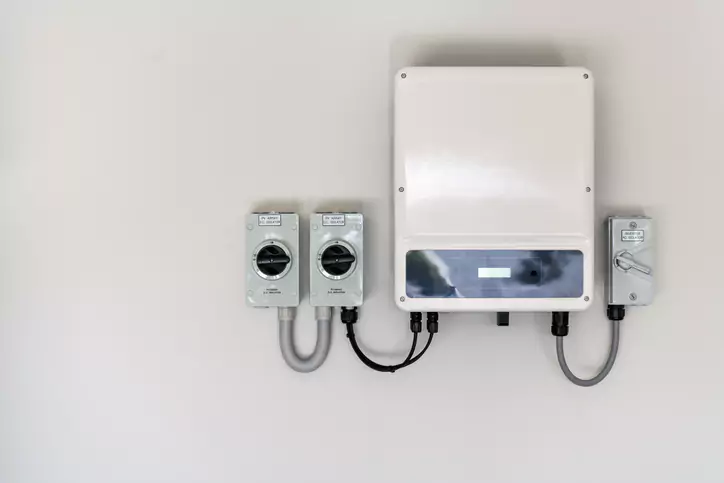
Understanding Solar Inverters
Solar Inverter Efficiency System Performance
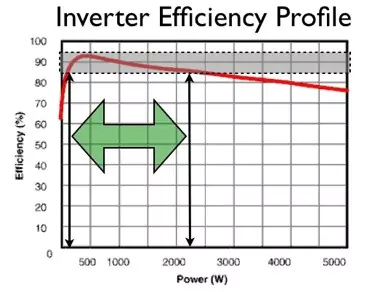
As long as the input from the panels falls within the range of the window, the inverter can be considered to be operating optimally.
In the graph below, the red line represents an average inverter efficiency and the green arrow represents the power output from your solar panels.
The grey box shows the operational window of the inverter based on the input from the solar panels and the predetermined efficiency of the inverter.
Optimal Sizing for Maximum Efficiency
Under-sizing Your Inverter
The Role of Inverter Size in Solar Panel Output
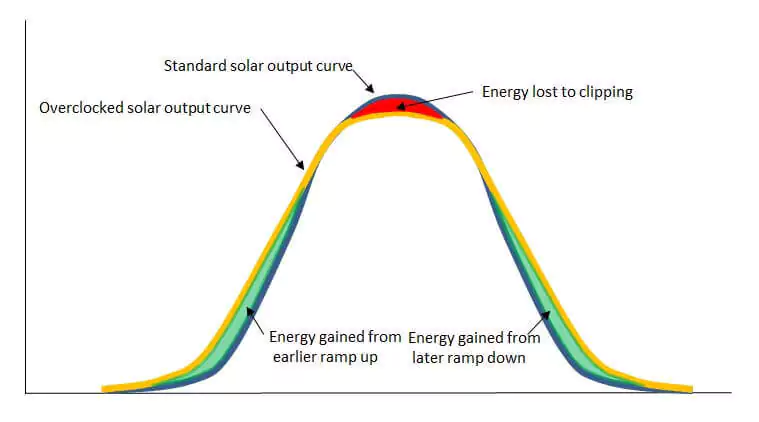
Regardless of the output of the solar panels, the power output will be cut off (‘clipped’) by the inverter so that it does not exceed the inverter’s rated capacity (e.g. 3kW, 5kW etc).
Efficiency Gains at Different Times of the Day
Over-sizing Your Inverter
It’s therefore important to ask your installer questions about how your system will perform in the event that an over-sized inverter is suggested – e.g. how would your overall energy yields differ over the next 5-10 years with an over-sized inverter vs a ‘right-sized’ or under-sized inverter?
Balance this against the cost of the various system configurations before making your final decision.
How to Calculate the Right Inverter Size
To calculate the ideal inverter size for your solar PV system, you should consider the total wattage of your solar panels and the specific conditions of your installation site. The general rule is to ensure the inverter’s maximum capacity closely matches or slightly exceeds the solar panel array’s peak power output. However, slight over-sizing of the solar panels compared to the inverter capacity (up to 133% under certain guidelines) can sometimes yield better overall efficiency due to the variable nature of solar irradiation throughout the day.
The Ratio for Inverter Sizing
The ratio for inverter sizing often depends on specific system requirements and local regulations. A commonly accepted ratio is that the total nominal power of the solar panels can exceed the inverter’s capacity by up to 133%, as per some guidelines by regulatory bodies such as the Clean Energy Council in Australia. This practice, known as “overclocking,” allows for more energy production in the early morning and late afternoon, although it may result in power clipping during peak sun hours.
Calculating the Capacity of an Inverter
The capacity of an inverter is determined by its maximum output in watts (W) or kilowatts (kW). To calculate the required capacity for your solar inverter, sum up the total wattage of your solar panels and adjust based on expected system efficiency, shading, and the specific energy needs of your household or business. Remember, solar inverters are rated based on their continuous and peak power output, which should align with your solar PV system’s output and your energy consumption pattern.
Should You Over-size or Under-size Your Inverter?
Deciding whether to oversize or undersize your solar inverter hinges on balancing efficiency with potential future system expansions. Over-sizing an inverter may be prudent if you anticipate increasing your solar array size, allowing for greater flexibility without the need for immediate inverter replacement. On the other hand, under-sizing, within regulatory limits, can lead to more efficient operation during low light conditions, although it risks energy clipping at peak times. It’s essential to evaluate your current and future energy needs, the solar irradiance patterns of your location, and regulatory constraints before making a decision.
Conclusion
Choosing the correct inverter size is crucial for the efficiency and effectiveness of your solar PV system. While oversizing can prepare you for future expansions, undersizing might optimize your system’s performance under certain conditions. The key is to strike a balance that aligns with your energy needs, potential growth, and the operational characteristics of solar panels and inverters. Consulting with a solar energy expert can provide tailored advice, ensuring that your system is well-equipped to meet your energy goals both now and in the future.

- Why a big battery could be cheaper than a small battery with the federal rebate? - 19 June, 2025
- Heat Pump Costs – Solar Choice Price Index - 1 June, 2025
- Solar Panel Costs: Solar Choice Price Index | June 2025 - 1 June, 2025



Howdy,
I have a 6.24 kW system with a 5 kW inverter. Does this sound right? From what I have read here it does sound right to me. Looks like from 9:45AM or so to about 1:30PM i’m peaking at 5 kW due to the inverter. So 4 to 5 hours of peak generation is hamstrung by the inverter. Looks to me though it’s just the top of the bell curve.
Stinks to miss out on generation but if it’s for better overall generation throughout the day makes sense to me.
What do you all think?
Hi Timothy,
Here are a couple of other articles (one from inverter maker SMA) both saying that oversizing your panel array is not a bad idea and has definite benefits:
http://en.sma-sunny.com/en/7-reasons-why-you-should-oversize-your-pv-array-2/
https://www.solarchoice.net.au/blog/oversizing-solar-panel-arrays
Cheers!
James
Hi,
I have just had a system installed that uses 2x3KW SMA Inverters. One inverter has 14 x 265KW Canadian Solar Panels on North facing roof and the other has 7 x 265KW Panels on the east and 7 x 265KW Panels on the West. I was informed that it was a 7.44KW system but having read this page it will never produce anymore than a maximum of 6KW. Can you please advise if the Inverters should have had a larger capacity as the system is hitting the 6KW and I’m assuming is being limited from producing more. I realise this is summer so will be better than the winter months but does seem a little low.
Thanks
Hi Ian,
The maximum power output is indeed limited by inverter size – which in this case is 6kW. However, having the extra solar panels can still help to produce more energy over the course of the day (see this article about ‘overclocking’). Read more here about energy vs power in solar & batteries. In fact, oversizing of solar panel arrays relative to inverter capacity is a common and beneficial practice if done properly – and is even recommended by SMA themselves.
I have been quoted on a 3.9 Kw solar system with a 3.5 inverter. Is this the right size inverter or should I get a bigger size?
Thank you
regards
Hi Vic,
Undersizing your inverter (or oversizing the solar panel array, if you want to look at it that way) is sometimes referred to as ‘overclocking’, and it is a common and effective practice if done appropriately. In fact, SMA – the largest inverter manufacturer in the world and the leader in Australia – recommends the practice. You should of course consult with an accredited installer about the details, but there’s nothing wrong with it in principle.
Hope this helps!
I have 3kw inverter and 3 kw panels all facing north in melb.
In mid summer the sun sets west/southwest (WSW) so can I instal a second (1.5 KW) group of panels to that same inverter? The panels would be facing that WSW direction to operate while the north facing 3kw panels are functioning at low /very low capacity late in afternoon. Facing that direction I expect the inverter to be not overloaded. Your thoughts please? (Both technically and regulatory).
Thankyou.
Graeme.
Hi Graeme,
The first question you need an answer to is whether your inverter has an input for a second string of panels (and associated Maximum Power Point Tracking – MPPT). If your inverter only has one string input (or the current array uses both inputs), it’s not a good idea to add more panels facing a different direction – you’ll end up losing efficiency. If there is an additional MPPT input sitting unused, however, it might be possible and even worthwhile – consult with an installer about the technical details (although I have doubts that you’d be able to add on another full 1.5kW, as 30% ‘overcapacity’ is the maximum they recommend in the Australian standards for PV installations).
Another option would be to install a second, separate system facing west with its own dedicated inverter, but adding on to the existing system (as discussed above) would be preferable, finance-wise.
As for the regulatory aspects, you won’t be eligible for the federal STC ‘discount’ if you add new panels, but it will apply if you add a whole second system (including inverter). Additionally, if you’re currently on a state-sponsored solar feed-in tariff then you migh forfeit it by increasing your existing system size or adding on another system – it depends on the rules in your state.
I intend to put up a hybrid system which shall have dependence on solar as well as grid power. Due to space constraints I may be able to install only 1 KWp solar panels. In this scenario, is it OK if I have 1 KWp solar array but 3 KVA solar inverter (with battery bank). Any deficit in solar energy shall be met from grid.
Hi Hemant,
Probably not a good idea to undersize your solar array too much – most inverters require a certain power signal from the panels in order to ‘switch on’, so the efficiency losses could be significant. Best to speak with a certified solar installer, but my feeling is that you should opt for a smaller capacity inverter for the PV – and maybe a separate battery inverter for the battery bank.
Dear Sir / Madam
Why do you need a PV Array with a total voltage output of 600VDC supply a 380VAC; 11kW Inverter? What is the importance of the 600VDC?
Best regards
Fanie
Sir,
Please,can I use 2.2kw iron on 5kva 48v inverter comfortably for laundry work.
Hi Gabriel,
It would depend on the time of day and where you’re located. If you’ve got a lot of sun and your panels are at peak production (about 2 hours on either side of midday) you should have enough energy to run the iron. Of course you might have problems if the sun passes behind a cloud or on days with inclement weather. Batteries could be a solution for you.
I have 20 panels of 350 w each, which comes to 5000 with. Can I install 2 hybrid inverters of 5 kva each to enhance the output
If your panel array’s peak output is 5kW (5000W), then you should have an inverter that is roughly classed for that figure. It’s not uncommon practice for installers to oversize a solar panel array relative to the capacity of the inverter, but it’s doubtful that many of them would recommend 2x 5kVA (~10kVA) for a 5kW solar array – an example of gross inverter oversizing – unless the plan was to eventually fit the system out with more panel capacity.
Hi…I have a 3kw system with 12x250w panels and a 3.3kw inverter(panels facing north for almost all day sun,dropping off in arvo).
the most I have ever seen it produce at once is 2.2kw (14-16kw a day)..The inverter is about 15 to 20 metres from panels and have been told this is the reason it only produces that…I am able to add on more panels (another 5 im thinking on afternoon sun only roof)as the other panels drop thes will pick up in arvo, my only worry is this going to damage inverter if it sends too much dc current to it…its only converting 2.2kw now out of 3kw panels..they told me excess would just get dumped ?
please advise….thankyou
Hi Trevor,
You’re correct that the distance between panels and inverter and the resultant voltage drop could be the cause of the relative inefficiency of your system. We ordinarily estimate that a solar energy system is about 80% efficient from panel to socket – for a 3kW system, that translates into a peak output of about 2.4kW. The voltage drop could be further dragging it down to the 2.2kW that you’ve been witnessing – a total panel-to-socket efficiency of about 73%, which is not outlandish at all.
Oversizing the panel array to maximise and ‘flatten’ a system’s output is a fairly common practice. This could be an option for you – especially if your inverter has a second MPPT (maximum power point tracker) input which is currently unused. I would recommend speaking to an installer or post-installation specialist (SolarSafe is one company that we know of that provides post-installation services) about exactly what your options are and what the benefits would be.
Best of luck!
Have a question, we had a company install a 4KW 16 panel system on our house last year, this is not leased. So far we have seen none of the savings they promised, per the solar company our peak usage has increased which is causing the lack of savings. We have not changed any of our daily or house utilities and we are on a set thermostat and have added, blinds, insulation and anything else. Any ideas or suggestions to debate them? Any additional suggestions are appreciated as we are not paying the same utility bill on top of paying the bill for the system.
Thank you for you time.
Hi Anthony,
Sorry to hear about your issues with your system.
Do you have anything in place to monitor your electricity usage throughout the day? For example, a monitoring system? This would provide you with some data to present to them.
Could you possibly switch over to a flat-rate retail tariff instead of time-of-use? Generally speaking, that is the best way to get the most out of a standard solar energy system, provided you shift your electricity usage to the sunlight hours.
hello i am designing a solar station of 3kw for the load demand of 5940Kwh/ day with an autonomy of 3 days from 48V, 600Ah battery bank. is there any fault in the design? plz justify
Hi,
Hope you can spread some light on an issue that I am having. We have just connected my power monitor to our meter box after getting solar installed (approx 6months). My reason for this is we were getting massive bills after the digital meter was installed, I have been using an iPad APP to record the numbers everyday and the numbers are not making any sense. Here are some details of our setup (in basic terms..lol)
Solar Spec:
SMA Sunnyboy Inverter (I believe from memory is a 3.5Kw Inverter)
24 Panels in 2 x arays (NNE and NNW) as the house is not quite N.
Produce rought 20Kw / day (as of the last 2 weeks)
Inverter reads: Producing – 2945W
Monitor reads: Solar – 2867W
: Household – 2390 (day)
: Household – 17-23 (night)
My issue is that with the inverter turned on and producing power our consumption goes up as well. The monitor with the solar turned off we are only using about 14W/h.
Is this showing correct numbers or do we need to contact the installers and have them out again. Hopefully not as we made a poor choice on installers and they haven’t been the best of businesses to deal with.
Thanks for you help.
Merv.
Hello,
We currently have 3 x 12volt solar panel for our boat (two x 80 watts and one x 60 watts).
We are planning to expand the solar panel by installing a 190watts solar panel. The question is, what should the size of inverter be for optimum result?
Thanks very much
Specifying the value of the panels in volts will be a bit confusing. The possibility of maintaining 12V DEPENDS ON THE KIND OF INTERCONNECTION whether series or parallel. Your current 260w panels added to 190w will be optimised if you contact your installation tech and explain to them what your expansion needs are. Thanks Maggie
Hello.
Energy Australia sold us a 3.9Kw system (15*260W panels) These were fitted with Enphase M215 inverters. I was playing around with API calls to my Envoy unit and the Enphase website, and the system reports it’s size as a 3.225Kw system. (This is exactly 15* 215W). During summer months my generation flatlines at 3.23 Kw per hour, which seems to indicate that the inverters are the limiting factors in my energy production.
Questions:
Should this legally be sold as a 3.9Kw system, with it having a 3.2Kw inverter, and effectively being able to only ever produce 3.2Kw?
The inverters are rated roughly 17.5% lower than the panels. Is this a significantly large enough number to cause overheating and/or other issues with any components?
Thanks,
Nico
Hi Nico,
You’ve probably already read our response to Robert’s comment above – it is acceptable to have the panel array oversized to ‘flatten out’ and ‘fatten’ production, even if this means clipping peak production. The Clean Energy Council’s guidelines recommend that inverters should be rated at no less than 75% of panel capacity, and it sounds like what you have is within this limit.
The above aside, we can see why you might not like the idea of a system being labelled as 3.9kW in capacity when it never reaches that level of power production. But hopefully the installation company knew what they were doing and sized the system as they did in order to maximise overall power output. What are the daily production numbers for your system in kWh, as opposed to kW?
Hi Nico,
I just had *installer name removed* install 8 JA Solar panels with 8 x M15 micro inverters and said my system is a 2.15kw when really it is a 1.72kw system as the inverters are rated at 215 watts. Out of curiousity how much did you pay for your system? I paid $4875.
Cheers,
Joseph
My installer just installed a 7.6kw inverter. My system I had installed is a 9.6kw. Is this the right inverter for this size system?
Hi Robert,
We’ve just had a chat with Nigel Morris of Solar Business Services about this and here’s his response:
Yes oversizing the array is ok in some circumstances.
Its ok as long as the current limit of the inverter is not exceeded.
The good part is that is can flatten out the generation curve and thus maximise production, albeit at the expense of clipping some power during the middle of the day.
So basically, array oversizing is a common practice, but whether it’s being done correctly in your situation would depend on the specifics of your system and components. If you’re concerned, we’d recommend getting a second opinion from another installer.
You can read more about array oversizing in this informative article from Climate Spectator.
Best of luck with your system.
I have 14 -CS6X Canadian Solar 300P Modules with a Sunny boy 3800 Inverter. This peaks early in the day and stays their for a a good while, I this to small of an Inverter ?
Thank you,
Joseph.
Hi Joseph,
Thanks for your comment. We’d advise you get in touch with your installer if you think there might be some kind of issue – but yes, there is a possibility that your inverter is limiting the output of your solar array.
we have a 5kw system and my power bill went from $600 to $1200 and know one can tell why
Hi Trevor,
Can you describe in further detail when your bill went from $600 to $1200? Did this change happen between your last bill without a solar system and your first bill with a solar system? Or are you referring to a sudden drop in solar electricity output (and associated increased power bill) after you had the system was installed and presumably working without problems for a while?
It’s hard to help you figure out what the problem might be without knowing these things!
HI ,we are currently somewhat confused. We engaged a solar company to install a system with the intent of connecting stand alone battery system in a year or two, because it was indicated to us that the cost of the batteries would come down significantly due to an American company setting up for large scale production. Our average useage on our power bill was 65kwh /day, so a 15Kw system has been installed, with a ZED controller however we were not informed of the issues around export control. We are on 3 phase power and are told that the export has to be restricted to the lowest use phase. System is currently limited it seems to covering about one third of power consumption.
The installation company has now offered to remove the installed system and install a 5Kw system instead with 5kw Ingeteam inverter and EPC control unit (more efficient they say). We are unsure now as to how to proceed, do you have any comments or advice you can offer in this regard?. Do you have any current knowledge around the quality , availabiltiy, pricing, future pricing of the stand alone/ off grid battery power storage packs?.
Hi Vivette,
Sounds like a confusing situation indeed.
First of all – it sounds like the system was inappropriately sized from the outset. We constantly emphaise that a solar system should be sized to meet only the daytime electricity needs of a home – this is because no utility offers a reasonable rate for excess solar power these days (and in fact, utilities in Queensland actually prohibit excess solar power from being exported to the grid).
Unless you were going to have an energy storage system installed at the same time as the panels, it really wouldn’t be worth your while to wait for batteries to become more affordable – that’s about 2+ years of ‘wasted’ excess solar power. And as of now, it is still a ‘wait and see’ game for energy storage affordability – despite lots of talk about the upcoming viability of energy storage, there aren’t many homes or businesses yet making the decision to have batteries installed.
If they are offering to do so at no additional cost (and refund you the difference on the price between the two systems), it would probably be best for you to have them install the 5kW system in the place of the current system – unless you find an energy storage option that makes financial sense for you.
Best of luck!
Is there any law to stop me having a 4KW system and a 4KW inverter on a domestic setting
Cheers
Hi Mick,
There certainly shouldn’t be anything that prevents you from having a system of this size – in fact, 4kW solar systems are quite common for domestic applications in Australia.
Depending on where you live, you may need to install some sort of export control device. This would be if you’re in regional parts of WA or Queensland. But provided you meet the local requirements it shouldn’t be a problem to have a 4kW system installed.
Are you running into some kind of issue?
I am thinking of buying 5KW inverter for 3 KW SYSTEM, to begin with just so in future if i choose to upgrade, i have an option. My question is, does it affect the performance of panel n inverter if its not used at its full capasity??? In my case 5KW inverter bein used for 3KW system. Let me know please. Thanks.
Hi Dishant,
We generally advise against getting an oversized inverter for future expansion of your solar panel array. There will be efficiency losses when you do this, and it’s highly unlikely that most people will actually expand their system in the future. On top of this, if you do want to expand the system, you’d have to try to make sure you get exactly the same brand & output of panels–something that might be hard to do further down the line.
Read more on this topic here.
I did only read about 1/2 the above but now I really have a concern.
3kw panels with 3kw inverter has been performing great last 3 years with max kw noticed last summer at 3900kw, all well and good, but now this summer I have suddenly noticed over 4kw with full sun on every day, I have watched when clouds have been active and kw down to 1+kw but then up to over 3 and 4 kw and staying there. I know enough about electricity to know what I don’t know and this has me confused and concerned, I don’t understand how, help please
Hi Bill,
Thanks for reading and for your comment. That does sound pretty unusual – if you only have a 3kW array you shouldn’t be producing more power than that. Your inverter is highly unlikely to be able to handle more than its rated capacity, although it would really depend on the specs of the model that you have. At the risk of sounding slightly silly (please don’t take offense), are you sure you have a 3kW system and not a 4 or 5kW system? Just taking a shot in the dark here, but usually system will not perform above their rated power output, especially for extended periods as yours appears to be doing.
An alternative explanation might be that you’re somehow reading the DC output of the panels as opposed to the AC output of the inverter? This is also pretty unlikely, however.
We’d recommend you get back in touch with the company that installed your system or the inverter manufacturer – they should be better equipped to address your concerns.
We have a 5 k system (24 x 210w Sunpower) panels (grid tied) that was installed about 3 years ago. PVP 4800 Inverter (Advanced Energy) South facing roof mounted in San Diego. We noticed a big drop in PV production the last 3 or 4 months. We used to over produce during the winter which allowed us to use the AC during the summer. Getting an average of 2400 to 2600 watts at the inverter on a sunny day now. Electric bill no longer has us overproducing. Could it be the panels or the inverter?
I really appreciate your website. Too bad I can’t find one in the US.
Hi Don,
Difficult to say without more information about the system–might be some new shade on your panels or perhaps a fault in one of them? Do you have any trees that could have grown tall enough to begin casting shadows recently? (Read more about partial shading & solar panels) .
If you don’t think that’s where the problem is, the best course of action would probably be to get back in touch with the company that installed your system. If it’s new there should be some kind of performance guarantee.
We have a quote for a sistem involving 15*260 JA SOlar pannels and a Goodwe GW3600-DS system (inverter has 2MPPT and supports two strings). The idea is touse both strings (7 and 8 panels, respectively) to meet the MPPT input range. The same problem bothers me, though: Can the inverter take all theoretical power of 15*260=3.9KW, although it is rated at 3.6KW (3.8 maximum) ? Should I ask for a bigger-capacity inverter ? Next in line seems to be the GW-4200-DS.
I appreciate any advice. Thanks.
Hi Andrei,
You’d be best to ask your installer about that-there may be aspects to the system you’re looking at that we don’t know about. However, by the sound of it, it should work fine. The actual output of your panels will rise and fall like a bell curve during the day, and only at the peak of output will they generate 3.9kW–a point they may never reach when other various derating factors are taken into account (check the specs and play with the PVWatts tool).
We have a 1500w array in Far North Queensland. That we are very happy with. Output varies dramatically because of cloud and rain however on the right day it reaches just below the 1500w inverters 1600w limit. We receive a very generous feed in tariff which would be lost if we upgrade the system. It may sound silly, but if we had more panels we would even out the seasonal variations but we would need something to limit/dump the DC input to the inverter on the good days. We would still only output 1500w. Does such a device exist? Regards Bill.
Hi Bill,
There are devices that limit export of power to the grid (e.g. here and here), and are essentially required for most solar systems in Queensland these days. It’s not quite the same thing as limiting power from the inverter, though, and if you’re considering expanding your solar array you will almost certainly need a new inverter to make them worth your while–and changing the inverter is pretty clearly a no-no under QLD feed-in tariff rules. Must say to be straight, though, that installing additional panels/capacity to an existing solar array is also a technical no-no under the scheme, so tread lightly.
Something else you could consider is getting a second system, but be advised that the federal up-front price reduction available through the Renewable Energy Target cannot be accessed more than once by for systems at a single address, so the price would be a bit higher than the market rate for you. Additionally, you’d have no feed-in tariff on it, so you’d have to make sure you use as much of the power it produces as possible.
Whatever your eventual decision, good luck!
I have a 5000 growatt inverter operating with 20 250 watt panels can I add more panels to overload this setup safely
Thank you
Les
Hi Les,
We generally advise against installing more solar panel capacity than your inverter can handle. You have (20 x 250W =) 5000W (5kW) of solar panel capacity, and the inverter is also 5kW. If you want to add more panels it would be best to get another inverter sized to match the new array.
Regarding Solar Output appearing to be Low.
The major factor affecting the output of solar cells is the position of the sun in the sky – ie the angle of incidence of the sunlight on the solar cells.
For maximum output the sunlight needs to hit the solar cell at 90 degrees.
Unfortunatley, this only happens for a very short time during the day – (around Noon in winter).
Hence solar system outputs can only reach full power for a short period during the day.
To simplify this – you will only get the RMS value of the rated output on average throughout the day.
This is due to the solar angle of incidence on the cells – best output is between 10:00 and 14:00 – where the sunlight enters the cells at around 70 – 90 degrees.
So – dont be disheartened if your system hardly peaks at its rated output – it is operating normally.
You need to derate the power output by the RMS value as this is a result of how the sun moves through the sky during the day (appears to move)
ie – a 5 Kw system will average out to about 3.5kW over the whole day – due to the apparent movement of the sun angle of incidence
If you have the opportunity – watch your power meter
write down the output in bright sunshine only – during the day – and guess what – it will average out to be the rms value of the solar panels rated output.
So realistically, you are starting with an average of 74% output – all other system inefficiencies (inverters etc) will reduce the output further.
Have fun!
NB
Hello All,
We have recently installed a Solar system (1KW panels, 3.5KVA/48V inverter, and 48V/150ah battery) in a petrol station to operate two pumps of 0.75hp each. The panels are connected 4in series (125W each) to match inverter voltage of 48Vwith 2rows. The system worked well by sharing solar, batteries and mains power. The reason to chose 3.5KVA was to meet the initial load of motor.
However, now only one pump at a time working as the owner rewinded one of the motor and it is consuming high current. The owner has few bucks to spend on the system.
We planned to increase the inverter size initially, but higher capacity inverters, for example 5KVA is available in 72V only. My question is- Shall i use the 5KVA/72V inverter successfully within the existing 48V (panels and batteries) system?
Does the inverter V should be matched with panels and batteries?
Please help me.
Best,
Satish
Hi Satish,
Thanks for the comment. Unfortunately I am not confident giving you too much detailed advice about this situation given its technical nature (and the involvement of batteries). Have you tried contacting the person who installed the system, or did you install it yourselves?
Hi solsar choice,
I have a 1.6KW system consisting of 9 X 170Watt Dragon Panels and an Eversol 1500TL-AS inverter installed on my house in Perth, the roof faces NW and sits approx. 30 degree angle (tiled). I have had this system installed for almost 2 years now so I have had some time to assess it over several seasons. I am currently generating approx. 8.4 KWH per day during the summer months and around 5.0 plus in the winter months-on good days of course.
I would like to add a panel or two to the system as I feel there is room for the inverter to handle it – during observations at peak generating time I only see about 1250 watts momentarily on the inverter panel readout, most time it seems to run about 1000watts during the peak generating time of between 11am to 2pm (give or take). I would have liked to put a couple of panels on the opposite side of the peak of roof to the panels existing location to get more morning sun but note your comments to keep the new panels (matched if possible-same internal resistance??) on the same side next to existing panels for which there is space to add them.
I had concerns about overloading the inverter but feel it can probably handle it given that most of the time it is producing output as per above-I’m not sure if this inverter has no, single or dual mppt input that would allow me to run a separate string?? Your comments about adding extra capacity will void my current rebate for those KHW sent to the grid currently standing about 48.8 Cents-are the suppliers/installers of the extra panels obliged to let Synergy/Western Power know of the additions? Any suggestions as to pros and cons of this potential upgrade?
Hi Peter,
Thanks for commenting.
To answer the 2 key parts of your enquiry:
-As you are aware, you cannot expand your system size and retain your current feed-in tariff. The WA government has been clear about this. While you might be able to get away with installing 2 extra panels without your network company noticing, we would of course have to officially recommend not doing this. If you were found out, you’d risk losing a very generous incentive–the current rate is only a fraction of the 48.8c/kWh you are currently receiving.
-In any case, it is against the Australian standard for solar PV installations to install more panel capacity than inverter capacity, so no upstanding installer will do this. It would also most likely void the inverter’s warranty, which could land you in a tough position down the line if you start having problems with it.
I hope this information is useful. Best of luck with your system!
Hi There,
I live in 20km north of Perth. I have 3 kw SLK-3000 solar king inverter and 8 off 190kw mono crystalline (Total 1520kw) panes in a single raw. I want to add more panes to get more production from solar energy.
Can you please assist that how many more similar panes I can add to get more production at best performance efficiency of Solar king inverter? How many Optimum panes?
What is the actual efficiency of the inverter? How many maximum panes we can add?
I cannot add more panels in the same raw. Is it possible with this inverter to connect 2 raws of panels?
In a really good day I am getting only maximum 10KW production in a day with the current set up. Is it fair or average? How much I will produce in average after getting more optimum number of additional panels?
Also, how long our Feed-in-tariff rates remain same with western power? My upgrade of panels harms any current rate?
This section gives me a lot good info and proper understanding. Thanks in advance for your expert advice.
Hi Nisarg,
Thanks for the comment. First of all, I thought it would be pertinent to point out that if you are receiving the feed-in tariff in WA expanding your system could change your eligibility–i.e. you might lose your feed-in tariff if you add more panels.
For the technical questions, I would recommend first consulting the inverter and panel manufacturers, or possibly the company that did your installation. You can also read more about inverter sizing and solar panel array sizing in this article: “Optimising solar system efficiency through inverter sizing“.
To briefly answer your other questions:
Can you please assist that how many more similar panes I can add to get more production at best performance efficiency of Solar king inverter? How many Optimum panes?
Any new panels you add should be of the same brand and have the same specifications as the ones already installed, unless your inverter has dual maximum power point tracking (MPPT), in which case you may be able to have a separate string of panels. Please refer to the inverter and panel specs.
What is the actual efficiency of the inverter? How many maximum panes we can add?
Again, please refer to the panel and inverter specifications.
I cannot add more panels in the same row. Is it possible with this inverter to connect 2 rows of panels?
If your inverter has dual MPPT, it is possible to add a second row of panels. Even if it is only single MPPT or no MPPT, the inverter might have a dual input–but in this case it is key that all the panels are matched in brand and specifications (and as much as possible, age as well). If possible, you’ll also want all the panels to be facing the same direction, at the same angle without dual MPPT.
In a really good day I am getting only maximum 10KW production in a day with the current set up. Is it fair or average? How much I will produce in average after getting more optimum number of additional panels?
I am guessing that you mean 10kWh per day here (kWh is the measure of energy produced, kW is capacity), and I assume this is the system’s summer output.
Typically, a 3kW system in Perth will produce on average 4kWh of power per day (averaged across the year), equaling about 12kWh/day. This figure could be about 15kWh in summer if you had panels to match the capacity of your inverter.
Also, how long our Feed-in-tariff rates remain same with western power? My upgrade of panels harms any current rate?
As mentioned above, increasing your system size would invalidate your eligibility for the state’s feed-in tariff. It’s up to you whether the costs associated with upgrading your system and the benefits of the increased system output are worth losing the feed-in tariff. With electricity prices rising in WA, this may end up being the case, but it ultimately depends on your power use habits (timing, energy efficiency, etc).
Hope this helps. Best of luck with your system.
Hi
I’ve received a quote for setting up a 2.5kW solar system at home (10 x CMS 250 panels). The inverter quoted is a Eversolar 2000 – I think because it should be a generous system for my usage. Still, is it ok undersize the inverter? The guy said it may run more efficiently, but I’m concerned about your comments of overheating.
Many thanks.
Hi Andrea,
I believe you can slightly undersize your inverter as, at its best, your system will work at about 90% efficiency and each inverter has a different range. However, our in house solar experts advise that consistently going over the kW capability of your inverter can damage it and this leads to fire risks.
If you would like to get a second opinion, feel free to complete the Solar Quote Comparison to the right of the page. You’ll receive quotes for up to 7 installers operating within your local area and we’ll allocate a Solar Broker to you to help you make a well informed decision. Our service is free of charge and impartial, so there is no pushy sales pitch.
Hope that helped and we look forward to helping you soon
I have just had a solar system installed with 13 x 250watt panels and a 3kw macsolar inverter. 6panels facing west on one string and 7 facing north on another.
is this ok to be running 3.25kw of panels on a 3kw inverter?
Hi Adrian,
If the system is running at optimum efficiency, the output of the panels will still be around the 90% mark. This means that the 3kW inverter will be able to handle your everyday base load plus the occasional production of over 3kW, in addition to this all inverters have a range that they can work at – details should be in the manufacturers handbook.
Hope this puts your mind at rest.
thanks for that. in the hand book it states the rated input is 3000watts and the max input is 3300watts.
my installers advised me that all my panels would not fit north hence why i have some west. i have measured it myself and it is possible to have all panels north.
on a good day im generating 19kwh.
since it is possible to have all my panels facing north. do you think i would see any gain or would i get too close to maxing my inverter out.
my setup now is good as i get a good range from the north and west. but will i gain from having higher peak power from all panels north?
Hi Adrian,
19kWh on a good sounds like a good figure. Over the course of the year we normally advise that you should average at 4kWh for each kilowatt of solar you have installed.
Installers may have looked at your available roof space, for example there is a minimum distance from the pitch of the roof that has to be observed and there may be other features that have a space requirement around them. If you’re not happy with this you can ask the installer to clarify why there wasn’t enough space and explain the rules that they worked with.
You would get a little more peak power from having them all your panels on the north, but as long as the north and west panels are on different strings being fed into a dual inverter you’ll be getting the optimum output from each array. If you have some panels on the west you’ll get slightly longer day time generation and can substitute your day time energy needs for longer, therefore reducing your reliance on the grid and your energy bills.
This is another one from the UK.
I’m looking at installing 4Kw, (12 Panels) of Sunpower E20 333 and the company I’ve talked to have recommended Samil Power’s SolarRiver SR4K4TLA1 inverter. I’ve read that Samil have a good reputation and have been recommended by Photon Lab as a ‘serious competitor’ to the top supplier’s inverters, but would you recommend this inverter with Sunpower panels or should I look at either SMA, Power 1 or Fronius as a better option?
N.B. I’ve really enjoyed reading the letters and appreciate your expert knowledge.
Thanks. Glenn
Hi Glenn,
All the inverters you’ve mentioned have a good reputation. One of our installers gave us some positive feedback about Samil inverters, however, they haven’t been in business long enough to really prove their longevity.
If you’ve been working with our UK office, Solar Selections, you can contact your Solar Broker directly. They will be able to talk you through your quotes and the components offered and help you make an informed decision.
Hope this helps
I am trying to get feedback about panels made by GESOLAR as well.Is it a tier 1 brand and would you recommend it?Thanks in advance.
Hi Cherry,
As we’re an impartial service we can’t recommend one manufacturer or installer over another, and without knowing your circumstances it’s difficult to know what set up would be right for you.
You can fill in our FREE, impartial Solar Quote Comparison and receive an instant quote for up to 7 installers who operate in your area. This will give you a rough guide to what’s on the market and if any quotes you’ve been sent so far are good or over priced, we also allocate you with your own personal Solar Broker who can talk you though your quote and provide advice and information about the set up of your system.
Alternatively you can contact us directly on 1300 78 72 73, a member of our team can with you to assess your needs and generate a personalised solar quote.
We look forward to helping you soon.
Thanks again for your comprehensive reply.Much appreciated.
One final question is regarding SMA and Aurora inverters.
SMA5000TL, I understand, will operate without performance derating up to 30 to 40 degrees internal temperature (50 to 60 for Aurora) and
Will operate without performance derating in environments up to 60% to 70% humidity (100% for Aurora).Inverter efficiency is 97% for SMA and 96% for SMA.
Based on these facts and figures how does one choose between either of them?
What are the feedback from customers with real life experience.
Look forward to hearing from you soon.
Hi George,
Wow, it looks like you’ve really been doing your homework! I both the SMA and Aurora inverters have good reputations, SMA is probably the best inverter on the market. Looking at the figures you’ve quoted if you live in the Territory or Far North Queensland you might be better going with the Aurora to help as it looks better for the extreme heat and the humidity you get up there.
Other than that, because they are so close together specification wise it would probably be a matter of cost that makes the decision, but whatever you chose you won’t go far wrong.
If they same installer is offering both you could ask their advice, if you have two different installers you are considering you might look at what future support and warranties they are offering to help you choose.
Good luck.
Thanks for the informative reply based on which we will stick to 20 panels!Could we also know if polycrystalline panels are more suited for QLD than mono panels?We have read about Suntech being in financial difficulty.If they go bankrupt and into administration what happens to our warranty?Look forward to hearing from you soon.
Hi Cherry,
Monocrystalliane used to be the ‘big’ thing in solar and when some of the newer panel manufacturers launched their polycrystalline models they marketed them as being the future of solar and told people mono was out of date, in reality there is no real difference in performance. With regards to SunTech, their demise has been greatly exaggerated, we had a visit from the SunTech team a couple of weeks ago who advised us that it’s business as usual for the company. There has been wide spread misreporting regarding a court case in Italy, SunTech is not part of that court case but a company they hold a majority shareholding in is. SunTech is fully expecting a positive outcome and this case isn’t affecting their everyday finances.
Suntech is one of the best solar PV manufacturers on the market, the warranty you mentioned is for 25 years and in the last ten years they have had a 0.06% claim rate. When you consider they have over 7GW of panels installed globally that’s a pretty good figure!
Enjoy your solar panels and if any of your friends or neighbours are looking to go solar send them our way, we’d love to help!
We are planning to install 20x250w Suntech panels with a 5kw Aurora inverter.We are told this inverter can take up to 5.75kw or in other words 3x250w more panels.Is this recommended?We have secured 44cents feed in tariff.Will this in any way result in us being disqualified for the FIT?Thanks
Hi Cherry,
Although inverters have the ability to cope with additional energy periodically, constantly operating your inverter over it’s capacity will significantly reduce the life of the inverter and may lead to a potentially dangerous overheating scenario. If the installer has recommended 5kW of panels and a 5kW inverter, under optimum conditions you should be operating at around 90% efficiency.
Adding panels to your existing system can disqualify you from the existing FiT, I believe your installer would be in the best position to advise you. If you haven’t signed a contract or are still in the cooling off period you can check you’re getting the best deal by filling in our FREE Solar Quote Comparison, you’ll receive quotes from up to 7 installers who operate in your area. We also allocate customers with a personal Solar Broker who can answer your questions and, with the Solar Choice Discount, you can get a better deal than going to the installer direct.
Good luck with your system.
Hi Guys. I am currently running 14 LPK 250W Solar Panels on a Xantrex GT5.0 Inverter. I have been realy happy with it’s performance and am looking at adding extra panels. How many should I add? I know that 6 new panels (to make 20 panels total) takes it to a 5kW array, but I have been told adding 8 would be fine too. What are your thoughts??
Hi Leigh,
It’s great to hear you’re getting on so well with your current system and want to expand. There are a few things you have to take into consideration when adding panels to your current system. If you installed your system a while ago and are benefitting from one of the Premium feed-in tariffs adding panels may mean that you are no longer eligible to receive the Premium rate.
If you do decide to proceed you will need to purchase panels that match your current set up (ideally the same panels you have now). Normally we would advise that your panels match the output of your inverter, so adding 6 woud take you to 5kW, this is because the inverter is not designed to cope with power generation above its capacity on an ongoing basis, overloading on a regular basis is actually detrimental to the system and can cause a fire hazard.
It may be that you have been advised that 8 panels would be ok due to the loss in performance of your existing system so adding 8 may mean that the maximum you would generate would be 5kW (your system will only perform as well as the worst panel so any new panels will perform as through you had installed them at the same time as the originals).
If you are looking to increase your energy generation to help you further offset your bills, the best option may be to install the extra panels on a separate inverter ensuring you get the maximum power from your new system.
We hope this information helps.
Thanks guys. Really helpful. Will go with 6. My system was approved up to 5kW so it won’t affect FIT. Your advice and website is great. Thanks.
Hi I live in South Yorkshire, England, and wonder if you could assist. I have 14 X 250 watt sharp solar panels fitted with an SMA3000TL inverter. On checking the spec of the inverter it states that max input power is 3200w and the nominal power available is 3000w, is this acceptable as to my mind the panels are, or should be producing more power than the max input allowed, i.e. 3500 watt should be produced by the panels. Is the inverter adequate for me to obtain max performance from the system or should it have a larger one such as the SMA 3600, for example. Also I have noticed that 2 of the panels look different from the others. Could they be of a lower output than the others in order to make the system compliant with the max input for the inverter. Any comments would be appreciated, prior to contacting the installer. Thanks.
Hi Ade,
Our UK office might be better placed to answer this for you, http://www.solarselections.co.uk.
In Australia the inverter size has to be larger that the kW outage of your panels, but this could be different in the UK. We also haven’t heard of any instances where two different types of panels are installed and I’d definitely query this with the installer, if you contact our UK office they should be abe to give you the correct advice.
We hope you get it all sorted!
Hi we have a system installed 20 x BLD 190w modules and a JSI 5kw inverter. The system does not seem to be producing what we expected average 14.7 kw per day over last 91 days. Located in Canberra with system in full sun north facing position 17.5 degree pitch. Could the inverter be oversized? or we’re our expectations too great? Thanks for your help.
Hi Chris,
We would expect an average of 15kWh per day over the past 3 months, due to the shortened winter daylight hours, so it sounds like your system is doing really well. As we’re going into summer with longer hours of strong sunlight you’re system should start producing more energy and this might be more in line with what you’re expecting.
If you are basing your calculations on a 5kW system, as this is the size of your inverter, that might be where the difference between the expected generation and the actual figures arises. The the system size is actually 3.8kW (20 x 190w modules), we normally advise that a system will produce 4kWh per 1kW averaged throughout the year.
We hope this helps.
SB1700 DOES NOT HAVE A DUAL MPPT……
Hi TJ. You’re right–SB1700 does not have dual MPPT. It has 2 inputs for the one MPPT. Thanks for pointing that out.
Great information on this page, I have 8 x 190w panels connected to a MacSolar 1.5 facing NNE in Perth, looking at the specs for this inverter I see that it has a max input of 1800, would you recommend adding an additional 1 or 2 panels to this system? I have room for more panels but assume I would lose the RECS if I upgrade my inverter.
Thanks in advance
Hi Russ,
We’d only recommend adding the other panels if you can find the exact same modules as what you’ve already got up there. Differences between panels in the same string can lead to inefficiencies, as with solar PV it is a usually a case of ‘weakest link breaks the chain’.
You will not receive additional RECs for upgrading or replacing the system. However, you might be eligible if you installa new system on a separate building. Read more.
Depending on your state, you might also forfeit eligibility for the Feed-in Tariff by changing the size of your array/system/inverter.
Thanks for the reply… so if I could source 2 identical panels the resulting maximum output (theoretically 1.9Kw) would not cause a problem for the inverter (1.8Kw input)? I’m led to believe that in WA the tariff is forfeited if the inverter is changed but not an official word on the matter.
Hi Russ,
Theoretically that is the case, yes–1.9kW of panels shouldn’t much (or possibly any) efficiency losses with a 1.8kW inverter.
And you’re right about the inverter sizing: Increasing your inverter size in WA means giving up the FiT.
You can confirm this for yourself on the WA Dept of Finance site: Forfeit of Feed-in Tariff eligibility if inverter size is increased.
Awesome…thanks
we live altona meadows melbourne, have 14x 190 panels facing west, with 4.2 growatt (mtl) inverter. installed dec 2011. max produce during summer was 19.9 kw 1 day, av @ 14-16 kw + saw many day peaks of over 2500 – 2610 max i saw around 2pm once. i have a mate with 17×190, facing north & 5kw growatt invertor recently installed 5 minutes away he lives from us. we have been comparing our out puts recently, 1 day past 2 weeks, ours did 3.8kw, his done 12.9kw.i have been scratching my head regarding the big differance in out puts?? we both have the same brand nesl panels (40ml). last week 1 bad day, he got 1.8kw, ours did .1kw. lol?? any suggestions please,i have contacted supplier, electrician coming to check system in next 2 weeks, meantime i am doing daily etoday check . 1 of our panels when it gets wet, turns a very dark blue. ??? the installer noticed this as well, he said he had not seen this before. as it was drizzling lightly when they installed the system. i check panels for dung & dirt 2 times a week. clean with just water & hand windscreen sponge , like the petrol servo ones?? thanks lorenzo
Hi Lorenzo,
First of all, your inverter is oversized for your solar array, at 2.66kW and 4.2kW respectively. This can lead to inefficiencies in your system, depending on your inverter’s efficiency curve. I don’t know the specs exactly, but you could be losing as much as 10-20% efficiency from this alone–we don’t recommend oversizing inverters unless the customer plans on upgrading the solar array size within about 6 months of installation because it can significantly compromise the yield of the system.
The second factor that may be contributing to the less than stellar performance is the fact that your solar array faces west. This isn’t bad in and of itself (some homes have no north-facing roof, so it’s the only option), but it’s important to understand that in having a west-facing array you lose about 20% system output daily.
Doing some quick back-of-envelope calculations, we can come to a conclusion as to what you should be expecting from your system:
14 x 190W panels = 2.66kW. 2.66kW x 3.7 peak sunshine hours (average daily number over the course of a year in Melbourne–although higher in summer and lower in winter) = 9.842kWh per day. Multiply this by 0.8 (80%) for the western orientation and you get about 7.87kWh/ day. Multiply this by about another 0.9 (90%) (although the actual figure may be a bit more or possibly less) for the oversized inverter, and you’re looking at more like 7kWh/day.
Your max of 2500 – 2600 (2.5kW-2.6kW) actually sound pretty good for instantaneous production, as this is about the capacity of your solar array. However, the numbers that really matter are what your system has produced in total at the end of the day. If you can get back to me with some kWh figures (total solar power generated per day) as opposed to kW figures (which show only the instantaneous production), I’d be able to help out a bit more.
As far as the oddly coloured panel, I’m not sure what’s going on there. However, if it is causing problems for that panel, you could be seeing a disproportionate reduction in your system’s overall production–knocking out one panel in a string can effectively knock out all the panels.
Good luck!
I have a 1520 watt system comprising of 8 190 watt panels connected to 1700 watt SMA invertor. At the quote stage the installers rep gave us a quote to upgrade from 8 to 10 panels in the future. Would the invertor i have allow you to have two extra panels fitted ie 10 190 watt panels . Would they be connected in series with the existing string, or would the panels have to be reconfigured to two groups of 5 panels connected in series and then each group connected in parallel.
Hi Neil.
A quick check reveals that the SMA Sunny Boy 1700 inverter does indeed have dual MPP tracking, and each MPP tracker has 2 inputs. You can certainly find a way to connect them somehow, but uour options for connecting the 2 remaining panels would depend on how the array was set up in the first place–do you currently have 1 string or 2 connected? MPP trackers have min-max current and voltage ranges in which they function, and you have to make sure that the strings you put together fall within these.
I assume you’re having the original installer put in the additional panels? They should hopefully have a good understanding of this and be able to advise you accordingly.
Best of luck with your system.
Can we support a 10KW solar solution with 7KW of solar panel and higher capacity of solar Inverter? Will this system support a 10KW load and if we need to even add 4 hours of battery back-up to it for the non-sunny hours will this system support
Regards
Anson
Hi Anson,
Since you do not have 10kW of panels, your system cannot generate 10kW of power, even with a 10kW inverter. Conversely, your system’s output may actually be compromised by having an oversized inverter and you don’t plan on installing more panels at some point in the future–as opposed to 7kW of peak power, it may be slightly less, depending on the efficiency curve of your inverter. What is the brand and model?
We are using 18 X 240W total 4.3KW PV array system and power conditioning unit of 4 KW which will charge the batteries also. We have connected load 2 KW. My question is can we use 2 KW PCU instead of 4 KW ? What happens actually if 2 KW inverter is connected to 4 KW PV system.
Hi Harshad,
Thanks for the comment. Generally speaking, system output will be severely limited by having an undersized inverter, as you suggest. Depending on the specifications of the inverter in question, you will see very little generation above 2kW, even if you have 4kW of solar panels. We do not recommend it.
Thanks
We have a 100kw system under contract with the possibility of adding another 100+ in the near future. We would like to use a SMA 250U inverter we have in stock. We were going to use MOTECH IM 72 (295W) -31 strings of 11. Nominal power ratio is 258% but all other voltages check out on sunny design. Would it be safe to use this inv. or am I losing too much in efficiencies? Thank you.
Hello John,
I understand your predicament but unfortunately I haven’t got the technical expertise to advise on this matter. A 258% power ratio is huge, however. However, it could theoretically work as long as the inverter’s efficiency curve doesn’t cut your output so much as to make it not worthwhile to do at that low a wattage. Good luck!
we are looking at a 5kw system utilizing 20 x Q245 monos from Qcells they are offering two types of inverters the sunny boy 5000tl or a growatt sungold 5000tl. which system would produce better efficiency and return. We are in perth central true north facing 25* pitch clear.
cheers in advance
Hi Laurence,
SMA Sunny Boy inverters are some of the the most widely used and most trusted inverters in the world, with extremely low failure rates. Paying a bit extra for an inverter makes a difference, if you can afford it.
If you would like more quotes on systems, a number of the installers in the Solar Choice network use both SMA and Q-cells products. Request a Solar Quote Comparison by filling out the form to the right of this page, or call us on 1300 78 72 73 for more details. Our service is 100% free to our customers.
I have 12 Suniva 240 Mono in a single string with a SMA 4K inverter. Is this a good fit for an expansion system?
Hi Cosmic,
You would be able to expand your panel array by another 1.2kW.
Hi I am looking at a system that has a growatt 4200MTL and enough panels to produce 2.2 kw
if all conditions are perfect (sun beaming at the correct angle, temperature correct etc.) would this run at max efficiency?
Hi Aaron,
Generally speaking, we don’t recommend oversizing a system’s inverter unless the owner is intending to increase the solar panel array size to roughly match the inverter’s capacity within about 3-6 months from installation. The inverter is the ‘brain’ of a solar system, and needs to be selected carefully. Have you looked at an efficiency curve chart for the Growatt 2400MTL?
We have 11x215W Hyundai monocrystalline panels (2.365) with a Fronius IG20. The salesman encouraged to go for as many panels as we could afford, which we did, but then they supplied a 2kW inverter. Max we are producing at the inverter is 1700w even on a bright day (Scotland, facing perfect south). I know its not peak summer and the sun will be lower but I’m worried we’re losing out. Would an IG30 make better use of the capacity? We won’t be adding further panels in future.
Many thanks for your informative blog.
Graham
Thanks for the comment, Graham. We don’t get many inquiries from your side of the world.
I’m having trouble finding any graphs of inverter efficiency curves for the inverter you’ve mentioned. If you have the spec sheet, that could indicate where things are going wrong with your system. You may not actually see a significant loss in efficiency if your input voltage is just a bit over the nominal voltage of the inverter–in some cases it can actually be good to have a slightly undersized inverter. Without this information it is hard to say definitively if the problem is likely to be occurring with the inverter.
We also have an article about how to troubleshoot grid-connected solar systems , which might be worth a read.
we have six monocrystalline 170 watt panels (1020 watts) and have an Orion 2.2 Kw inverter. Can we add another six panels to our system or would the voltage more too high?
Hi Kathleen,
What is the brand of your panels? Different brands have different voltages per panel, although this is unlikely to exceed the input voltage of your inverter. A spec sheet would be useful in answering your question.
In principle, adding 6 more of the same brand of panels should not be a problem, but you might need to ensure that they are arranged into strings so that the basic conditions (voltage, power) are met for proper inverter operation, and that the panels are arranged so that they are getting roughly the same amount of sun. Having the same brand and model of panels is also important for this reason–output discrepancies between panels can result in power loss. It seems, however, that your inverter comes equipped with a maximum power point tracker (MPPT), which means that even if there are some small inconsistencies between panels, it will not cause any major issues with array output.
gday i have a 3kw aurora and 12 x 250w panels im north facing 40deg pitch and west qld! im get full sun and 25 deg temp and my max power is around 1800-2000wats peak i dont understand this not a cloud in the sky bright as a button no shade the day instaled it peaked at 3024w and has not gone above 2200w since then its also not meeting the daily average of 12.6kw even in this type of weather !this doesnt seem right to me the inverter is aurora 3600 !cheers tom
Hi Tom,
You might be able to attribute the low output to the fact that you’re currently in winter and, as your panels are on an immobile tilt frame, they will necessarily produce less power than their rated capacity indicates they should.
You should also be aware that all systems have inefficiencies, and there are a number of places where these might occur. You can also check out our solar power troubleshooting blog for ideas about how to check and test your system.
If you want to know whether or not the problem has something to do with your inverter, you’ll probably want to get in touch with your installer or the inverter manufacturer. Are you signed up for any post-installation customer service?
Thank you very much for your explaination.
I am using SMA sunny boy 3000us inverter. And I want to feed 1 string of 10 Centrosolar K230 modules. I saw the inverter efficiency profile chart on their product cut sheet too. However, I have no idea how to read it. Could you give some instruction on how to read the graph in your post?
Thanks for your time!
Ada
Hi Ada,
The important thing to remember is that the chart above in our article does not apply to all inverters. Each inverter has its own individual efficiency curve. I tried to find the efficiency curve for the SMA Sunny Boy 3000US, but was only able to find the curve for the 4000US, which is an inverter meant for bigger systems with more capacity in the array. You can see a chart for the 4000US inverter below.
On the left you see can see efficiency (%), on the bottom you can see power (in Watts–i.e. the power of your solar panel array). The lines show different voltages of systems. You can see that efficiency is greatest overall if you have a 250V system (the voltage of your system depends on panel configuration). So basically, if the system is 250V and has a power output of 1000W, this inverter (the 4000US) will perform at its optimum efficiency (about 97% in this case.)
The important thing to note here is that efficiency really does not drop significantly until your array output exceeds 4000W. Between 1000 and 4000W the inverter is still performing in the ‘sweet spot’ of 96-97% efficiency. Be aware, however, that during the day the output of any system varies depending on how much sun is shining, cell temperature, etc. So, because they usually have efficiency curves similar to the ones you can see here, the rule of thumb for inverters is to oversize them–by doing so you avert potential losses that occur when system output falls into the ‘dead zone’ below the sweet spot.
I hope that this helps. Let me know if you have any more questions, Ada.
I do not quite understand the chart above. Could you explain a little more about what would happened if the inverter is oversized. For example, we connect 2.75kw system to 4k inverter.
Thanks in advance.
Hi Ada,
The answer to your question depends on the actual specs of the inverter that you would be using. Some inverters are better at coping inputs lower than their rated capacity than others.
In essence, what happens is that the efficiency of your system as a whole drops due to the fact that your inverter is not optimised to use the electricity from your solar panel array–the input power from your solar panels is outside the inverter’s ‘sweet spot’. As I mentioned above, how much efficiency you lose will depend on the inverter in question. A 4kW inverter may have an optimal operating range where you get between 90 and 98% efficiency even if your panel array is not rated at exactly 4kW.
Can you give specific examples of the components you are using?
Hi,
We live in Norwood SA and our ordered panels will be facing due north at 22 degrees pitch. My original quote was to install 8 x 190W MONOcrystalline panels with a 2500 watt inverter. They are not yet installed however, the company has been very keen to replace the inverter quoted with a 1700 watt inverter. First off they offered me $500 discount to take the smaller one, which I declined. Now they are offering me 8 x 205 W POLYcrystalline panels with the 1700 watt inverter with no price difference. They tell me that I will get 5% increased efficiency but won’t be able to add on to my panels. I have seen conflicting information on the efficiencies of both mono and poly crystalline panels. Would you be prepared to offer an opinion on whether it may be more beneficial to go with the larger inverter and put more panels into the system when I can afford it, or go with the 5% increase in efficiency and settle for the smaller inverter?
Thanks
Hi Andrew,
Thanks for the comment. Sounds like a tricky situation.
First of all, there is commonly a lot of misunderstanding about the difference between monocrystalline and polycrystalline solar panels–the difference between mono- and poly-crystalline technology is not so important as the merits of the particular brand and model of solar panel that you are considering. What brands are on offer to you? (You might be able to compare their performance on the Desert Knowledge Australia Solar Centre website.)
Secondly, whether to go with the smaller inverter or not will depend on your household energy consumption and the financial viability of adding on panels later in the life of the system. What state are you in? Be careful: if you are on a feed-in tariff, some states do not allow for a system to be upgraded later–doing so may actually void your eligibility for the feed-in tariff. This is an important thing to think about, especially considering the fact that taking the smaller inverter will (according to the installer) offer you greater efficiency, but it will also lock in the size of your system.
In summary, if you are going to be on a feed-in tariff and live in a state where feed-in tariff eligibility is not altered by upgrading the size of your system, it would probably be the best outcome for you to try to get a bigger inverter, provided you are seriously considering upgrading the size of your system in the future. Otherwise, you’ll have to be content the more efficient system–8 x 205W polycrystalline with the 1700W inverter. This is because a favourable feed-in tariff could tip the balance and make the smaller, non-expandable system the more financially attractive option.
I have just had 16 x 190 watt solar panels fitted and using a Aurora 5000 enverter so I can add an additional 10 panels if I need more power. THE PANELS ARE SUPPOSE TO PRODUCE 3.04 KW. With the rated efficiency 90% this is reduced to 2.736kw. AND the inverter efficency down to 2.653 kw.
On the day it was installed and switch on in the pm it peaked at 2530 watts and produced 6kw that day then I had the following readings for the next 6 days the first 3 having a few clouds around and the last 3 days completly clear skys.
PEAK KW PRODUCED
2715 12.7
2780 13.8
2806 14.2
2256 14.4
2232 14.3
2197 14.1
Now the question why on the 3 completly clear days with lower peaks did the unit still only produce about the same kw? at the peak power days AND why on the completly clear days di the peak power output drop by around 600kw ? shouldn’t the peak be higher on clear days? One would think the peak and then the power output on a clear day should be higher? Even the electrical firm who installed it contracted to the company could not explaine this and the rep from the company was no better saying he would be the electrical company to come and check everything and for me to ring Power One for info on the Aurora inverter?
What do you think is the problem ?
What output in kw a day should I expect out of such a system.
Hi Laurence,
Thanks for the comment. That’s sounds a bit complicated, but there could be a good explanation.
First of all, the output you can expect from your array depends on your location–where are you located? Different locations get different amounts of sunlight.
Second, it’s important to distinguish between kW and kWh. A kilowatt is a measure of power (how much we can produce)–systems are usually rated in kilowatts. If the sun shines on (for example) a 1kW panel for one hour, your system will produce 1kWh of electricity. So you won’t measure the output of your system in kilowatts, but kilowatt hours. A kilowatt hour is a measure of energy–how much is produced.
The important numbers that you should be looking at daily are the kWh produced: this is how much you use can use for home consumption or get paid for on a feed-in tariff. The ‘peak’ production number is the highest
You have a relatively large system, and according to those numbers it seems to be operating more at its anticipated output–2.653kW. The ‘peak’ number is the highest point of production that your system reached in that day–it doesn’t measure any thing across the day, just one moment. The disparity between your ‘peak’ numbers in the left hand column and the kWh produced in the right hand column could be explained by partial cloud cover: the partially cloudy days may have been cooler, which would have meant better performance from your panels when the sun was shining, but less during the moments when the sun was blocked by the clouds. Hence your higher peak for the day but lower energy output on the first 3 days. Day three may have been cool with lots of sun.
You’ll also notice that the next 3 days are the opposite: low ‘peak’ numbers but high energy output (kWh). This could mean that that the high heat from the constant sun brought down the peak productivity of your system, but that you got steadier production through the day thanks to the lack of cloud cover.
This is just guesswork, as I haven’t seen your system, of course, but it could explain what happened. It doesn’t sound like your system is functioning badly at all, and it’s unlikely a problem with your inverter.
Hope you found this helpful.
I have a new 10 kW system, but it is only peaking at about 6 to 7 kW in the middle of the day. The panels are on a tracker which is not yet able to rotate (technical issues are currently being fixed), but the panels have been manually aligned to their optimal true north facing angle for this time of year. The inverter is a CMS10000 which has a maximum capacity of up to 11000, and an efficiency of over 95%. There is no shading other than clouds.
Is it true that the voltage from the brand new transformer being too high, could decrease efficiency. Voltage is about 255 to 259 volts, and the transformer is due to be “tapped down” this week (hopefully) so that the voltage will only be +/- 5% from 240 volts. Will the optimal output increase once the transformer is “tapped down”?
So does that mean you are having the transformer within the inverter replaced when you say you’re going to have it ‘tapped down’, or are you having it adjusted internally?
After accounting for all the inefficiencies that exist in a solar power system like you have, it’s not really a huge surprise that you are producing only 7kW in peak conditions–presuming, of course, that by 10kW system, you mean that your solar array (the panels themselves) is 10kW?
No it means that the transformer in the street has multiple “taps” for the incoming feed and they represent different numbers of windings being used in the transformer to get the right voltage out the other side.
The reason why all of you are getting less than max output from the inverter is that solar panels make their STC rated power under STC conditions, which in most instances is less than 0.1% of the time. The remainder of the time the light is less ~800W/m2 and the temperature is much higher -like 40degrees higher resulting in a ~20% loss in performance. (0.5%/degree of temp rise).
ORER quote an average of 4.4kWhrs/Kw of installed panels in Perth per day, if the system made a full kW from sunup to sundown that number would be 3-4times higher but it isnt because it takes into account real world performance and systems should be judged in comparison to ORER’s guide for your location, adjusted for knockdowns for tilt and orientation.
I m looking at the same system as Julio, but the feedback I am getting from friends who have similar they are not happy at all with their systems.
What do you think… Regards Dennis
I have the same question as Julio, we have 6x 180 Watt Panels and a 3kW Sunny Roo inverter (for future expansion), however even with the sun measured at 90 degrees to the panels we still only get just barely over 1000 Watts out according to the inverters own meter, voltage is close to 320v. Panels are on a 22 degree roof 3 degrees east of North, location is 30km North of Brisbane. Is it due to an oversized inverter? Thanks
James
sorry, that was meant to be 8x 180 watt panels (1440 Watts total)
James
Hello James,
Your array is 8 panels x 180W, which would ideally give you 1440W if it were 100% efficient, which no system is. There are a number of factors that could be causing this unsatisfactory performance, and one of them is indeed the fact that your inverter is oversized. Looking at product specs for the inverter you specified (you can find your inverter listed on this page), it seems that in ideal conditions, i.e. if your inverter and panel array were perfectly matched, which they’re not, you could expect 96% efficiency from the inverter. That would mean an actual capacity of about 1380W, but as you can see in the chart at the top of the article, which although not specific to your inverter is a typical representation of an inverter efficiency curve, efficiency drops off fairly quickly the more undersized your array is compared to your inverter.
So in essence, factoring in other inefficiencies (such as derating for dirt on the panels, the effects of overheating, wiring losses, etc) in the system which are possibly exacerbated by those brought about due to the extra-large inverter, it is not unfeasible to imagine the sort of production that you have mentioned. Hopefully the efficiency of your system will improve significantly once you install the rest of the panels! Good luck with it!
The reason you don’t get the rated power output is because all panels are rated under ideal standard operating conditions of 25degrees and 1000w/m2. These conditions are just a point of reference for comparing panels they almost never occur in practice. Most of the time your panels will run very hot especially durring high solar insolation levels. These higher temperatures dramatically effect the output of the panels. A 180W (rated output) panel will typically only output 130W in practice. This temperature effect is something many people do not realise.
Hi Damon,
Thanks for the information, we know many people are unaware that hot days will reduce the productivity of solar panels. Ideal conditions are cool but bright. We actually put this information on our Facebook and Twitter (@Solar_Choice) stream last Friday, the hottest day on record in NSW!
If you are looking for information on how panels fair in the Australian climate you can visit Desert Knowledge Centre, based just outside Alice Springs it shows how selected panels perform throughout the year.
I recently installed a 1.52 PV solar system at home and a Efergy meter was added to the system as well. The inverter is a Latronic 2500 cause I plan to install extra panels later on to get a 3.0Kw system and that was that the company recommended.
I know that the system is not 100% efficient, and the output varies during the day, but even on sunny and relatively cool days the reading doesn’t get close enough to the 1.52 Kw.
Is this has to do with the oversize of the inverter or are the solar panels not effcicient enough.
I live in Springvale South, Melbourne, Vic.
Thanks for your comments.
Cheers
Julio
Hi,
Do these comments apply whether you are grid connected or not? We have a lot going on here and use about 60+ kW-hrs per day; I would like to substitute some with about 5kW renewable. Can I use a 5kW inverter and take what else I need from the mains, or will my inverter have to cope with my stick welder, water pump, air conditioner, pool filter, deep fryer etc. on its own?
Hi Colin. Thanks for the comment. I’m not quite sure what you mean. Have you already got a system installed? And where are you located? Depending on which state you are in you have either a net- or gross- feed-in tariff. With net feed-in tariffs, you will get greater returns if you use less electricity while you are producing it, whereas with gross you get paid a flat rate for the amount produced, regardless of how much you use or when.
The comments apply for both grid-connected and stand-alone systems. In grid-connected systems, following this advice will ensure you get the best returns from feed-in tariffs, and in stand-alone, that you get more power from your solar panels to run your electronic devices, etc. Of course if you have a stand-alone system you face the possibility of actually exhausting your power reserves and your devices not working because your batteries have died or your panels can’t produce enough to keep up with your consumption. Stand-alone systems need to be designed with your expected use in mind.
As long as you are grid-connected you will be provided with electricity, even if it is excess of what your system is producing. Your inverter’s job is simply to convert what your panels produce into usable AC electricity and feed it into the grid (or your batteries, if you have a stand-alone system.)