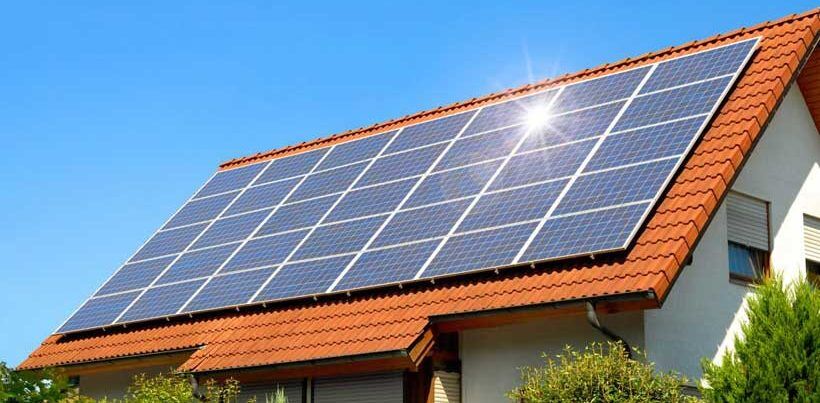
The amount of electricity a solar panel produces is obviously one of the crucial things that you need to know when looking to install a solar system. Some solar energy companies are giving a wide variety of unreferenced numbers, so we have done our research and provided you with fully referenced and reliable information for you to consider. Read on to find out how much electricity a solar panel can produce.
What is solar panel output?
The power rating of your system (stated in kilowatts, or kW) is a measure of how big your generation system is, not how much energy it will produce. This is a bit like a car engine, where the size of the engine gives you an indication of how powerful it is, but does not itself tell you how much petrol it will use, although the two are related.
In addition to knowing the output rating of your solar power system, you should also understand how many (kilowatt-hours or kWh) your solar system can be expected to produce. Knowing this number will help you calculate the revenues and savings you can expect to receive from your solar panels.
What factors influence how much energy your solar panels produce?
Of course, the first factor influencing how much electricity you will generate is your solar installation’s size (otherwise known as rated power). A greater number of solar panels will produce more electrical energy (just as a bigger car engine has more grunt).
If we move past the obvious impact of size, the amount of energy your solar cells produce depends on how much fuel they are fed (just as the amount of energy a car engine will produce depends on how much petrol you pump into it via your foot on the throttle). In the case of solar PV cells, their fuel is the sun.
The amount of sun your solar cells are exposed to (and hence how much energy they will generate) depends upon:
- The orientation and tilt of your solar panels (which will be optimised by your installer)
- Whether there are shadows cast over your cells (due to trees, buildings etc)
- The number of daylight hours (governed by where you live)
- The intensity of the sunlight (governed by where you live)
- The number of hours of full sun vs cloudy days (governed by where you live)
If we exclude the first two factors, which you have a degree of control over, your location in Australia is the primary variable dictating how much energy your cells will produce. In most cases southern parts of Australia will receive less total hours of sunlight that northern areas. Hence, a 1.5kW system in Melbourne will typically not produce as much electrical energy over the year as the same system in Alice Springs.
Compare solar quotes from up to 7 local installers now.
Average solar panel output per day
Fortunately, studies have been conducted that take all of the above factors into account and give the average energy output for solar cells in locations around Australia. These figures are given as:
The amount of electrical energy (kWh) a 1kW grid connected solar PV system will generate on an average day (kWh/kWp.day).
The most comprehensive source of this information is the Clean Energy Council (the body that the Australian Government charges with accrediting solar cells, inverters and installers):
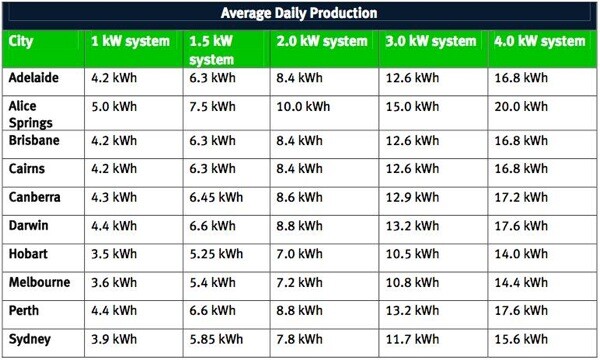
Average daily production of solar PV cells in Australia
p4, “Electricity from the sun: Solar PV systems explained” by the Clean Energy Council
Researching this topic will reveal other credible sources, with slightly different figures. The USA’s National Renewable Energy Laboratory’s (NREL) PVWatts tool also works for Australia (using Aussie meteorological data) and is a great resource for plugging in numbers and estimating a solar system’s output. We encourage you to check it out.
Some exploration will reveal that it’s not quite possible to put an exact unequivocal figure on the energy you will produce from you solar cells. Indeed, as Dr Anna Bruce, Lecturer at the School of Photovoltaic and Renewable Energy Engineering at the University of New South Wales informed us, different solar systems both rated at 1kW sitting side by side may produce different amounts of energy due to the quality and efficiency of their components, how the grid is functioning and how well your system deals with high temperatures. Her expert advice is that “4kWh/kWp.day in Sydney is certainly feasible if a system has optimal tilt and orientation and is running well”.
So the Clean Energy Council figures above act as a good guide and are one of the best and most comprehensive sources available, however, due to the nature of solar, your system may produce more, or a little less than the figures given.
Since 2008 our knowledge and sophisticated software has allowed over 300,000 Australian households and businesses to make a well-informed choice on their solar & battery installer.

- Why a big battery could be cheaper than a small battery with the federal rebate? - 19 June, 2025
- Heat Pump Costs – Solar Choice Price Index - 1 June, 2025
- Solar Panel Costs: Solar Choice Price Index | July 2025 - 1 June, 2025



What’s up everyone, it’s my first pay a quick visit at this website,
and post is genuinely fruitful for me, keep up posting these content.
On my 4kW, 22-panel Sunny Boy/Suntech system, my early estimate was to produce a high of 21kWh/day and low of 17.3kWh/day.
This compares with the reality of 21.5kWh/day in 2011, slowly reducing to a current 19.9kWh/day, still well above the Perth estimate of 17.6kWh/day which I’m satisfied with!
Hi,
I have 3.6Kw inverter with 20 Solar panels and doing ok with it but I am thinking to buy a 500W Wind turbine that I can use during the night if there is any wind.
Is this possible to implement? I can’t find any information about it or anything mentioning restrictions on it so I assume should be ok.
I live in Perth.
Any comments from anyone?
Thank you.
Hi Orlando.
You will need to get planning approval to install a wind turbine. So enquire with your Local Council or State Department of Environment to see if it possible for you.
I just want to commend whoever it is that is answering the questions on here, your attitude and the information you provide is spot on.
Cheers
Jeff
Thanks, Jeff! Your comment is much appreciated! We try our best. :)
Hi, I’m in Brisbane and have a 3.5kw system(20 panels) and wondering what daily output I should expect at this time of the year.
Cheers Gary
Hi Gary,
This time of year you can reasonably expect around 3 kilowatt-hours (kWh) per kilowatt (kW) of solar capacity (assuming that your roof faces due north and has no shading and that your system loses about 15% in energy yields due to inefficiencies).
In total that works out to about 10-11kWh per day for this time of year.
For more info, check out the PVWatts calculator.
Hope this helps!
In determining our solar needs we are looking to manage our electricity consumption during daylight hours to keep it below the a-point-in-time output from the solar installation in kilowatts, not kW/hours. Thinking about kW generating capacity, and accepting inefficiencies of the system due to sunless days, we are more interested in covering usage cost than FiTs. Are we misguided, please?
Hi John,
You are absolutely on the right track: for anyone going solar now, using the solar energy directly in the home is the best way to save money. This is called ‘solar self-consumption‘ and it’s a must for solar system owners these days. Feed-in tariffs are a bonus.
A home energy management system is what we generally recommend to people looking to maximise self-consumption. These days they’re relatively affordable and can really help to make a difference within the home.
Hope this helps!
Was after some advice..have installed a 5kw system in townsville however just got our power bill and was at a loss of the amount we “saved”.
In the quarter it is saying we generated 856 kwh.. is this realistic or is there a probkem with our system. Thanks
Hi Nathan,
What you see on your bill will only reflect the amount of solar energy that you’ve sent to the grid (‘solar export’) – you get a credit for each unit (kWh) of solar that you send into the grid. What will not show up on your bill is the amount of solar energy that you’ve used directly inside your home (‘solar self-consumption’). Solar self-consumption is actually the main way to save money with solar these days – basically, every unit of solar that you use yourself is one less unit that you have to purchase from the grid. Unfortunately the amount of solar that you’ve self-consumed over the billing period will not appear on your bill (as your retailer only shows you energy flowing in and out of your home).
To get full insights, you need a solar/energy monitoring or energy management system. I’m thinking that your system is probably working fine – a 5kW system in Sydney (I don’t know exactly where you are so just using Syd as an example) will produce about 20kWh of energy per day. Assuming your bill was a quarterly bill and the system was installed for the full 90 or 91 days of the billing period, it would have produced about 1,800kWh (very rough figure only). If you’re self-consuming 1,000kWh, that’s a self-consumption ratio of about 55%, which is reasonable for a system of that size.
Has there been a reduction in your bill overall (aside from what’s listed regarding solar export)? That’s where you should be seeing the savings if everything is functioning properly.
Hope this helps! Feel free to reach out with any further questions.
My daughter has a 5kw solar system. We live in Gladstone Qld. I have a 3kw system & my system produces more power than hers. Her average output for 1093 days was 9kwh. Can you suggest why this should be (we live within 4km of each other) thanks…..Bill
Hi Bill,
There are lots of possible reasons this could be happening. My first question would be about shading – is their any shading at all on your daughter’s roof throughout the day? Even partial shading can have a significant impact on solar system output (unless you’ve got microinverters).
Do either of you have apps or some kind of monitoring apparatus for your systems?
Hello,
We have purchased a home with a Solar power System fitted to which our previous residence did not have. As this is all new to us – How do I know how many Kilowatts the solar system is on our new home and do I need to have it re-connected to be fed into the grid as i assuming that the previous owners would have had their account cancelled ???
Hi Bradley,
The best way to see if the system is working at all might be to look at the inverter (which should be at eye level somewhere on your property – looks like a box stuck to a wall with cables coming out) – hopefully it has some kind of interface on it that shows your system’s energy production.
Alternatively, you can wait until your energy bill shows up and see if you’ve got any credits for your solar there.
What state are you in?
I have a 1.5 kW system yet on average am only getting 290-300 kWh export per 3-month period. As an example for a 92-day period, the export was 291 however if I were to base on the above average of 6.3 kWh (in Brisbane), then I should be getting about double that.
Is there an reason fro possibly not getting as much solar as possible?
Hi Kelly,
What’s probably happening is that you’re ‘self-consuming’ most of the solar energy that your system produces – using the energy directly with your appliances. This is not a bad thing, as it’s saving you money by reducing the amount of electricity that you have to purchase from your electricity retailer. 1.5kW is relatively small, which increases the likelihood that you are indeed consuming most of the energy as it is produced. Do you have any numbers on the system’s total energy production?
One point of possible confusion is that you only see exported solar energy (and not self-consumed solar energy) itemised on your electricity bill. It may in fact be the case that you’re exporting 300kWh per quarter and self-consuming the balance (approx 300-380kWh). The only way to tell is by knowing what your solar system produces in total on average – which would not be detailed on your electricity bill (you’d have to look at your inverter or whatever monitoring software you have, if any).
Hope this helps!
Also, depending on whether or not you have access to the 44c/kWh solar feed-in tariff or only the 6-8c/kWh currently on offer by most electricity retailers, you’ll want to aim to use your solar energy differently. Basically, if you have access to the 44c/kWh rate, you’ll want to export as much solar as possible to maximise savings; if you have access only to a lower rate, you’ll want to try to self-consume as much solar as possible to maximise savings.
Hi there.
We have moved into a property with 33 solar panels but I suspect they aren’t working very efficiently. They probably need a clean and service.
What I’m hoping to find out is roughly how much energy would you expect to see 33 panels produce?
I’m in the Blue Mountains, NSW.
My current bill says for 99 days the 33 panels produce 143.000 – is that what you’d expect or too low?
Thanks!
Hi Emma,
Your system is almost definitely underperforming. Without knowing the capacity of each panel (how many watts?) or the total capacity of the system (how many kilowatts), it’s hard to say exactly, but it should be around 5-8 kilowatts if it was installed within the last 5 years. Over the last 99 days you should have seen around 2,500 kilowatt-hours (kWh) of electricity produced (you’ve indicated only 143kWh).
My first guess is that it’s a problem with shading, knowing from experience that a lot of homes in the Blue Mountains are surrounded by trees. Even partial shading is bad for solar systems with central inverters, while microniverter systems perform better in shaded conditions.)
If shading is definitely not a problem, there could be a problem with one or a few of the panels – or possibly the inverter itself.
The best thing to do would be to get in touch with the company who installed the system (if you have those details), or – in the case that you can’t locate them – get in touch with a solar-accredited electrician to have a look. I’m guessing that the system was installed under NSW’s generous solar feed-in tariff scheme (whose 60c/kWh payments finish at the end of this year), which means you could be missing out on some significant energy bill savings, so it could be worth paying to have it fixed if it’s not a major issue.
Best of luck!
We have a 3.5kW system, 7 panels facing east and 7 panels facing west. We are now on our second inverter and about to have it replaced again as we are not producing (apparently) any energy at all. We are being billed for every kW we use at peak rates. Our bills are roughly $800.00 per quarter and even though, we have sent energy back to the grid we are only getting $0.51 cents per kilowatt. Not sure how we are sending back to grid if we aren’t producing, but that’s what we have been told. Our energy supplier, just keeps telling us that we shouldn’t expect to save any money at all just because we have solar. We paid roughly $7,500 for our system eighteen months ago and we feel like we have just wasted our Monet rather than creating an investment.
Hi Narelle,
Sorry to hear about the problems you’re having. Just to clarify, are you getting 5.1c per kilowatt-hour (kWh) or is it 51c/kWh. I’m going to answer you based on the assumption that it’s 5.1c/kWh – which really isn’t very much at all but is unfortunately pretty standard across Australia now.
These days, going solar is really only worthwhile if you are able to ‘self-consume’ as much of the solar energy that you use while it is being generated – this means trying to run appliances during the daylight hours. The company who sold you your system should have explained this to you from the outset – if they didn’t explain it, I would question whether they are a trustworthy company. Also, $7,500 (about $2.14 per watt) is a bit on the high end price-wise for a 3.5kW solar system, even for October 2014 (when I gather that you had your system installed).
I’d recommend first making sure that your inverter is, in fact, malfunctioning. It’s not really clear from what you’re written if you’re certain that there is a technical problem with your inverter (how much does solar energy does the inverter say the system is producing?), or if you’re assuming that it’s not working because your electricity bills are still so high. Your electricity retailer is correct that having solar panels does not necessarily guarantee that you will save money (again, the company that installed your system should have explained this to you). If you use none or only very little of the solar energy directly, most or all of it will be sent back into the grid at very little benefit to you (the 5.1c/kWh). By contrast, if you self-consume the solar energy, you will probably save more money (whatever you pay for retail electricity).
There are a couple of other things that I should point out:
-If you’re on a time-of-use (TOU) electricity tariff, you might want to consider switching to a flat rate. Even with some of your panels facing west, it’s unlikely that the energy that they produce will cover all of your peak-time (and most expensive) energy usage. Instead, your solar is probably being consumed most during your less expensive off-peak and shoulder periods. Depending on what your exact rates are, you could stand to save a lot more money on a flat tariff, where you pay the same amount per kWh no matter when you purchase the electricity.
-If you’re on a 3-phase connection, you’ll want to ensure that your inverter is either a 3-phase inverter (which is unlikely for a system as small as yours) or that it’s connected to the phase that uses the most power in your home (again, if you’re installer was really thinking in your best interest, they would have spoken with you about this). If you’re on single-phase power, on the other hand, this probably isn’t the issue that you’re having with your system.
Hope this helps, and best of luck with your system!
My xdaughter has 24 panels and her last bill was 300 odd dollars, she used hef air con for 5 days in the 3 months she only gets 6 cents per kilowatt on energy saved. So why is her electric bill so dear. She works 9 hours a day and uses the air con from 6amm to 6pm on the 5 days. What is she doing wrong.
Jane
Hi Jane,
It’s hard to give answers without knowing more of the specifics. For example, are you talking about a quarterly or a monthly power bill? If you’re talking about a quarterly bill, then $300 really isn’t a lot to pay – especially when running AC for 12hrs/day!
Just in case there’s some kind of misunderstanding, I should state that these days saving money with solar panels means that you must ‘self-consume’ as much of the solar energy produced as possible. In most states, a home will save in the range of 20-28c per kilowatt-hour (kWh) of energy by using their solar power as it is produced (while the sun is shining). Otherwise, the solar energy is ‘wasted’ – sent back into the grid for only 6-8c/kWh.
What I assume is happening with your daughter is that here system is actually stopping keeping here power bill much lower than what it would be otherwise – AC is expensive to run, as it uses a lot of energy. If the installer told her that she would be able to completely eliminate her power bill, they were lying. These days, with solar feed-in tariff incentives having been closed in virtually every state, it’s basically impossible to have a $0 energy bill unless you get off the grid entirely (which is not economical for other reasons). Even if you have a grid-connected solar+battery system, you’ll still be charged fixed ‘supply’ charges which don’t go away if you consume less energy.
Hope this helps!
Im still stuffed with 18 panels 4.5 kw yet stll pay around %80 of what was my old bill.
I need an assessment to be done. Who do i get. the installer says all is ok.
Hi Rob,
The problem may be with your electricity consumption patterns. If your solar panels are generating energy but you’re not using any appliances at home, then you’re probably not going to see the sort of electricity bill reductions that you were expecting – even if your solar system is working perfectly well, as your installer says may be the case. You need to be consuming more electricity during the daylight hours. If the installer didn’t explain this to you clearly, then they did not fully relay to educate you about how solar works in Australia these days.
HI
I have a 4.5 KW 18 panel system set up but only get a minimal amount of refund from the server.
The sysytem takes in on average around 10 -12 kw per day. Ranges from 4 to 14.
Im with ausnet and powershop but get stuff all rebate. Why is this
Hi admin
I have a 4.5 w solar system installed for the past 12 months I live in Healesville Victoria. I have a smart meter from SP AusNet.
I have created a daily record sheet for solar output/ kWh & smart meter reading usage including feed in tariff, from which I can calculate the usage & cost daily. If anyone is interested they can e-mail me for the sheet at the above e-mail address
Hi Frank what sort of rebate do you get. Im getting stuff all with 18 panel and a 4.5 kw system.
Hi, I am doing a school solar project which is due next Friday. The project is for a Solar Installation and to make an efficient solar farm for my school. I need to convince my audience the project will be cost effective, how many solar panels I need and how much power or energy I need to supply.
What would be the best solar system plan to use for powering a school and how would I work out the costing?
Hi Liv,
The first thing you’d need to do is figure out what your school’s daytime electricity consumption is, then size a solar system to match it. I assume you’d be mounting the system on the school’s roof?
As for pricing, you can check out our commercial solar PV price index articles to get an idea of what different size solar systems cost.
I have 8 190 watt panels, will a 50 amp charge controller be enough for the system?
Hi junglecook,
We wouldn’t be the best to advise on this topic, although someone else in this forum may chime in. We’d advise getting in touch with an electrician or solar installer about what your goals are, or reference the user manuals of both the panels and charge controller that you have.
Good luck!
hi!
im nathaniel from mariano marcos memorial hospital & medical center, can you please help me for sizing the solar system for the hospital? the hospital’s monthly power consumption is 115,000 kw.. what is the size of system should be use.?
Hi Nathaniel,
It would be hard to size a system without knowing more of the details of your electricity usage, sunshine hours available where you are, and the solar PV support policies of the Philippines government. If you mean to say that your usage is 115,000kWh (not kilowatts or kW), you’re looking roughly at a 100kW system.
Hi,
Nice summary. I am a novice and would like to setup a mini solar electricity generation system in my roof. But I have no idea what all things will I be needing to do it (Exhaustive I mean). Assuming I have a 500W 24V solar panel, what else should I need to make it usable for household use – 220V AC.
As far as I browsed, I would be needing a charge controller, battery and an inverter. So, what would be the config of these devices which would be required in my case and also are there any other things I would be needing?
Thanks a lot for someone who takes time to reply to this.
Hi Harsh,
We’re not in the position to tell you what you’ll need if you’re planning on installing the system yourself, although it is certainly possible (especially if you happen to be an electrician). Getting a solar installation kit (with all parts included and designed for a 220V AC home) might turn out to be an easier choice than piecing a system together from individual parts.
Thanks for the reply.
I am just wondering how hard could it to be to assemble such a setup. Should just be connecting few ready-made devices properly, noe..!
Anyways, thanks again.
Hi I am answering a question for my uni assignment and its on “Is the efficiency of Solar Panels improving”?
I need some statistical data preferably graphs that show a trend of solar panel conversion efficiencies improving over the years and predicted efficiency conversions well into the future but i’m not sure where to start with my research, any suggestion guys?
Kind Regards
Hi David,
There have been lots of developments that promise to improve solar panel efficiency have been taking place, but it’s hard to predict which ones will be adopted first. A big factor is commercialisation–whether these technologies can be implemented economically. Conventional silicon–currently the most popular technology–might even be usurped by other materials like graphene.
I’d recommending looking towards Bloomberg New Energy Finance (BNEF) and McKinsey for some actual past and predicted future figures.
Good luck with your project!
Hi, I have 3kW of panels and a 5kW growatt invertor. North facing at 30 degrees tilt and zero shade. I have 2 questions…. what instantaneous wattage should I get at Noon? and secondly, what total gereration on a cloud free May Autumn day? Have had issues with the unit and can’t seem to get reliable advice on what I should be getting. Thanks !!
Sir. How much area is required to make around 100kwh(4*24) per day? I my area we receive sunlight for 5-6 a day.
Hi Deepak. You’d need approximately 20kW of solar panels to produce 100kWh of power per day. The area will depend on the exact panels used, but assuming an average-sized 290W panel (1.954m x 0.982m) is used and the panels are laid flat, approximately 6,620 square meters of are would be required.
Calculating the energy output of a solar system can be rather complex. The formulas to use are difficult for a person that has no or little knowledge of elementary physics.
There are several sites that provide an easy way to calculate the energy output of a solar system. For example on http://www.sustainableenergyworld.eu/solar-panel-energy-output-calculator/.
The calculator on that page first determines the maximum capacity in Watt of your solar system by asking you the number of panels and the maximum capacity of each panel. Then the revenues of the system are calculated depending on where you live. The revenue is given in kWh/year. Finally a correction is made for the actual placement of the panels depending on the irradiation factor. The irradiation is a function of both the orientation and the inclination of your solar panels. You only have to supply the orientation and inclination in degrees to finish your calculation. The calculator gives you the result in kWh/year. Furthermore the calculation method used is explained in a clear way. Worth a visit!
Thanks Frank!
Unfortunately this calculator only covers Europe. So, no good to us.
Hi Patricia,
We’ve found one that works globally at EcoWho.com, visit http://www.ecowho.com/tools/solar_power_calculator.php. There is no perfect answer but this should give you a good idea.
Hi,I have had a 3kw system on a north facing roof for just a year. The panels are 12x LDK 250 D and the inverter is an Aurora 3kw. I have noticed that the peak output of the system has not exceeded 2140 w since the start of this year and was only 2150 last year. The reading on a sunny day is around the 14.5kwh mark. This would seem to indicate the system is producing approx 2/3 of its rated power. Is this reasonable or is there a possible problem I should follow up? Thanks Kurt
Hi Kurt,
With all the variables optimised, your solar PV system should operate at about 90% efficiency. A one year old system operating at 60-70% does sound like there is a problem. In an ideal word your panels will face due north and be tilted to a degree that is a little lower than the line of latitude your house lies on. You might want to check that there is nothing shading your panels (including themselves – unfortunately we have come across this from installers not on our network), if one panel is even partially shaded it will effect the output from those on the rest of the string.
As the problem has been ongoing for a year, it might also be worthwhile getting the installer out to service the system. Issues with the wiring or the inverter would dramatically effect the reading on your meter.
Hope you get this issue sorted soon.
I have a 16 panels/3kw JSI 3000TL grid connected inverter (CHINESE MAKES ) and I have noticed that my panels are now a mixture of blue and black . This was not the case when they were installed 10-2-12. I have been experiencing larger than normal power bills of this period .My panels are on a tilt system and I live in Hallett Cove south of Adelaide and have full sun for 100% of the day What I have stated Re: the colour of the panels ,IS THIS NORMAL APPRECIATE any comments you have Regards Ray
Hi Ray,
Although you’re panels can change after they are exposed to the elements it’s not normally a huge change. Mono panels should all be uniformly dark, while poly panel will have a range in colour.
If you’re panels started dark and have discoloured to a light blue colour this suggests that something could be very wrong. We had a visit from a premium panel manufacturer and he showed how their panels perform over time compared some of the less reputable manufacturers, the panels who’s performance decreased significantly over time had turned light blue.
The other thing you might want to check is the inverter, generally speaking we encourage customers to go with European manufacturers because the Chinese products just aren’t up to scratch, although we’d be happy to be proved wrong.
I would contact your installer and get them to come and check your system, if it turns out it’s an inverter issue and they offer to replace I’d recommend investigating the possibility of upgrading to a European model. SMA, Fronius and Aurora are reputable brands but you can research anything else you’re offered on the internet before going ahead.
We hope this helps and it’s only faulty wiring not the components that are the problem!
I got a 3 Kw solar system installed last month – 12 X 250W Polycrystalline LDK panels with Omniksol 3.0k TL Inverter. The inverter allows for remote monitoring via wi-fi and I’ve been watching the performance of the system for its 20 days of operation so far. All panels face West (even slightly NW) and there is no any shadow cast at any time on any of the 12 panels. The tilt is approx. 22-25 degrees. What I would like ask is whether it’s normal that the highest peak power generated so far on a really nice clear sunny day is between 1650-1700W with only 1 exception of 1980W after a period of cloud. Now I understand that I can’t expect to get 3.0Kw (as peak) since my system is facing West and I believe I automatically loose around 10-20% efficiency but what I get is actually bordering 50%. Am I right to think that there maybe something wrong (with the installation?) and what do you think the possible reason for that low peak power might be? Do you think I should contact the company which I purchased the solar system from or the subcontractor who installed it.
Thank you very much for your support!
Hi Tanya,
I’ve just spoken with one of our team who is a qualified electrician and used to install system before moving to Solar Choice. Given the details you’ve passed on he suspects it’s an electrical issue and advises that you contact the installers to arrange for them to come and check the system. Check your warranty as you may have a clause which would cover this call out.
If the electronics are wire correctly the other option is the inverter, Omnik Inverters are not used by any of the installers on our network and I’m not familiar with their products. I’m slightly concerned with the poor English on their website, the better quality manufacturers tend to spend the time getting the small things right. If it turns out that this is the problem I would try switching to a different manufacturer, you can research the different options online. Whirlpool forums are great for getting feedback from people who have dealt with both installers and manufacturers.
Generally we advise that people spend some time doing their own research before signing any contracts. We do the due diligence on behalf of our customers but it’s always great for customers to go that extra mile to ensure they’re really comfortable with what they’re signing up for. Look for companies that have been around for a while are generally a good choice, a companies website is a good indication of whether they’re investing in the long haul and reviews from other customers (try getting ones in the last few months) are a good indication of performance.
Hope this helps.
Hi, I live in Punchbowl in NSW. Recently I got a 2kw Trina Solar installed along with a Delta inverter. Today the 4th of Sydney the inverter showed that it produced 13,340wh which 13kwh. Is this correct?
Hi Hany,
When we talk to customers about how much energy their solar system will produce we normally advise an average of 4kWh per kW installed. As we’re in the middle of summer with longer day light hours and the beautiful sunshine your panels will be generating for longer and at a higher intensity.
We hope this helps
I have 2kw system with 10 – 190w facing north and want to upgrade to extra 3kw with 12 – 250w facing west will SMA 5kw will work or I need another inverter.I have approved to put extra 3kw.
Hi Teddy,
From what you’re saying you currently have a 5kW inverter with 1.9kW of panels attached and want add another 3kW to this. Technically this is feasible and I know some installers, who are not on our network, actively sell larger inverters with the promise you can ‘add on’ later. The problem you do have is that ‘adding on’ is not straight forward.
Hopefully your inverter will be a dual input inverter meaning that to can set up the 250 watt panels and plug them into this second input socket. You may need have have your cables upgraded but the installer should be able to advise you of this.
The worst case scenario is that you have a single input inverter. This causes a problem as solar PV systems only work as well as the worst panel, so your new 250 watt panels will only function at 190 watts at best and possibly a lot lower than this depending on the age of your panels. If this is the case you have a few options: find some 190 watt panels that are as close a match as possible to your existing system; replace all the panels with 250 watt panels, or stick with your current set up. Although the second suggestion sounds a bit extreme if it dramatically reduces your consumption from the grid thew ROI may be worth it.
Lastly please bear in mind any changes to your solar PV system may result in you loosing your current feed-in tariff, your energy provider and installer should be able to help you with this.
We hope this helps
I have a 3.5 KW Growatt inverter with one string of 8 x 190 watt panels and one string of 7 x 195 watt panels. The watts they are producing are 1440 watts for the first and 840 watts for the second string. At any time of the day the wattage difference is aprox 60% but it should be ony 10%. Please help! Thanks Thomas
Hi Thomas,
There few things you can check for. Is there shading on any part of the second string or at they on a different facing roof space than the first string (e.g. west instead of north)? Either of these will dramatically reduce the production of your panels. Is there any damage to any of the panels on the second string? Do they need cleaned? Do any of the panels look like they’re a different make or model? Were the two different strings installed at different times, performance will degrade over time so if you installed the 195 watt panels a few years ago they will be performing lower than newer panels.
With solar panels, they system only works as well as the worst panel. If there is an issue with one of the panels on the second string this could be bringing the whole performance down. If you contact your installer they should be able to come out and service your system (which is recommended every few years) and identify any possible issues.
We hope this helps!
We live in Adelaide and have had a 3.2 KW system installed. We are not seeing the cost saving results that we expected.
Is there anything that we are doing wrong? The last billing period of 3 months we have only been producing 3 KWH per day according to our bill – but our solar is reading an average of 9kwh per day.
Hi Robyn,
The difference in your meter reading and energy bill is because residents of South Australia are on a net metering set up. The 3kWh you see on your bill is what you export to the grid the ‘missing’ 6kWh is what you are using during the day.
There is not way to increase the energy you export unless you become more energy efficient e.g. hanging clothes out to dry instead of using a dryer or turning the air conditioning down or off. There are lots of energy saving website out there that will give you great advice.
We hope that answers your question.
Mate,I,m led to believe that people around the place who have installed lots of panels are cleaning up on the Govervment feed in tariff. And as a consequence the Government have decreed that in such cases they,re feed in tarrif will be reduced. My panels get me to pretty much a break even point. An annual electricity bill of say $60-$80.If I go over the top and say,cover myself in blankets rather than use the air con while watching T,V. And actually come out in front financially, { lets say, the electricity provider pays me $50 or$60] does this mean that my feed in tariff reduce???? Cheers Phil
Hi Phil,
Thanks for your comment. Which Feed-in Tariff are you referring to? If it’s NSW, it’s certainly true that those who made it in on the 60c/kWh gross Feed-in Tariff are doing very well, as it was an extremely generous scheme (somewhat to the embarrassment of the Greens who helped get the program through state parliament and later saw the backlash that occurred in its wake).
Which feed in tariff are you receiving, if any? And which state are you in?
Hi, I’ve found this site very interesting and would luv someone to help us in making a decision. We are looking at a 5kw Fronius IG60HV inverter & 20 renesola JC250S -24Bb solar panels. We live in Lancefield, Victoria, our roofline faces north & our last bill said that we use 33kw daily consumption. We have 4 children under 12 and 2 adults. With all this info could you tell me what the daily output would be in kw from this solar system, the solar hours in our area,will the system bring our bills down( last bill was $733), is it worth getting a couple more panels added to make up for the tolerance in each panel to make the whole system run at full capacity! I’m sorry for all the questions just want to make right decision as it’s such a large outlay of money.$9330!
Hi Julie,
Lots of questions! One of our brokers would be happy to assist you and introduce you to some other options available to you in Lancefield. We are a 100% free service to our customers. Give us a call on 1300 78 72 73 or fill out the form to the right to receive a free and instant comparison of solar quotes from installers in your area.
To answer your questions quickly, $9330 is not a bad price for a 5kW system with those components. A perfectly designed and properly designed 5kW system in your part of Vic would produce just under 20kW/day on average throughout the year–more in the summer, less in the winter, of course. I imagine that with the size of the family you’ve got, you’re probably using a lot of electricity during the day, which is perfect, even if you don’t make the deadline for the Vic Feed-in Tariff. Hope this is helpful.
Hi
I am in Mackay Qld, and have a 4KW system comprising of 2 x 2KW Growatt Inverters each being fed by a 11 x 185w panels, which face west. The system basically work extremely well, and I am on 44c/kwh rebate scheme. I still havent reduced my electricity bill to zero yet.
I am wondering if it is possible to utilise the 2nd set of unused DC input jacks to connect extra solar panels on either the northern (or even eastern ) side of the roof, to increase the KW produced early in the day and therefore the kwh per day?
Currently in cloudless conditions, in the morinings each inverter is producing about 400-500 watts. At around 11am they produce 1500-1600w, then at midday till about 2.30pm, they run close to max power output. When summer is upon us these times will obviously increase.
Are there limitations on the system, or could I damage the system?
The inverter specs are as follows
Max DC power 2300W
Max DC Voltage 500V
PV Voltage range 120V-450V
Max No Parallel strings 2
Number of MPP Trackers 1
MPPT Inut current 0-12A
Max DC Input Isc Current 15A
The installed PV panels specs are as follows
Max Power 185w
Open Circuit Voltage 44.8V
Max Power (Vpm) 36.2
Max Power (Imp) 5.11
Hi Ashley,
It’s great that solar is working out for you.
Unfortunately, your inverters are already at capacity and it wouldn’t really benefit you to add any panels as the inverters can’t handle any more power coming into them–they only really operate up to their rated capacity.
You can read more about inverter efficiency in this article: Types of Inverter Efficiency.
Best of luck with your system!
Excellent site with sound opinions & advice.
Just what the Solar Doctor ordered!
Thanks
Qld has just reduced its FIT from 44 cents to 8 cents. I am building a new house but missed out on the cutoff to retain the 44 cents FIT. I live in Brisbane. At present I have a 2.5KW system in my present house and my avg. daily usage of my last bill for 92 days was 555kWh @ $0.027 and my solar bonus was 680kWh @ $0.52; giving me a Credit of about $208 per Qtr.
I was intending to install a 5KW solar system and with my supplier topping my FIT with another 8 cents (16 cents) total, I have been told that it will not be worth my spending $8,000 on the new system. Should I invest the $8,000 and what will be my ROI?
Hi Benny,
First of all, be careful, as installing a 2nd system may result in you losing eligibility for the 44c/kWh rate. The Queensland Government stipulates that there can be only ‘one application per premises‘ for the Feed-in Tariff.
If the 2nd system is for a different location, there are still strong arguments for going solar in Queensland under the 8c/kWh rate. The article linked there also has an (indicative) return on investment calculator, so you can get an idea of what payback periods are like for solar systems in Queensland now.
If you are interested in getting a 2nd system, don’t forget to come to us for a free and impartial comparison of solar quotes from installers in your area of Australia.
Hi,
Looking for advice on what system is best for us…. We live in Perth & We tend to use an avg if 15 units per day in winter costing $231, & an avg of 26 units per day in Summer costing $371. I am home in the day which I was told is great as this is the best time cram our electricity usage into. We had a quote the other day & it was suggested that we get a 9 panels x 240(w)= 2.16 Kw, with an inverter type -delta, size- 2.5 & apparently we can upgrade to 3Kw in the future… We feel this may not be big enough to suit what we use? I know it will reduce our bills but will this be enough to see a difference?? Understanding all of this seems very confusing… please help us to understand this a bit better.. ;-/
Hi Melissa,
Thanks for the comment. Just a few of points:
1) We do not recommend installing a system with a significantly oversized inverter unless you plan on adding the additional panels to ‘fill out’ its capacity within about 6 months from installation–which most people don’t end up doing. So generally we advise people not to go this route, as having an oversized inverter can compromise overall system yields.
2) You’re right that your system will only provide you financial benefit if you’re using power as the system produces power, so it’s good that you’ll be home. Getting the most out of the system really means, therefor, that you need to really pay attention to how and when you’re using electricity at home. Run things while the sun is shining as much as possible! Solar Choice has a Perth Solar System return-on-investment calculator that will give you some idea how you might benefit from a system, but please keep in mind that the figures are purely indicative, and real returns will depend on a number of factors, such as weather, your electricity consumption patterns, and the price of electricity.
3) Since there is no Solar Feed-in Tariff for WA residents who install a system now, there is no point in getting a system whose output will be more than your daytime electricity consumption. I see that you’ve requested a Solar Quote Comparison from our website; one of our brokers should be in touch with you soon to discuss your options, or you can give us a ring on 1300 78 72 73 to expedite the process. They’ll ask you to look at your power bills, so try to find a recent one.
Hi
I live in the western suburbs of Adelaide in a single storey house. I have calculated that my daily average usage is approx 14.5Kwh. We have been advised that we need a 5Kw system comprising 19 – 21 panels depending on each quote and using different panels some panels are 190w and some are230 w.( is there any preference to the panel outputs.
The house has a north face aspect and due to asthetics we have decided that the panels would be installed on the western side of the roof and every company that has quoted agrees, this is due in part to a double storey home on the esaster side of our house that has potential shading impacts on my roof.
Can you please give me some advice as to
1 Is this sound advice
2 Can you direct me to a table for comparing solar panels (best vs worse) the reason for this is due to the sales pith that we get from the companies saying that other products specified by competitors are “cheap and/or not very good
Kind regards BJ
Hi Brian,
1. That is indeed sound advice if the house next door is going to be casting a shadow on your north-facing roof. However, you can expect about a 20% loss in output with a west-facing array. This isn’t a problem as long as you know what you’re getting into, which I expect you do.
About the 190W vs 230W panels, there is no substantial difference. The figure to watch out for in the end is the cost per watt of the system, not the size of the individual panels, provided they all fit on your roof. 190W panels are becoming less common and tend to be older stock, which is not necessarily a bad thing.
2. I can’t point you to that sort of chart, as which panel is the ‘best’ is a subjective issue, and will depend on your own needs and budget. Solar Choice does give free advice regarding solar panel installations. Start a dialogue with us by requesting a free, instant Solar Quote Comparison that will give you a broad look at the market in Adelaide.
Great website with so much useful info. Thanks!
I have a new 4.6kW Motech PVMate 4600MS system with 2 strings of 10 panels. The uptime is 397 hours with only 496.4 kWh production in sunny Cairns over 37 days.
Should I be concerned? By my rough calculations, i am averaging 2.8kWh/kW per day which must be low for a sunny location.
What would you suggest?
Hi Carl,
Not sure what you mean by uptime, exactly, but an average of 2.8kWh (you do mean kWh, and not kW, right? the former measures total production, the latter refers to production at a given moment) is indeed quite low for a 4.5kW system. You should be getting about 18kWh a day in Cairns from a 4.5kW system in ideal conditions. What orientation is the solar array at? If the problem isn’t the orientation, then you might need to have your installer come back out and check that the components are all functioning properly.
Hi,
Is there an expert body or person from who I can get an impartial opinion as to if some individual cells in a panel are cracked. I can see physical random cracks through several individual cells but the supply company says this is a cosmetic non issue and that the system total output as recorded in the inverter proves that the system efficiency is acceptable.
Thanks,
Geoff
Hi Geoff,
If the glass on a panel is cracked this could potentially pose a short or long-term issue, as moisture may leak in and affect the silicon cells themselves, although it seems that in your case this is not happening right now. Your panels and system should, however, most likely have a warranty that protects them against faults such as this. Contact your installer with regards to this, as they should be able to help you out–provided that a warranty does indeed exist. All quality products come with a warranty and it is a concern if they do not.
You might want to contact the Clean Energy Council about this issue. They are the independent body that regulates all things to do with solar power–including components and installers. They might be able to help you out.
Hi,
I have a quote for a 3kW system with a 5kW inverter, reading the many comments from others I am wondering if the 5kW inverter is an overkill?
Hi Lois,
Oversized inverters can result in inefficiencies in your system’s output and are not recommended unless you plan on adding the balance of panels to match up with the inverter capacity within 6 months after the initial installation. Read more about inverter efficiency.
Hi I hope that you can help me I bit confused on how many solar panels I really need I’m in Perth WA I’ve been told that I need 38x190w with 2.2.5kw inverter it seems such a lot of panels although they cannot promise that it would cover 100% of my electricity. my bills range from $321.80 for 58days with 1472 total units (oct to Dec.) and $571 for 63days with 2614 total units (dec to feb) then I had an estimated bill of $738.20 for 63days (feb to apr) with 3376 total units and the bill after that was for $92.95 with 425 total units. Thank You.
Hi Ann,
Thanks for the enquiry.
In most cases in Western Australia, where the Solar Buyback rate currently sits at only 3c/kWh, no solar system will completely offset a power bill. The most you can hope for is a big chunk to be taken out by avoiding the purchase of electricity from the grid–you can only do this during the daytime, as this is the only time your system will be producing power.
A bit more concerning, however, is that your inverter capacity and total solar panel capacity don’t seem to match up. Perhaps you typed the number of panels incorrectly? 38x190W panels would be 7.22kW of panels with only a 2.5kW inverter? Are these figures correct? It’s not possible to work out the rest of the figures without first getting these straight.
What I’ve been told is that 2 x 2.5kw ( which is 5kw) inverter with 38 x 190w panels. I hope this does help. Because I’d hate to spend all this money with so many panels and still have to pay an electricity bill.
Hi Ann,
38 x 190W panels would be overkill for 2 x 2.5kW inverters, as it’s more than 7kW worth of panels and your system output will basically be capped by the capacity of the inverter. I’m also wondering why they’re suggesting 2 x 2.5kW inverters as opposed to a 5kW or 7kW inverter. I don’t mean to disparage, but it doesn’t sound like a trustworthy operation.
Let’s also be clear that having solar panels will ever completely eliminate your power bill. There is currently no Feed-in Tariff in WA, so you do not get any credit on your bill for power that you export to the grid (well, actually you can get about 8c/kWh, but this is not much). You can offset your power bills by consuming your own solar power as it is being produced, but when night falls and you want to turn the lights or oven on you’ll have to draw it off the grid, which means paying for it.
The thing you need to do is 1) figure out how much electricity you can reduce in your household and 2) how of your electricity-using activity you can shift to daytime hours, when you’ll be able to take advantage of your power-producing solar panels. Only then will you be able to figure out what size system you need. As a rough estimate, however, the average household in a state with no feed-in tariff would benefit most from 3kW, 4kW, or 5kW solar systems.
If you’re still looking, give us a ring or fill out the form to the right of this page to get a free and instant solar quote comparison of installers who service Perth. Our service is free and impartial and we do our due diligence to ensure the installer in our network are reputable and do a quality job.
Best of luck!
Hi, I live in a house where the ridge runs almost north/south. If I get a 3kw system can I put half the panels facing east and the other half west? Will this mean that only half will produce power in the morning and the other half in the afternoon as 1 half will be facing away from the sun? If this can be done will it be more efficient splitting the panels or having them all on the side that faces slightly more north?
Hi Chris.
Thanks for the comment. I can’t really answer your question until I have a bit more information from you.
1) Which state are you in? (Some states have feed-in tariffs, some don’t.)
2) Are you eligible for any feed-in tariff? (If you are, it would probably be safe to split the array. If not, it’s not advisable unless you’re home.)
3) Is there any shading on either side of your roof? (If there is you won’t want to install panels on that side.)
4) Is there anyone home during the day? (If someone is home during the day using power, it make sense to split the array. If you expect to use more power only in the afternoon, you should aim to have most of the panels on the west-facing roof.)
In the meantime, you might also want to read this article: East vs west orientation for solar panels
Hi, wie are Interested to get a 2kw System to Cover our aircondition use. If we are producing energy during the day and don’t use it we sell it to the government and at night when we are home we buy it back for the current price of electricity? We were under the impression that you use your own production up first for free and then buy as required.
Thank you clarifying this for us.
Hi Shoun,
Thanks for the comment. You’re under the right impression: At present most inverters will automatically direct the solar power your system produces to your home appliances (if you have any running), and direct any surplus into the grid. If you are in a state with a Solar Feed-in Tariff, however, then electricity retailers are required to purchase your power at a premium rate. If there is no Feed-in Tariff on offer where you are, they may not have to pay you anything, or possibly only very little.
Read more: The economics of a 1-for-1 Solar Buyback scheme vs a Solar Feed-in Tariff
Hi Everyone,
does anyone have a free program to record your daily grid power usage, solar system output, etc and then using these figure calculate what your power bill will be?? Also want it to record all solar output and be able to produce graphs, tables, etc.
I live in Cairns
Des
There are companies out there that have monitoring solutions like those you’ve described, but ordinarily such systems don’t come standard with systems. They probably should be, as people are much more likely to watch and change their usage patterns if they know their system production and power consumption statistics in real time.
Hi
I am in Melbourne and have A 4Kw system comprising an Eversol T4600 inverter and 16 XH (Chinese) solar panels. The panels face west on a roof of 30 degrees. The system has never produced more than 2700w. I have had it checked by the installer and an idependent check and have been told there is nothing wrong with the installation but no one can tell me why the system is 40% down. My roof pitch is 23%. The system has produced an average of 7.2Kwh/day since installed. Do you have any ideas?
Hello D,
Thanks for the comment.
There are a number of factors that could potentially be affecting the performance of your system.
First of all, in order to understand what sort of output you should be expecting, it would be helpful to know what the total rated capacity of your solar panel array is–there are different models of XH solar panels, each with a different capacity. I assume they are approximately 190W, as this is a common capacity for residential solar panels. If they are indeed 190W panels, your array capacity will sit at around 3.04kW. This would be about 1.5kW lower than the capacity of your inverter. I cannot find the efficiency curve for the Eversol T4600, but it may be the case that it is being underpowered, which could result in a disproportionate loss of efficiency. (Read more about inverter efficiency.)
Another problem could be the fact that your panels are west-facing. The ideal scenario is to have your panels facing due north, but it is not uncommon to put panels on an eastern or western roof if a north-facing roof does not exist. If all else is perfectly arranged, a solar system with panels on a tilted roof facing due east or due west will suffer an approximate 20% loss off output. Assuming that your inverter is underpowered, however, the output could be even more severely compromised by the western aspect of the roof/panels.
Another issue could be a fault with the panels. XH are not a tier-1 manufacturer of solar panels. If there is a fault with even 1 of your panels (i.e. a cracked cell), the output of the entire array or of that ‘string’ could be compromised. (Similar to the effect that shading has on panels.) It wouldn’t be possible to check this without testing each panel, however (although you could narrow it down if your array has more 2 strings within it by checking to see if one of them is not producing as it should be). If it is a problem with one or more of the panels, you’ll have to check into the warranty. If XH does not have an office in Australia and you do find a problem with one of the panels, you may have to send it back to China for servicing, or it may take some time for them to get you a new one.
Alternatively, you can get in touch with the company that installed your system–if it was less than 5 years ago, you will likely have a warranty that is still valid with them.
There could be other reasons your system is not performing as it should, but these are likely culprits for the unexpectedly low yields of your system. Best of luck with it, and hope you found this helpful.
Thank you for your comments.
My system comprises 16 x 250w panels facing west on a 23 degree roof with no shading. The system comprises 2 strings of 8. Both strings and all panels have been tested and I have been told the voltage in panels and strings are within spec.
My brother also located in Melbourne has the exact same system. His NORTH facing system continually produces 80-100% kw/h per day greater than mine. I have had the inverter replaced with one of the same type, but it made no difference. Any ideas would be very welcome as no one appears to be able to explain why my production is so poor (average over the last 5 months = 7.5kwh/day)
Hi D,
The difference in orientation would explain the bulk of the difference between your system’s performance and that of your brother’s system. You should be looking at about 10kWh per day on average throughout the year with that setup (you can knock about 20% off the efficiency with west-facing solar arrays vs north-facing ones). In the winter this number will be lower and in the summer higher.
Your numbers are not too far off from what you should be expecting, especially if you’re quoting numbers from the winter months.
Just a couple of questions: Is your inverter properly sized to suit your panel array? Also, what is the tilt angle of your brother’s array?
Thanks for the comments. I am still at a loss to understand how my brothers same system, facing north on a roof pitch of 25 degrees can provide 100% more kwh/day than mine. If I am losing 20% efficiency (I have been told by various people that a west facing system can lose between 5% and 20% (depends who you talk to) how can his produce 100% more, It doesn’t add up. The eversol T4600 is rated at 4600w (specs can be found at ever-sol.com.au then products then inverters then eversolTL then TL4600). and I have 16 x 250w XH solar panels ( found at solar360.com.au). It just doesn’t seem right that his prodution is so much greater than mine. I don’t understand your comment regarding my system is performing to expectations. If this is so, my brother would have to have a far superior system but that is not the case. Any assisstance would be greatly appreciated
Hi D,
Thanks for coming back.
I retract my earlier statement that your system is not performing very far below what it should be, but whatever the problem is, it is not likely due to the tilt angle or orientation of your roof. Sorry about the confusion.
I know you said you had someone check out the system, but have you had the individual panels tested? The Evasol TL4600 has 2 DC inputs and one MPPT. One of the 2 strings could be dragging down the output of your system, potentially due to a flaw in one of the panels.
I have been told that the 2 strings are very close in voltage. I donot know if each panel has been tested, but wouldnt this show up on one of the strings if a panel is faulty? I have been in contact with a number of people (including the installer and gren energy council) and have been told my system appears to be poviding reasonable daily kwh. No one can tell me why my brothers system is repeatedly providing him with at least 100% more kWh than mine per day. I would appreciate any further advice.
Hi D,
This one has proven to be a tricky issue. I’ve spoken to a independent consultant with a longer history in the solar industry than myself and he suggested the difference in outputs between the two systems could be due to differences in the panels’ power tolerance. An XH solar panel datasheet that I found here says (rather confusingly) “High reliability with guaranteed + 3% power output tolerance”. Usually power tolerance figures are listed in the form “-3%/+3%” or “-0%/+3%”, for example. I presume the latter is what they mean.
Power tolerance figures indicate how much actual power output could potentially vary relative to the nominal capacity of the panel. A 250W panel with a -0%/+3% power tolerance would therefore produce anywhere from 250W to 257.5W at standard operating temperature. If all of the panels in your brother’s array just happen to be on the higher end of the power tolerance, this could explain why your brother’s system is producing significantly more power than yours, especially if there is some other as of yet unidentified issue pulling down the output of your panels.
Apologies if this doesn’t answer all of your questions. Hoping that you get it figured out.
Thanks for your assistance. I have increased my system to 4.5 kw. I guess the system is what it is and the reason for my brothers system producing a lot more kwh will remain a mystery. Just one last thing, do you know of any company or person in melbourne that could do a complete test of my system?
Hi D,
You may have to pay an installer to do the test. I don’t know of any offhand who offer such a service (it’s not ordinarily advertised) but I would recommend simply Googling ‘solar power melbourne’ and finding an installer that has an office in the area. Check with a few before you reach a final decision, though.
Good luck with your system!
Thanks again for your comments. I just have one final question (i think). I have noticed that on cloudy days my inverter is producing lets say 1.5kW. When the sun comes out, this will increase rapidly to approx 3.5kW. If the sun stays out, the production will slowly reduce and settle around 3.1kW. can you tell me why this happens?
Hi D,
It might sounds strange but solar panels prefer cold but sunny conditions. When the sun first comes out after a period of cloud the panels are cool and can function at their optimum capacity, as the panels heat up in the sun they loose some of their conversion efficiency and this is why you see a slight reduction in the energy produce even though it’s still sunny.
Hope this helps!
Hi – My Daily consumption is 23.25kWhr. I have had a quote of a 5kW unit for $15.5k. What would be the expected rate of return on this investment (Brisbane based). AGL have a tariff of 52c (till 2018). What is the industy average of Daytime Vs Night time usage. Is 40%:60% a nominal value that is used in calculations? It would be nice if I could get a proper breakdown on this. Is there a meter that can record and store sunlight duration and night time power consumption? This will get a better idea of available export.
My calcs show a payback of 10+ years ( I have west mount on the roof so derated values apply). Is my calc in the ball park? Looks like it is better to keep the money in the home loan. Obviously I have not included tariff increases in my calcs. Your feedback please.
Hi Pranesh,
Thanks for the comment. I’ve addressed your queries below.
1) A 5kW system for $15.5k is not an unreasonable price if it includes all high-end product. What are the brands of the panels and inverter that the quoted system will be using? At the moment, it is not unusual to find systems at around $2/watt–An ok quality 5kW system can be purchased for around $10k right now.
2) As the Queensland Solar Bonus Feed-in Tariff Scheme offers a rate that is higher than the retail electricity tariff, you are actually better off trying to export as much of your solar power to the grid as possible because it is worth more when you do so. (If you were in a state with a feed-in tariff incentive that is lower than the cost of retail electricity such as NSW, it would make more sense for you to try to self-consume as much of your solar power as possible, as this would save you more money than exporting. Read more–> The economics of a 1:1 Solar buyback vs Solar Feed-in Tariffs.)
3) I’ve just used the Brisbane Solar System Payback Calculator (at the bottom of that article) to calculate a rough payback period, and although the figures therein are only rudimentary, with a feed-in tariff rate of $0.53 you can expect the system to pay itself off within about 5 years, even with a $15k system. How did you arrive at your conclusion that it would be 10? The payback period would only be that long if you were in a state without a significant feed-in reward and if you did not closely monitor and manage the timing of your electricity use.
4) Most ‘Smart Meters’ will tell you when you are consuming and exporting your electricity, but to date none of them are explicitly linked with the rising and setting of the sun–or if they do exist, they are not widely commercially available. This is a good thing to watch out for, though. You could consider the PowerRouter, but it is arguable whether the extra cost is worth the difference in payback time for the average household.
Advice and solar quote comparisons through Solar Choice are 100% free to our customers, so feel free to fill out the form to the right of the page or give us a ring on 1300 78 72 73 to initiate a dialogue with one of our brokers. We look forward to hearing from you, and hope this response was helpful!
Hi I was wondering if u could tell me, How do I know that all my panels are working to is potential or is working at all.
Ive got a Samil Power 3.3kw inverter with 12 Sun earth 250v panels.
How can I check this on my inverter or wherever.
Sorry for the stupid question, but I am quite ignorant to the facts of Solar power and its workings.
Thanks for ur information
Hi Troy,
Not an ignorant question at all, but a perfectly reasonable one.
The fact is that unless you have micro-inverters (i.e. inverters on each panel–such as Enecsys or SolarEdge), most systems do not have the capacity to track the performance of individual solar modules. Inverters with dual inputs and multiple power point tracking (MPPT) capacity can, however, track the performance of ‘strings’ of panels. Do you know how many strings your panel array is divided into?
You can see the stats for Samil Power 3.3kW inverters on the Samil Power website.
Hi there,
I’m a business student doing a project for uni. If you have a 3KW system and for sydeny they have on average 8 hours of sunlight a day then the system if perfect conditions working at full capacity should produce 3 times 8 = 24kw/h a day so is the average system in darwin working at 11.7/24 = 48% ?
Hi Hayley. Sunshine hours are not the same as ‘peak sun hours’, an industry term referring to the equivalent of all the solar irradiation ‘concentrated’ into uniform units. In the morning and evening, the sunshine is more diffuse on any given roof or solar panel; around midday it is highly concentrated. In reality, Sydney only gets about 4 (actually more like 3.6) peak sun hours per day, averaged throughout the year (more in summer, less in winter).
So a 3kW system in Sydney would produce more along the lines of <12 kWh per day. Since Darwin gets about 4.6 daily peak sun hours averaged over the year, you're looking at about 13.8kWh there.
When you talk about efficiency, it's important to distinguish between panel efficiency (or conversion efficiency), cell efficiency, and system efficiency. Your figure of 48% efficiency based on 24 hours doesn't make any sense in the context of solar power, unless you're comparing to other forms of power generation.
This message is for Mike from Rockingham above with the disabled wife.
He may not be aware of this rebate: http://www.finance.wa.gov.au/cms/content.aspx?id=1691
Which is provided by the state government called the Thermoregulatory Dysfunction Energy Subsidy Scheme
Good morning,could you please help us with some advice.We have a solar system 3kw with a german converter. We have just received our first electricity bill for 91 days, we are extremly upset as in all that time we have just made 222 kws and it reduced our bill for $97.68 only. We live here in sunny qld and for such a big outlay our bills are still over $500. We thought having 16 panels would have lowered the bill. Thank you any help would be appreciated.
Hi Pauline,
How much were your bills prior to installing your system? And have you contacted your installer to let them know that your system is not meeting your expectations? And do you have a monitoring device to track your system’s daily output?
Hi thanks for the reply, i have no shading issues the voltage output is vmp 36.6 voc 44.7 imp 5.19 amp ,and yes i think it is a growatt 4200 mtl kind regards mark
Hi Mark,
The specs of the inverter and panels, plus the fact that you don’t have shading issues, indicate that 2 strings of 5x panels on the second (currently unused side) of the MPPT input would be ideal. 2 strings of 5x is preferable to 1 string of 10x just on the odd chance that something goes wrong with the panels–with conventional strings of panels as we are discussing here, the malfunction of just 1 panels can knock out the entire string. So it’s best to hedge your bets.
Simple analysis and calculations with regard to your query can be found below.
Growatt 4.2 Inverter
-MPPT input voltage range: 120V-550V
-MPPT input current range: 15A
Your panels (those not yet connected, assuming they are all fed into only one side of the MPPT input):
Single string configuration–
36.6V * 10 = 366V
5.9A * 1 = 5.9A
Double string configuration–
36.5V * 5 = 183V
5.9A * 2 = 11.8A
As you can see, both configurations are well within the acceptable ranges on both counts. However, as mentioned above, all things being equal, it’s best to hedge your bets with more strings of fewer panels.
A very interesting site, which also demonstrates there are quite a
number of posters that have a good knowledge of solar power.
Perhaps a member can answer the following question for me!.
We are a retired couple residing in Rockingham, Western Australia, my wife is totally disabled and suffers among other with things a
condition known as “Thermoregulatory Disfunction” and has no
capacity to control body temperature when exposed to extremes
of weather conditions.
Subsequently our electricity bills (every 60 days) is now around
$500 (an average of 41 units per day), with more increases on the
unit rate guaranteed to be implemented in the near future, so our
premier (Barnett) has warned.
Can anyone give me a clue as to the cost of a system that would
provide a break even situation for us so that we can recover the cost over a period of years.
Hi Mike,
Thanks for your inquiry.
Your area receives an annual average of 6 peak sun hours per day–i.e. if you have a 1.0kW system, you could expect it to produce about 6kWh (“units”) of electricity per day. Since you require 41 units per day, roughly speaking a 7kW system is probably what you’re looking for. At current prices, this could run you anywhere between 18 and 22 thousand dollars.
Keep in mind, however, that you will only stand to benefit from a system of this size if you wisely time your usage to coincide with generation–since the cancelation of the state’s feed-in tariff, in your area of WA the only ‘renewable energy buyback scheme’ available is through Synergy and is a nominal 7c/kWh. This means that you will only be paid 7c for every unit that you feed into the grid, so it makes more financial sense for you to use the power directly instead.
Sizing a system to make it worth your while would require a bit of analysis regarding when your demand is highest (e.g. evenings? daytime? around the clock?) for each season. It might even be worth your while to invest in energy storage in the form of batteries.
Our automatic quote comparisons do not include prices for 7kW systems, but our brokers can tailor a quote comparison that suits your needs. To initiate a dialogue, either fill out the form on the right, or email sales@solarchoice.net.au. Our services are free and impartial.
Hi again id like to know what the best combination of panels and strings,i have a growatt 4.2kw inverter which has one string of ten 190 watt panels connected and i have another ten sitting here waiting to be hooked up,the inverter has 4 inputs so i gather thats for 4 strings of panels but im confused as my installer tells me 10 per string is good anyhow id love some input on this matter regards mark.
Hi Mark,
Unless you have shading issues, whether you decide to go with 4 or 2 strings of panels shouldn’t make a difference. I’ve done a bit of research and the max DC input voltage of a Growatt4200ML inverter (I assume this is yours) is 600V, and an MPPT range of 120V-550V. What is the voltage output for the panels that you have?
Hi i was wondering if anyone could tell me the best tilt angle for burpengary which is about 30ks north of brisbane kind regards mark.
Hi Mark,
The rule of thumb for systems outside the tropics is to tilt the panels at the same degree as the latitude. Solar panels in the Brisbane area should be fine at about 30 degrees.
I have a 3kw system on flat roof (10deg) facing north with no shading in Melbourne.
The system produces peak outputs of around 2.4 – 2.6kw with very occasional spike of 2.8 on an overcast day when there is a break in the cloud so presumably panels are a bit cooler and more efficient. Given we are now into summer with sun angles almost straight overhead at mid day I would have thought the system would be hitting closer to 3kw peak rating. Is it likely I have a panel not working or is this just typical heat derating? Appreciate your comment.
Thanks
Hi Ralph,
Thanks for the comment.
The figures you’re quoting don’t sound unrealistic when heat derating is taken into account. Since all systems have inefficiencies, it is usually more useful to look at the overall daily output of your system than the instantaneous output. Taking inefficiencies (heat derating, inverter efficiency, dirt on panels, wiring, etc) 3kW system in Melbourne can be expected to produce about 11.5kWh of power per day. Broken down, this is 3kW * 3.8 sun hours. Some people do solar system output calculations without taking into account inefficiencies–e.g. 4.6 sun hours * 3kW = 13.8kWh, which is higher than what should reasonably be expected. So for the most part, it sounds like your system is doing what it should do.
I have a 1.5kw klein inverter with 9 x 180 w panels on a 45 degree tilt roof facing north with no shade. I get around 5.2 to 5.5kwh at this time of the year November. I think this is quite effecient? Appreciate your comment? I am located in melbourne.
Hi Chris,
Thank you for commenting. In November in Melbourne you should be able to expect about 6.1 sun hours per day, so (1.5kW * 6.1=) 9.15kWh. Even if it is perfectly sunny and you have no shading issues, there are other factors that might be affecting your system’s performance–including heat. What brand of panels have you got installed, and what is the heat derating coefficient?
We live on the Gold coast and had our system sine ce Apr, we have 10kW of solar panels and a 10kw inverter, on a an overcast day we will make 8-16kW, our best day to date is 62kwW. How do out figures compare, we have mostly north facing panels, some on the southern roof ( we are considering tilting these up? not sure if it is worth the money to do it) Also we have a few panels on the western roof as well. I would be interested to hear your thoughts. Why is it that some 10kW systems are ~ $28K and others up to $48K ( is there really that much difference in the quality of panels and inverters?
Hi Karen,
Thanks for the comment.
First off, it’s important to note the difference between ‘kW’ and ‘kWh’–kW is the capacity measure of a system, or the instantaneous power output at a given point in time, whereas kWh are the measure of the energy produced. Perhaps you just forgot to put the ‘h’ at the end, but I wanted to clarify anyhow!
In any case, it sounds like your system is performing pretty well. The annual average for sun hours around the Gold Coast is 5.4. Multiply this by 10 and you have 54kWh per day on average across the year with a 10kW system. Since we’re almost in December now, you can be expecting a bit more sunshine than the yearly average–about 6.3. Multiply this by 10kW, and you’d be able to expect about 63kWh per day. This is almost exactly what you say your system is producing, so I think it’s safe to say that your system is a textbook example of how the calculations should work! I hope you’re happy to hear this. Of course, on the cloudy days you can’t expect nearly as much power out of your panels, but there’s nothing anyone can really do about that, is there?
In relation to your question about system prices: The variation in the market is due to a number of factors–quality of components, installer overhead, remoteness of the location of the system to be installed (travel costs may be incurred), whether the system is a ground-mounted solar array or roof-mounted, etc.
Solar Choice’s role is to impartially asses the systems and prices on offer from our network of installers from region to region across Australia and assist our customers in deciding which systems that best suit their budgets and needs. This gives us a bird’s eye view of the solar power market. Several years ago $40,000 for a 10kW system might have been acceptable, but nowadays $30,000 is a bit more in the ballpark. Through research and market analysis, our Solar Energy Brokers have even come across systems as low as $20,000 for a 10kW solar power system with decent quality components! This is admittedly a rare case (possibly unique in Australia), but we have witnessed the price of solar power come down dramatically in the past few years, so it does not come as a total surprise.
In relation to question 1, I have found out that the ETSA smart meter is an import/export meter; so one reading is what has been put back into the grid. Yesterday my system generated 17kwh; 13.1 kwh was put back into the grid. So I assume, the solar also contributed approx 3.9 kwh towards the consumption which would normally have been an import. Does this make sense?
Thx
Raymond
Hi Raymond.
Yes, that’s correct. You used the 3.9kWh in your home, so it was not exported to the grid. Only excess electricity produced by your panels when you are not using it is exported.
Hi – find this a fantastic webiste. Am keen to get some feedback and provide some information for your stats as well.
My 3KW system was installed yesterday in Adelaide. It has 14 panels (Suntech STP 220 – 20 Wd, Clenergy Inverter). Also have the smart meter installed by ETSA. (North East facing – 30 Deg)
1) Yesterday, at the end of the day (was only put into operation at 2:30 pm), noticed a difference between the ETSA smart meter and the Inverter panel (the invertor showed it had generated 2KWh for the day, the ETSA meter 1.3 kwh for the day) – wondering if this is because the ETSA METER gives a reading which is what is being used in the house minus what is being sent to the grid?) Any idea?
2) Also the clean energy council says a 3kw should generate on average12.6 kwh daily. Is this an average across the year? So in general should I be expecting in summer say 15 – 16 kwh per day and in the winter 8 – 10 kwh per day; such that the average across the year is 12.5 kwh per day. General question – understand that there could be a lot of variations etc, however there is no shading etc on the panels
3) Probably a question I am going to regret since already installed – but are the panels and inverter in general – on average, above average or below average
Regards
Raymond
Hi Raymond,
Thanks for the comment. The responses to your questions are below.
1. You’re right that the meter will show what is exported to the grid. What is exported to the grid (and what you get paid for) is the electricity your solar panels produce minus what you use domestically (and therefore don’t get charged for.)
2. the 12.6kWh is an annual average–you will see variation throughout the year.
3. Since your system was only put in at 2:30, you wouldn’t expect a full day’s worth of electricity to have come from it, so it’s hard to judge. Have you got any more recent figures?
Hope this was helpful.
There is a special on at the moment here in Perth which has a 4.2kw Growatt inverter with 8 190W ceeg panels for $2299. I don’t know much about this technology but wouldn’t you need a load more panels before you could make maximum use of the inverter? I have already got a 1.5 system on the roof but putting up another would mean me losing the 40c rebate, so i’m not sure whether I’ll be ahead, especially as it would cost me closer to 5K to install, because you only get one govt refund. I don’t know whether this piecemeal approach would be beneficial. Any thoughts?
Hi Brian,
Thanks for the comment. The combination of a 4.2kW inverter with 1.5kW of panels is an interesting one to say the least. You’d want to check the production curve of the inverter to see if such a system would even be worth considering in the first place–inverters need a minimum voltage to switch on, so if your panels don’t meet that, you’re not going to be getting much juice out of your system.
The second thing is that the price of the system as advertised almost certainly includes the REC price–the up-front ‘subsidy’ given by the federal government for renewable energy generation systems. Individuals are only eligible for one Solar Credit rebate per premises, so this will not be applicable to you. As you pointed out, the actual cost of the system may end up being much higher if it is the case that the RECs have been included in the advertised price.
Finally, it is not possible to increase the size of your current system and still be eligible for the 40c/kWh WA Feed-in Tariff that you are currently receiving, so even using the parts from the new, cheap system would still mean significantly longer payback periods. Unless you use lots of electricity during the day and your electricity bills are quite high, it doesn’t seem like it would be advisable to purchase the system you’re talking about.
I must be drunk, I meant to say that there has been no shade whatsoever, NOT no sun. It has been cloudless days.
Hello,
I believe I have a problem with my system but just want to check before contacting the company that installed them. They were installed last Wednesday and the inverter that came with the system tells me that the panels are only working at 60% effeciency. This shouldn’t be the case, as I have pretty good conditions for the panels.
It is a 2kw system, the roof has a pitch of 16 degrees, the roof faces 10 degrees off true north at 350 degrees, there is no sun whatsoever at any time of the day, the roof is colourbond sand colour, and there is no shade from any other sources. Yet at numerous times between 12noon and 2pm in the prime of the day, with no clouds, full sun, and a cool breeze at times (hence eliminating a heat issue) the system is only producing between 1.4 and 1.5 kws, from the 2kw system. Shouldn’t I be expecting a better result?
The only thing that may impact on the result is that it is a 3kw inverter, but that shouldn’t make too much difference should it?
Any help would be very much appreciated!
Hi Sean,
It’s hard to say exactly what the problem might be without seeing the system, but it could very well be an issue with the inverter being undersized. What brand of inverter do you have?
You can read more about inverter efficiency curves and types of inverter efficiency in these articles.
Hi,
We’ve had a 2.0 kw system installed in Dubbo & our system is generating about 13.12kw per day, so we’re pretty pleased with that.
Thanks for the fast reply with the info. Yes we thought we’d be better off installing a bigger inverter with the aim of adding another 4 – 6 panels in 6 – 12 months. Difference in cost was approx $1000. We couldn’t fit all the panels on the roof facing north thus we had to split them up, though the sales man said this would only have a small effect on efficiency.
Yesterday the weather was sunny, clear & 29*c & we totalled 21.5 units for the day……i think we’re happy with that???
Sounds like, fortunately for you, my estimates were a bit low! Your system is performing phenomenally well. It may have something to do with your roof angles–is your west-facing roof at a low angle?. It may also be due to the fact that I was using the yearly average as opposed to a season-specific number of Peak Sun Hours–5 as opposed to, say 7. Enjoy your system and your savings!
Hi there,
We have a Sunny Boy 5000TL inverter with 18 x SF 190 panels. 10 panels facing 0* N, 8 facing 270* W on dark colourbond roof. No shade at all from buildings or trees etc. We are situated approx 20km north of Perth CBD. We have only just had the system installed & were wanting to know what the highest possible reading we can expect from our system on an ideal day. Going from our previous electricity bills on average we are using 15units per day. I am hoping to cover the bill entirely in the future :)
Hi Tania,
Doing some quick back-of-envelope calculations, you could expect up to 11.8kWh on a good day, but this number may well be lower depending on how your inverter handles the two strings of panels, with are of disparate capacity. If all the panels in your system were facing due North and both of your strings were the same size, you could expect to just about be able to cover the 15kWh/day that you’re currently using.
I notice that your inverter (nominally 5.0kW) is oversized for your solar panel array (currently about 3.42kW–although this isn’t really an accurate description of capacity because of the different orientations and voltage levels of each string). Fortunately, with the particular make and model of inverter that you have this is not a huge issue, but you are losing a bit of efficiency. Did you install the 5000TL inverter with future expansion of your solar panel array in mind? That’s why people usually install an oversized inverter.
Hi there, I am just wondering what my 5 kw system which included 21 panels should produce. On average 28 degrees temp with panels facing north with full sun for at least 9 hours. We have only been averaging between 20 and 25kw per day but we were Expecting a lot more and we were told by the sales man when we signed up that we should still produce 17kw on a cloudy day.
Our neighbor has a 3kw system with only 16 panels and he is producing almost the same as us and his system was $10,000 cheaper.
I hope you can help..
Hi Toni,
Thanks for the comment. What type and brand of panels do you and your neighbour have? Some types of panels perform better than others in hot conditions, and this may be your problem. If that isn’t your problem, there may be other, balance-of-system issues that may need to be looked at.
If you get back to me with the panel information (try to get your neighbour’s as well), I can do some quick calculations to see if overheating might be the issue.
If I have a 1.5kW solar system, does that mean it is producing 1.5kW power at any time given a fully sunny day?
Hi Tim,
Thanks for commenting on our article.
As the sun moves through the sky, it casts varying amounts of light on your solar panels. You will only get the full 1.5W of electricity produced when the sun is shining directly onto your panels. You can therefore expect less output from your solar system in the mornings and afternoon because the angle of the sun would be less than what is optimal.
So the short answer to your question is no, a 1.5kW system does not consistently produce 1.5kW of power throughout the day–it would only produce this amount when the angle of the sun is shining on it at the best angle angle and orientation for solar.
There is solar power jargon for the cumulative sunlight that shines during the course of a day–PSH or ‘peak sunhours’. This unit measurement of daily sunlight takes into account the differences in sun angle throughout the day, consolidating it into one easy-to-understand number. You can read about peak sunhours and average daily solar system production in this article.
While surfing i came across this excellent site.
Sir i have a doubt..
If i am using 1.5 KW Solar system what will be my monthly energy and how do i calculate that.. I am from india i am planing to install solar panel on my home. Give me a general idea on this.. i hope you reply me soon…
Hi Ambika,
We usually only answer questions about Australia, but I’ll try to give you a basic answer to your question.
The answer to your question would really depend on how many peak sun hours you get in your area of India. You can see such a map here. (This is similar to the map in our article about RECs/STCs and the different solar insolation zones in Australia.)
If your system capacity is 1.5kW, on a clear, sunny, cool day, you should be able to determine how much electricity your system will produce simply by multiplying 1.5kW by the number of peak sun hours you get on average in your area.
hi there. just wondering if you can help me optimize my 1kw inverter and system. i currently have 6 x 170w panels. rated power output 1.02. i was getting a 2kw system but there was quite a delay, and wouldnt have been eligble for the full rebate, so settled for the 1 kw instead. they have placed the panels northwest, as i have a double storey next door and assumed that would block some of the light.
it seems though that im producing next to nothing, which makes me wonder why i waited a year to get them!
according to your chart, i should be producing 3.6kwh per day based on a 1kw system? i would be lucky to get 1 kwh.
it doesnt help when the electricity company cant get the bills right either!
can you work out what i should realistically be expecting, and if moving the panels is an easy answer? can i add more panels to the current system?
hope you can help.
dianne
Hi Dianne,
Sounds like a tough situation. I can’t answer your questions in detail without knowing the specifics of your situation. However, I can say that if you’re getting even partial shading on your array from the house next door, it is not impossible that your system would be producing the amount of energy you claim that it is currently producing–1kWh. You are right that this is significantly less than what you should expect per day from a 1kW system.
I don’t know where you’re located, but I presume (because you said you should be producing 3.6kWh/day) that you’re probably on the southern end of the Australian mainland–this may be the case in winter, but the angle of the sun may change in summer, and you might see an uptick in production. When did you have your system installed?
About adding extra panels–I would only suggest doing this if you are sure that the new panels will not be shaded! Other it will be all expense for little benefit. Moving the panels might be a slightly better option–if shading is indeed the cause of your problems.
Also check out our article about how to troubleshoot your solar power system.
I hope you find this helpful.
Apart from area, is there any advantage/disadvantage in using say 12 x 250 watt panels as opposed to 16 x 190 panels? How do they compare in efficiency and cost?
Hi Robin,
The efficiency and cost of any panels have more to do with the brand/manufacturer than the actual rated power of the panels. What brand are you looking at?
The only inherent advantages and limitations that would differ between the two combinations you mentioned is how the arrays can be configured. Depending on your system’s inverter, you may have to have a certain number of ‘strings’ of panels to achieve the correct voltage. Also, if you have any shading issues, you would want to configure your strings to minimise the impact of this–something you would have less flexibility with with a 12panel x 250W system.
I hope you found this helpful. Remember that we offer free solar installation quote comparisons nation-wide. You will have one broker to walk you through the process and help you to choose the installer and system that are right for you. You can also give us a call on 1300 78 72 73.
hi, we have had 16 190kw panels and 3kw Aero-Sharp inverter installed we live in cairns the roof pitch is around17 degrees facing nw the best output we have had was 9.1 kwh our friends have 16 175kw panels and 4kw inverter. on the same day their output was 14.4kwh they live 2k from us and face nnw there was no cloud that day and they get some morning shade from neighbours trees seems to be a big output difference any ideas how to boost output?
Hi Bob,
It sounds like your tilt angle is perfect for your location–latitude and tilt angle should be about the same or +5 degrees. Your latitude is 16 degrees, and your solar array tilt angle is 17. And NW is not a bad orientation.
That sounds a bit strange, for sure. We have an article about troubleshooting solar power systems for problems with output. This may help you a bit.
If you can’t find any answers there, I would recommend contacting your installer to have a look. You may be dealing with some kind of component problem. What components are used in your system?
hi thank you for reply have contacted installers they will send someone to have a look next week
not sure about components used will have to wait and see if they can find anything
Thank you for coming to us with your question, Bob. Good luck with your system.
Hi I just want to ask you, I originaly paid for 7 solar panels at 1.5 kw thrue my electrical company , but after they istalled them, i noticed it was alot more than 7 panels. Its been bothering me, so on my enverters lcd screen today I checked it had (system 171w ) and below it (today 3.004wh) it was cloudy and lightly raining and around 18 to 20 degrees in aearly august in sydney . so what I wanted to know did they install to my benefit more panels than I asked by mistake? also on my first bill i had (solar Pv buyback 490kW for 78 days)
If you could reply i would greatly appreciate it. Thanks
Hi Tommy,
Thanks for the comment. I think you can consider yourself lucky if they installed extra panels by mistake. How many are there? You might even want to call them up and ask if they did it by mistake–it’s unlikely that they’d actually charge you for them at this point. I can’t see any reason for them to install extra panels without telling you why they did so…
The numbers you mentioned don’t mean a lot without a bit more context. 171W was the system reading at the moment you looked at it, while 3.004Wh was the total amount of electricity produced during the day up until that point. The numbers are very low–not a surprise for a rainy, cloudy day! The important question to ask is how much your system produces on sunny days.
The important thing to remember is that W (watts) is the instantaneous measure of power (it will constantly fluctuate as the sun moves through the sky and passes behind clouds, etc), while Wh (watt-hours, or kilowatt-hours) is the measure of the total electrical energy produced across a period of time–for example, 1 day.
Hi, I have a 3.8kw system (20x190w panels) with a Xantrex 5.0kw inverter.
Panels face around 10 deg.
I have a little morning and afternoon shade.
I have mono panels
The system created around 13.7kw for yesterday which I am happy with.
I live SW Brisbane.
A work mate has just had a 1.52Kw system (8 Panels) and a Xantrex 3.0Kw inverter.
Not sure on his panel direction.
He claims full sun all day.
He claims 12.7Kw for yesterday .
He lives east Brisbane closer to coastline.
From what I gather a 1.5kw system should only see 4 to 7 kw/day.
How is this possible ?
Perhaps he is reading the display wrong or could it be faulty ?
My sytsem cost $11,000 more than his.
Hi George,
I’m not sure what to say! Your friend’s system shouldn’t be producing that much electricity in one day, especially in winter. On an average Brisbane July day, you should be looking at (4.2 peak sun hours X 1.52kW system =) 6.4kWh at most!
Yours, on the other hand, would be (4.2 peak sun hours X 3.8KW =) 15.9kWh, but as you said, you have some shading problems and a less than optimal tilt angle. So your system is performing quite well, I think.
You might want to have a look at your friend’s system and monitoring equipment. Or you might just need to question whether he’s telling you the truth, trying to one-up you with claims of superior system performance. Something doesn’t sound right with his figures…
Hi Admin, George,
I have a system that sounds identical to your friends (1.52Kw system (8 Panels) and a Xantrex 3.0Kw) and only managed to get it turned on over the weekend. Took Energex two months to upgrade my metering :-( . With an almost perfect roof (26 degree picth and only 4 degree of true north) I generated 8.203kWh yesterday. Sat and Sun I did approx 7kWh with some slight cloud during the day.
So 12.7kWh sounds very high but can quite comfortably achieve more than the 6.4kWh that has been mentioned as the “at most.”
What level of generation from the panels would the inverter normally cut out. I believe this can make a big difference as I have been advised that the cheaper inverters can cut out when generation starts to drop down to a couple of hundred watts. Is this true? as I have seen the reading on my inverter show 40W just after 5:15pm ( the sun was just about completely down) but it is still generating.
Hi Brian,
Thanks for the response. You are right about 6.4kWh being a bit low for ‘at most’–some panels actually produce more than their nominal capacity, so around 8kW is feasible, especially considering that my estimation was based on the minimum peak sunhour number of 4.2kW. Right now (in August), it’s actually a bit more than that.
13kWh, in any case, seems pretty incredible for the current level of insolation for a 1.52kW system.
About the inverter cutting out: with the Xantrex 3kW, you would see the efficiency begin to drop significantly when your array output drops to about 100W. You can see a chart of the efficiency curve at the bottom of this document.
Hope you found this helpful!
I have had installed 18 panel solar system facing west in melbourne what kws should this system produce per day
Hi Doris,
That would depend, first of all, on your solar panels. What is the rated capacity of each of your solar panels?
I Like to know how much 5x 4(kw) would cost solar panels
Hi Dave,
The answer to your question depends on the solar installer, your location, and a few other factors.
Give us a call on 1300 78 72 73 if you would like to discuss your options. Solar choice offers free quote comparisons of different installers who operate in every region of Australia.
I have had installed a 6.3kw inverter with 30 X 210 Watt Solar Panels Roof is facing North with a 22 deg pitch. Located on the Gold Coast in your opinion what sort of yield should I obtain in Winter?
I have just purchased a 2kw solar sytem panels (11 panels) i have just recieved the first bill which was taken from January to April in Melbourne. We have had a very lot of sunny day. On my solar panels i recieved a solar buy back of 126 kw. This does not seem to be very much to me. This was a saving of 83.00 on my electricity bill. When they came to seel the panels to us the gentleman told me a 2kw system will almost reduce my bill to nothing during the summer months. this is not so. With the month previous to having solar panels my electricity was a very lot cheaper than it is now. Am i set up to optimise and get the most of my panels or is there something else i should be doing
Hello Rosemary,
In order to help you out specifically, I would need to know the details of your location, both to calculate the the number of Peak Sun Hours (PSH) per day in your location, and the feed-in tariff for your state. Making some assumptions and doing a quick back-of-envelope calculation, however, the amount of savings you described sounds within the bounds of reason but still a bit low. How much was your quarterly bill? (Assuming: 4.5 PSH x 2kw x 84 days x $0.20 = $151) Every system is subject to inefficiencies, and you are also subject to the whims of the weather, which, even if they’re only a few days a month, could take a chunk away from your savings. (E.g.: 15 days without sun x 4.5 PSH x $0.20 = $13.50). Is there anything that might be shading your panels? Even just a small amount of shading can have a significant effect on your system output. I hope you find this reply helpful. Please also see this blog entry about how to troubleshoot a solar power system that is not producing to capacity, which we wrote a while back. Good luck.
I have 6 kw panels with a 5 kw inverter and my generation is averaging between 32 kwH and 37 kwH per day [except for a couple of very cloudy days] while it has been consistently over 30c and often over 35c right into the evening so I’m not sure if the heat can be to blame (unless this varies on the brand of panel) for Eddie and Adrian’s poor panel performance unless they have had a lot of overcast days. What I have noticed is that for the first month after installation, generation was peaking at close to 5 kw while for the past week or so it is now peaking at closer to 4.5 kw which I am curious about as could conceivably mean a loss of 10% of generation across the day.
Hi there Kieran,
The losses you are experiencing could well be due to high temperatures in your system. If you can check the operating temperature of your panels and know the ambient (air) temperature around them (this may be hotter than the temperature on the ground, especially if your roof is a dark colour, which it likely is), then you can use this handy tool to calculate what % loss in efficiency you should expect. You’ll also need to know the temperature derating factor for your solar panels, as this may be a bit different from the one on the linked page.
Adrian,
I’ve also had the same system just installed, and like you have been quite disapointed with the power my 3kw 16 190kw panels and 3kw Aero-Sharp inverter. So far on my best day I’ve only generated 6.9kw which is way below the expected daily average that has been mentioned when reading around the web. My position is also good. I’m going to contact the installer tomorrow and have a chat on what they think i’ll let you know the out-come.
Eddie and Adrian,
If you are in hotter, sunnier climes, your problem may be with overheating of your panels–there’s not a lot you can do about this. Generally, STC (standard test conditions) are 25C and 1000W/m2 of sunlight. For every bit that the temperature of your panel goes above that, its rated output is reduced. You should be able to get more info about just how much of a reduction to expect by looking at the specs for your panels, which generally include this type of information. You may attempt to run some water over the panels to test this hypothesis.
I have a 2.035 kw system 11 x 185w panels and I live in Yeppoon in central Queensland my roof faces north with 24 degree pitch (I am told)
The salesman quoted figures of 6 hours usable sunlight per day giving 12 kw daily.
I have a monitor on the system which tells me what is being produced minute by minute and this does not go above 1600 watts at any time
I was told that the system had an efficiency of 95% which should give 1933 watts
the best daily production I have had is 11 kw does this sound right to you
Regards Gordon
Hi Gordon
Thanks for the comment. It sounds like the production you are talking about is in the ball park of what you can expect from your system. What is the operating temperature of the cells? They become less efficient when they heat up, and this may be the cause of your unsatisfactory performance.
if i had a wind operated device to run an alternator, could i add this to the solar system. or rather to the inverter
A wind power generator would produce AC power. Solar panels produce DC power. An inverter is necessary to turn DC into AC power (which is the type of electricity that the power grid provides.) It is possible to connect a wind power generator into your system–this will most likely be fed into a regulator/inverter, which is a bit different from a standard DC-AC inverter. You couldn’t connect the wiring directly to the photovoltaic part of the wiring.
I am hoping you can help clarify an issue I am having with my solar panels that I have had reciently installed. It is a 3kw system with 16 panels facing North. I am in SE QLD. I have a 3.6 kw inverter. During the day when I check the inverter it is saying that I am getting 1.8kw an hour when the sun is out and unobstructed. I was expecting the output to be higher. Is this to be expected? The graph peaks after a couple of hours once the sun has come up in the morning and if there is no cloud cover it then levels out at 1.8kw for the remainder of the day before falling back to 0 as the sun goes down. I was expecting it to peak higher at the optimum position of the sun during the day. Im not sure if what is happening is normal or not.
Adrian
Looking to install but looking for a bit of advice first. I live in Perth and have a north facing installation roof with no obstructions. Looking to have 10 x 190w panels with either a 1.9kw or possibly a 2.28 kw inverter. What sort of daily ‘unit’ return should I get with either of those options?
Hi,
Does this mean that we should not buy a larger capacity inverter for the panels, with possible future expansion in mind eg 3 KW inverter for 1.5KW panels?
Pratik
Hi Pratik,
Thanks for the comment.
The above doesn’t mean that you shouldn’t buy an oversized inverter, but it does mean that you shouldn’t expect optimal performance until you install the rest of your array to fill out your inverter’s extra capacity.
Following my previous enquire, I forgot to mentioned that my panels array (8×190 w) is north facing and not shaded at all.
Julio
Hi Julio,
Thanks for the comment. How much power is your system producing, then? How far is ‘not even close’ from 1.52kW? Generally, inverters should be oversized by about 10%, but it sounds like yours is over by 50%, so this could be part of your problem. How long are you planning to wait before installing the rest of the system? Your efficiency should improve once you’re operating at the capacity of your inverter.
For several weeks now I have been concerned that my 2.16kw(12 panels) system has not been working to its full capacity, only producing 6.9kw after 12hours of sunshine( I did numerous readings of the inverter to reach that result).Having found your website and read your Average daily production table,it confirms my concern of my system and now I must contact my installer.I thankyou for all your information and the comments from all the other people. Regards Tim.
Thanks for the comment, Tim! Good luck with your system.
Hi,
I have had a an 1.5KW system put in and commissioned three days ago.
I am in Sydney and have 6 x 240 panels =1440W. The panels are facing North and I have had an average of around 4.5KW being produced per day. 5KW on the sunniest day.
Just wondering is this right? I had assumed that I would get a lot more on a summer day with full sun?
It has been around 40 degrees each day, not sure if this affects the inverter as it has been measuring 52 degrees internal temp.
Thanks Andrew
Hi Andrew,
Thanks for the comment. That number doesn’t sound too off the mark, and as noted in the above blog entry, the amount of power produced will vary depending on your circumstances, so it’s a bit tricky to estimate the numbers. Do you get much shading early or late in the day, from trees or nearby buildings? Heat could have something to do with it, as a lot of solar panels are rated for a standard operating temperature of 25 degrees because a lot of manufacturers have cooler climates in mind. You might want to give your installer a call and ask them about it; they should be familiar with the peculiarities of your system. Best of luck!
We just had our solar panel installed last Wednesday and last weekend, I was able to capture the highest generated watts (looking at the LCD display of the inverter). I figured these times are the best time in Blacktown NSW since the sun is directly on top. Note, it was clear sky and hot day 30C+.
Saturday 1:45pm – 2224w
Sunday 1:50 – 2300w
Our system is 2.31kw (11 panels) using SMA 2500.
Is there a website where I can find out the “Average Daily Energy Generation” or projected average energy production for my town. I understand there will be many factors associated to the results I may achieve. Thanks, John
Hi John,
Thanks for the comment. You can check out the insolation (sunlight, generally referred to in the solar power world as ‘peak sun hours’ or PSH) for your area by finding your location on this map, assuming you are in Australia or New Zealand. The amount of power that your system will actually generate depends, of course, on not only your location, but also on the capacity and efficiency of your system and whether there is any shading on your panels from nearby objects (this can adversely affect the output of your system, sometimes seriously.) Check out our FAQ page for more answers to other common questions.
I have been informed that my 2Kw. system(11 panels) connected to 2.5 inverter, can on a good day actually produce more power than 2Kw presumably because I have a larger inverter. Is this the case? Would appreciate your response. Thanks Rob
A solar panel system rated at 2kilowatts will on average produce 2kilowatts of power/hour. However occasionally if the temperature of the panels rises due to a greater intensity of sunlight hitting them, this can create a condition where a greater amount of current can be generated. If your inverter is not oversized then this increase will not be noticeable. The inverter does not generate any electricity it merely converts the direct current electricity that it receives into alternative current.
Thanks heaps for that response, I appreciate you taking the time to reply to my query. Regards Rob.
You might be interested in my figures for Sydney:
3kW (12x250W panels) connected 11 Oct 10. Pretty good orientation.
According to the inverter, 490 kWh since then = 11.8 kwh/day
According to the Gross meter, 483 units. Why the difference? Inverter ineficiencies? Metering errors?
Best on a sunny day has been 18 units, worst was 3 on a wet/dark day. Sydney has had a wet Spring, so I expect the figures are below average. And I expect higher figures in Jan at the height of Summer.
Comments?
This is very interesting!
The difference could be due to shading, wire losses, lack of sensitivity in the unit from the electricity retailer and as you said inverter efficiency.
The assumption of higher figures in summer is not wrong but it does depend on other factors like ambient temperature and what temperature the modules are rated for.
To work out the electricity output for a 2 kWh system do I just double the figure given above ? For Sydney eg.- 4 kWh per day gives me 8 kWh per day for a 2 kWh system. I would appreciate your reply very much. Thank you.
Kurt
Yes, that is correct. You multiply the average kWh/day by the size of your system.
Have you guys tested this calculator?
http://solar.anu.edu.au/EduResources/applets/PVPanel/_PVpanel.php
I’ve put some specs in for the basic system I’m purchasing, including upping the number of panels to make a 1.7kW system etc. Admittedly my roof pitch, orientation and location (SE Qld) are pretty ideal, but I got quite high figures (between 5-6 in winter and 10 in summer). Just curious to know if you’ve used this calculator and how accurate you think it is? Cheers, Jo
Hi Jo,
Thanks for your comment. That is the first time I’ve seen that calculator. It does seem like an interesting application.
When I gave it a run for Brisbane I got figures of 4.7kWh/kWp.day for Summer (1st Jan) and 4.1kWh/kWp.day for Winter (1st June). This isn’t quite as high as the numbers you got (I assume you are in a different location in SE Queensland), however, it is higher then the figures advised by the CEC. The reason for this is that it appears the ANU calculator is measuring the raw output of the PV modules. In reality your PV modules are connected to an inverter and transformer, then wired through a meter and on to the grid. Through all these electrical processes some energy is lost (known as electrical losses, or a DC to AC derrate factor), and the CEC figures take that into account. Another calculator you may like to try is PVWatts (http://rredc.nrel.gov/solar/calculators/PVWATTS/version1/) which takes all of the various losses into account.
Regards,
Kobad Bhavnagri
Solar Energy Consultant
Solar Choice Pty Ltd