Solar Choice is not affiliated with Rinnai or any other manufacturer and aims to provide an independent, unbiased review for Australian consumers.
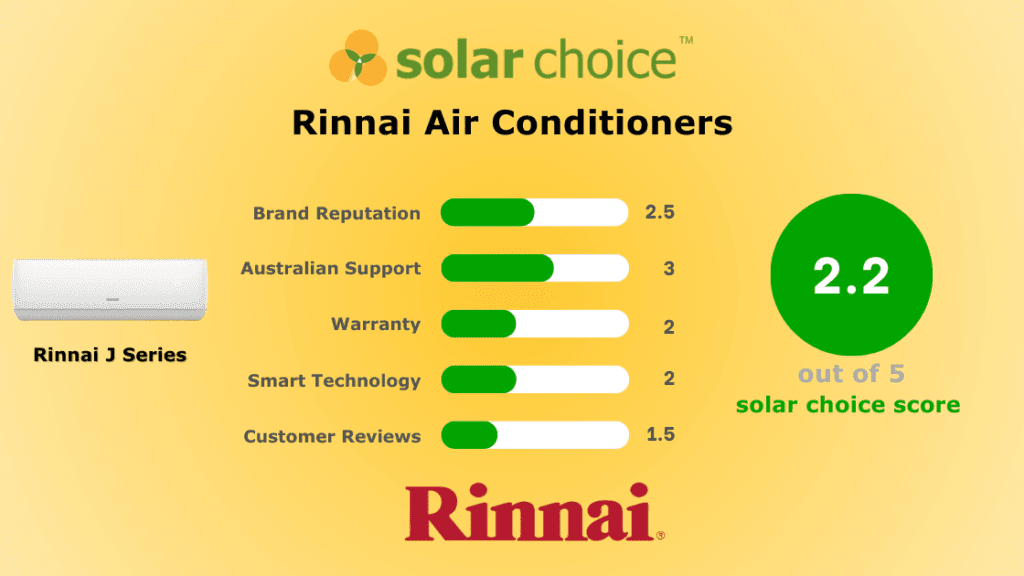
At a Glance: Rinnai Air Conditioners – Score: 2.2 out of 5
We have assessed and scored Rinnai Air Conditioners based on Solar Choice’s Air Conditioner Scorecard which is applied consistently across all brands on the market.
Brand Reputation & Reliability (2.5 / 5): Rinnai is a well-known Australian brand for hot water and gas appliances, but its split-system air conditioners have a shorter and less proven track record compared to leading HVAC specialists.
Australian Presence & Support Infrastructure (3 / 5): Rinnai Australia operates nationally with local offices and customer support, though air conditioning service capability is more limited than brands dedicated solely to HVAC.
Warranty Strength & Transparency (2 / 5): Warranty coverage is serviceable but generally shorter and less comprehensive than higher-tier competitors, with exclusions and owner responsibilities that require careful attention.
Innovation & Smart Technology (2 / 5): Wi-Fi control, basic smart features, and demand response capability are included, but innovation remains entry-level relative to market leaders.
Customer Satisfaction & Review Consistency (1.5 / 5): Feedback on independent review platforms suggests mixed satisfaction, with price being the main positive and performance consistency and longevity more variable.
Rinnai air conditioners are positioned as low-cost split systems aimed primarily at budget-conscious buyers and installers seeking fast, economical installations rather than long-term performance optimisation.
Overview of Rinnai – Company Background
Rinnai Australia is a long-established supplier of gas hot water systems, heaters, and home comfort appliances, operating in Australia for over 50 years. In air conditioning, however, Rinnai is not regarded as a specialist HVAC manufacturer in the same league as brands whose core business is climate control.
Rinnai’s split-system air conditioners are generally manufactured to meet competitive price points and are commonly selected for projects where upfront cost and installation speed are prioritised. Industry feedback from installers indicates that Rinnai systems are often used in quick-turnover residential installs, rental properties, and budget-driven projects rather than premium owner-occupied homes seeking long-term efficiency or quiet performance.
Rinnai Air Conditioner Range, Efficiency and Performance
Rinnai’s current Australian split-system range focuses on entry- to mid-tier reverse-cycle systems, with limited differentiation between series beyond capacity range, finish, and minor feature upgrades. Most models use R32 refrigerant, include Wi-Fi control, and meet minimum Australian efficiency standards, but generally do not exceed category averages.
CJ1 Series (Cooling-Only Split System)
The CJ1 Series is designed specifically for cooling-only applications, targeting hot and humid northern climates where heating is not required. It prioritises simplicity, lower upfront cost, and rapid installation.
| Model | Power Capacity | Efficiency Star Rating* | Indoor Noise (dB) | How It Compares |
|---|---|---|---|---|
| CJ1 2.6 kW | 2.6 kW Cool – | 9.0 Stars Cool – | 22 dB | Strong cooling efficiency for its size, but limited to cooling-only use and fewer comfort features than reverse-cycle peers. |
| CJ1 5.2 kW | 5.2 kW Cool – | 4.5 Stars Cool – | 29 dB | Typical efficiency and noise levels for a mid-size cooling-only unit; positioned primarily on price. |
* Star ratings from the Australian Government Energy Rating Register and show efficiency under test conditions — higher stars mean lower running costs.
T Series (Reverse-Cycle Inverter Split System)
The T Series is Rinnai’s main reverse-cycle offering, covering small to large room sizes with both heating and cooling. It includes Wi-Fi, voice control compatibility, and basic air filtration.
| Model | Power Capacity | Efficiency Star Rating* | Indoor Noise (dB) | How It Compares |
|---|---|---|---|---|
| T Series 2.5 kW | 2.6 kW Cool 2.9 kW Heat | 9.0 Stars Cool 3.5 Stars Heat | 22 dB | Efficient cooling but below-average heating efficiency compared to premium reverse-cycle systems. |
| T Series 7.0 kW | 7.0 kW Cool 8.2 kW Heat | 4.0 Stars Cool 3.5 Stars Heat | 36 dB | Performance and noise levels are typical for budget large-room systems, without standout efficiency advantages. |
* Star ratings from the Australian Government Energy Rating Register and show efficiency under test conditions — higher stars mean lower running costs.
PB Series (Reverse-Cycle Inverter Split System)
The PB Series adds minor durability upgrades such as GoldGuard coil coating, making it more suitable for coastal installations, while maintaining Rinnai’s value-oriented positioning.
| Model | Power Capacity | Efficiency Star Rating* | Indoor Noise (dB) | How It Compares |
|---|---|---|---|---|
| PB 3.5 kW | 3.5 kW Cool 3.8 kW Heat | 5.0 Stars Cool 4.5 Stars Heat | 24 dB | Reasonable all-round efficiency but still behind market leaders in quiet operation and seasonal performance. |
| PB 7.0 kW | 7.1 kW Cool 7.8 kW Heat | 3.5 Stars Cool 3.0 Stars Heat | 29.5 dB | Competitive pricing for larger spaces, but efficiency and noise sit at the lower end of the category. |
* Star ratings from the Australian Government Energy Rating Register and show efficiency under test conditions — higher stars mean lower running costs.
How Much Does a Rinnai Air Conditioner Cost?
Installed pricing for Rinnai split systems generally sits below the Australian market average, making them attractive for cost-sensitive households.
Typical installed price ranges:
- Small rooms (2–3.5 kW): $1,300 – $1,800
- Medium rooms (5–6 kW): $1,800 – $2,400
- Large rooms (7–8 kW): $2,300 – $3,000
These prices usually assume a straightforward back-to-back installation and standard electrical works.
This excludes rebates you may be eligible for through state schemes like the NSW Energy Savings Scheme, VIC Energy Upgrade Discount and the SA REPS Scheme.
Compare quotes from local, reputable Air Con installers
Rinnai Warranty for Australian Customers
Product Warranty
Rinnai split-system air conditioners sold in Australia typically come with a 5-year parts and labour warranty when installed by a licensed technician and registered in accordance with Rinnai’s requirements. This warranty length aligns with the minimum expected standard in the Australian air conditioning market but does not exceed it.
The warranty covers manufacturing defects in parts and workmanship under normal domestic use. Major components such as compressors are included within the standard warranty period, rather than receiving extended coverage as seen with some premium brands.
Claims and Exclusions
Exclusions apply for damage caused by incorrect installation, inadequate maintenance, power supply issues, environmental factors (such as corrosion in unprotected coastal installations), or use outside specified operating conditions. Like most manufacturers, Rinnai excludes faults caused by installation shortcuts — a relevant consideration given the brand’s frequent use in low-cost, fast installations.
Consumer Takeaway
While Rinnai’s warranty meets Australian Consumer Law obligations, it is not a standout offering. Compared to leading HVAC brands offering longer compressor warranties, clearer service pathways, or stronger performance guarantees, Rinnai’s warranty is best described as adequate but basic.
Pros and Cons of Rinnai Air Conditioners
Pros
- Lower upfront purchase and installation cost
- Established Australian brand with local support
- Wi-Fi and basic smart features included across most models
Cons
- Efficiency and noise performance typically below premium competitors
- Shorter and less differentiated warranty coverage
- Often selected for speed and cost rather than long-term performance
- Limited innovation compared to specialist air conditioning brands
Conclusion: Our Verdict on Rinnai Air Conditioners
Rinnai air conditioners are best viewed as budget-focused systems designed to meet minimum performance and efficiency expectations at a competitive price. They suit rental properties, short-term ownership scenarios, or homeowners where upfront cost is the primary driver.
For households seeking long-term efficiency, quieter operation, stronger heating performance, and premium warranty backing, higher-tier air conditioning brands typically represent better overall value — even at a higher initial price.
For official energy ratings and system-sizing advice, visit the Australian Government Energy Rating Register and Your Home Guide.
Compare quotes from local, reputable Air Con installers

- Smart Lifestyle Australia Air Conditioner Review - 5 February, 2026
- Bonaire Air Conditioner Review - 19 December, 2025
- Carrier Air Conditioner Review - 19 December, 2025
Reviews from Australians who have installed Rinnai Air Conditioners
Yes very happy, the given review by Solar Choice is garbage. Tested the unit over 3 days and the efficiency is outstanding. Unit very silent, both indoor and outdoor.
Happy with the way the unit was installed. No fuss and working as it should.
It doesn't work when outside temperature is below 5 degrees.
Review left 9 years after system installed
Power level of each indoor unit can be ramped down to provide maximum efficiency and minimum running costs. Another 3 indoor units along with the existing 3 units can be added at a future date.



