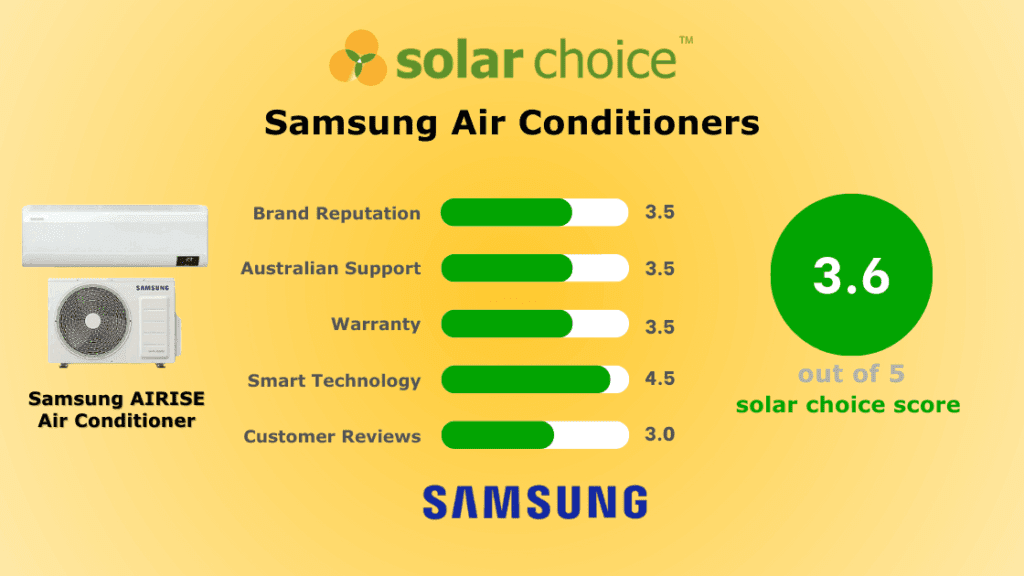
At a Glance: Samsung Air Conditions score 3.6 out of 5
Samsung scores 3.6 out of 5 on the Solar Choice Air Conditioner Brand Scorecard. The company is well known for consumer electronics and has built a solid presence in Australia’s air-conditioning market over the last decade, delivering well-featured systems with strong smart-home integration.
- Brand Reputation & Reliability 3.5 / 5 – Samsung has been selling air conditioners in Australia for well over a decade and is a globally recognised electronics brand.
- Australian Presence & Support Infrastructure 3.5 / 5 -Samsung has a well-established Australian office, local phone support and an online service network. On the downside, air-conditioning is a small part of Samsung’s overall business, so support can feel more “appliance-style” than HVAC-specialist in some cases.
- Warranty Strength & Transparency 3.5 / 5 -All residential Samsung Air Conditionerscome with a 5-year parts and labour warranty, which matches the Australian industry standard. The digital inverter compressor is extended to 10-years on some models with years 6 to 10 being parts only. The after sales support for Samsung isn’t reported to be as strong as for Air Con specialist brands like Daikin and Mitsubishi.
- Innovation & Smart Technology 4.5 / 5 – This is Samsung’s biggest strength. The AIRISE, GEO and AERO ranges all feature WindFree™ comfort cooling, AI Auto modes, in-built Wi-Fi with SmartThings app control, and advanced filtration (Tri-Care / Quad-Care PM2.5 filters) on key models. Features like AI Energy Mode, geo-fencing and voice-assistant integration are ahead of many similarly priced rivals.
- Customer Satisfaction & Review Consistency 3.0 / 5 – On independent review platforms and retailer websites, recent Samsung split systems typically score between 4.0 and 4.5 out of 5, but there are also reports of occasional faults, Wi-Fi quirks and service delays. Overall sentiment is positive but more variable than the best-performing brands.
Overall, Samsung suits buyers who value smart features and comfort-focused airflow.
Important note: Solar Choice is not affiliated with Samsung or any other manufacturer and provides independent, unbiased reviews for consumers in Australia.
Company Background & Australian Presence
Samsung is a South Korean global technology company founded in 1938 and best known for smartphones, TVs, appliances and home electronics. Air conditioning represents one of its established but smaller divisions. Samsung entered the Australian air-conditioning market more than a decade ago, focusing on inverter split systems, ducted systems and later its WindFree™ range.
In Australia, Samsung Electronics Australia Pty Ltd manages distribution, spare parts and customer support. Units are sold through major retailers, specialist HVAC installers and electrical wholesalers. Support is provided through Samsung’s national call centre, authorised technicians and online service booking system. Spare-parts availability is generally good for current-generation models, although some installers note that service processes can feel more “appliance-style” compared with specialist HVAC brands.
Installer sentiment towards Samsung is positive on features and ease of use, while long-term product reliability perceptions remain slightly behind leading Japanese competitors. Nevertheless, the brand’s strong SmartThings ecosystem that allows you to control your appliance from your phone and accessible retail distribution make Samsung a frequent choice for tech-focused households.
Air Conditioner Range, Efficiency & Performance
Samsung’s air conditioner series mainly differ in airflow, filtration, design and smart features. WindFree™ cooling spreads air gently without a cold draft, while higher-end models add AI Mode, which adjusts settings automatically for comfort and efficiency. Filtration also improves as you move up the range, and premium units have sleeker front panel designs.
GEO and AI Smart GEO target users prioritising air quality and purification; AERO focuses on AI-driven energy optimisation at a mid-market price point, while AIRISE WindFree™ is a widely distributed flagship range suited to most homes.
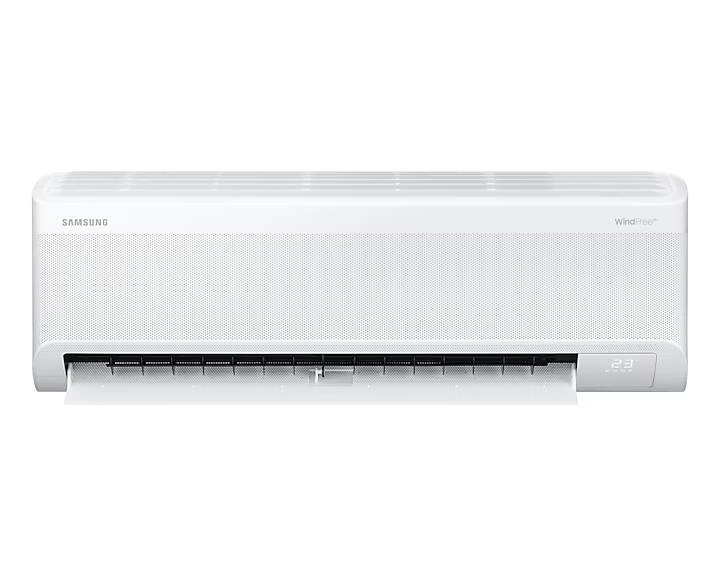
GEO WindFree Purification (DXEA series)
Designed for users who want premium air purification and Samsung’s WindFree™ comfort airflow.
| Model | Power Capacity | Efficiency Star Rating* | Indoor Noise (dB) | How It Compares |
|---|---|---|---|---|
| AI Smart GEO WindFree™ 2.5 kW (AR09DXEAN) |
2.5 kW Cool 3.2 kW Heat |
4.5 Stars Cool 3 Stars Heat |
17–38 dB(A) | Strong small-room efficiency, extremely quiet on low fan, and competitive with premium mid-range Japanese units. |
| AI Smart GEO WindFree™ 3.5 kW (AR12DXEAN) |
3.5 kW Cool 4.0 kW Heat |
4.5 Stars Cool 3 Stars Heat |
17–40 dB(A) | Above-average cooling performance for mid-sized bedrooms and offices, with quieter operation than many value brands. |
| AI Smart GEO WindFree™ 5.0 kW (AR18DXEAN) |
5.0 kW Cool 6.0 kW Heat |
4.5 Stars Cool 3 Stars Heat |
25–41 dB(A) | Reliable mid-size system with strong airflow; efficiency remains respectable though heating stars are typical for this class. |
| AI Smart GEO WindFree™ 6.8 kW (AR24DXEAN) |
6.8 kW Cool 7.2 kW Heat |
4.5 Stars Cool 3 Stars Heat |
26–45 dB(A) | Suitable for larger living areas; efficiency holds up well for its size, though noise increases at higher fan speeds. |
*Star ratings sourced from the Australian Government Energy Rating Register and show efficiency under test conditions — higher stars mean lower running costs. Learn more about heating and cooling energy ratings here.
How it compares to peers:
A strong performer in the 2.5kW category, especially for households wanting purification and low-draft airflow. Heating efficiency is typical for this size.
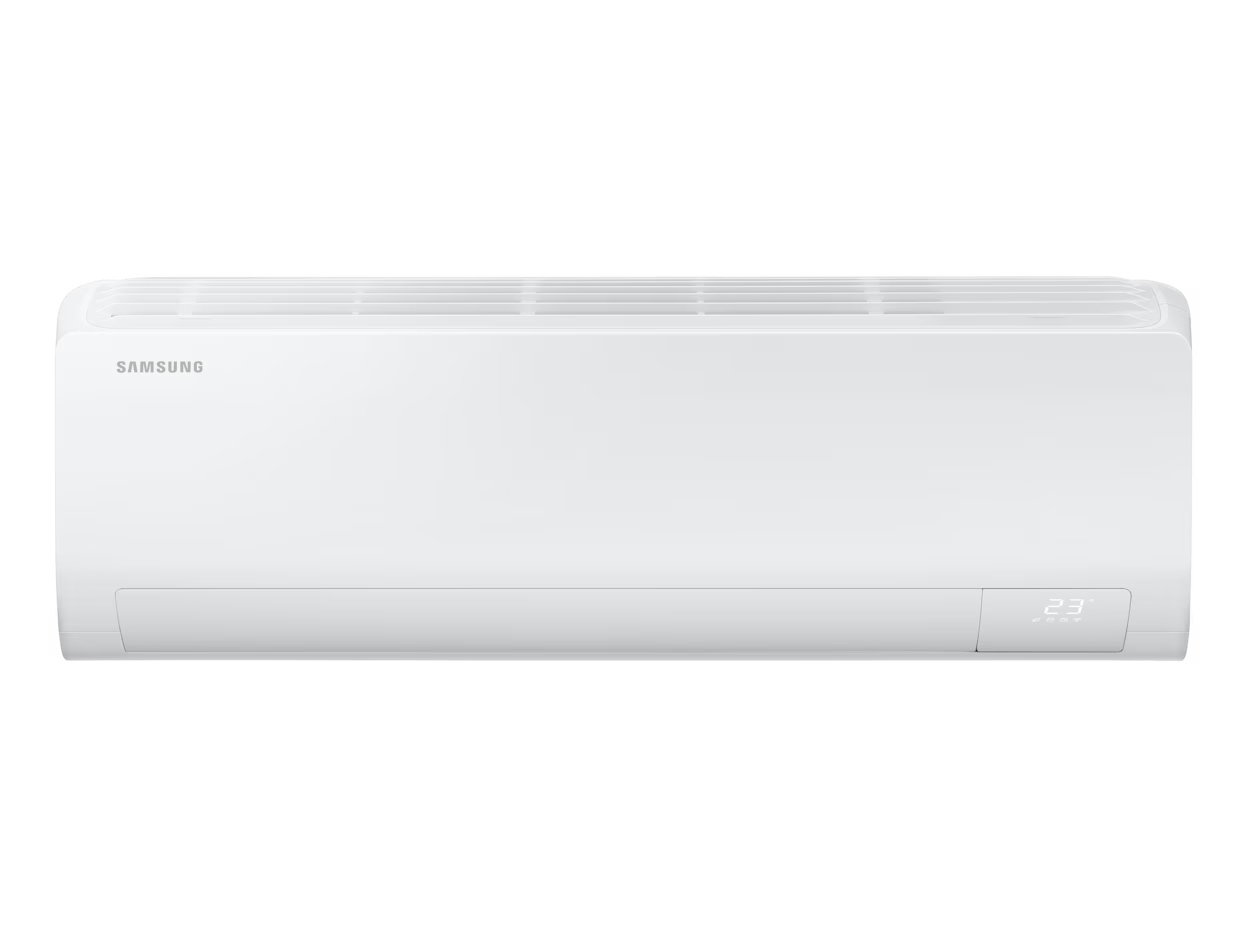
AI Smart AERO (DXFZ series)
Focused on AI-driven efficiency and a streamlined fascia for buyers wanting smart features at a mid-range price.
| Model | Power Capacity | Efficiency Star Rating* | Indoor Noise (dB) | How It Compares |
|---|---|---|---|---|
| AI Smart AERO 2.5 kW (AR09DXFZ) |
2.5 kW Cool 3.2 kW Heat |
N/A Stars Cool N/A Stars Heat |
17–38 dB(A) | Compact and quiet unit suited to small bedrooms; mid-range efficiency typical for this class. |
| AI Smart AERO 3.5 kW (AR12DXFZ) |
3.5 kW Cool 4.0 kW Heat |
N/A Stars Cool N/A Stars Heat |
17-10 dB(A) | Good match for larger bedrooms or small living rooms; efficiency data not provided by Samsung AU. |
| AI Smart AERO 5.0 kW (AR18DXFZ) |
5.0 kW Cool 6.0 kW Heat |
N/A Stars Cool N/A Stars Heat |
25–41 dB(A) | Capable performer for medium living areas; noise increases at higher fan speeds. |
| AI Smart AERO 6.8 kW (AR24DXFZ) |
6.8 kW Cool 7.2 kW Heat |
N/A Stars Cool N/A Stars Heat |
26–45 dB(A) | High-capacity AERO model suited to large spaces; lacks published star-rating data. |
| AI Smart AERO 8.0 kW (AR30DXFZ) |
8.0 kW Cool 8.5 kW Heat |
N/A Stars Cool N/A Stars Heat |
30-47 dB(A) | Largest AERO model; adequate cooling power but missing efficiency details on Samsung AU pages. |
*Star ratings sourced from the Australian Government Energy Rating Register and show efficiency under test conditions — higher stars mean lower running costs. Learn more about heating and cooling energy ratings here.
How it compares to peers:
Strong cooling efficiency and smart features at a mid-market price point; slightly behind premium Japanese brands in heating performance.
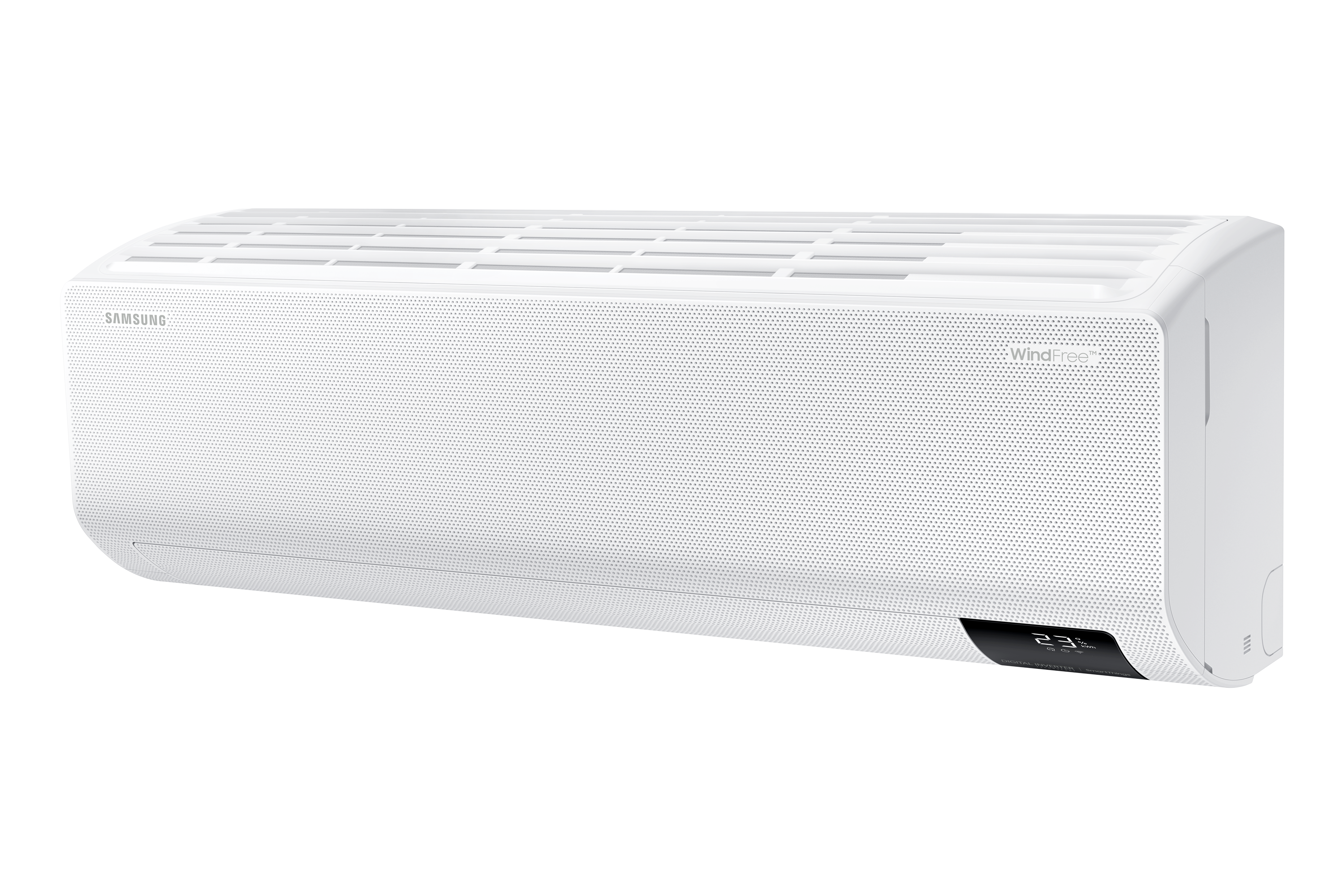
AIRISE WindFree (BXEC series)
A widely available AIRISE range offering balanced efficiency, quiet operation and SmartThings integration.
| Model | Power Capacity | Efficiency Star Rating* | Indoor Noise (dB) | How It Compares |
|---|---|---|---|---|
| AI Smart AIRISE WindFree™ 2.5 kW (AR09BXEC) |
2.5 kW Cool 3.2 kW Heat |
N/A Stars Cool N/A Stars Heat |
17–38 dB(A) | Compact WindFree™ model ideal for bedrooms; quiet, with missing efficiency data on Samsung AU. |
| AI Smart AIRISE WindFree™ 3.5 kW (AR12BXEC) |
3.5 kW Cool 4.0 kW Heat |
N/A Stars Cool N/A Stars Heat |
17-40 dB(A) | Suitable for larger bedrooms; WindFree™ airflow, but efficiency specs not published. |
| AI Smart AIRISE WindFree™ 5.0 kW (AR18BXEC) |
5.0 kW Cool 6.0 kW Heat |
N/A Stars Cool N/A Stars Heat |
25-41 dB(A) | Good fit for medium living areas; lacks star-rating and full noise disclosure. |
| AI Smart AIRISE WindFree™ 7.0 kW (AR24BXEC) |
7.0 kW Cool 7.5 kW Heat |
N/A Stars Cool N/A Stars Heat |
26-45 dB(A) | Large-room WindFree™ option; essentials listed but efficiency data missing. |
| AI Smart AIRISE WindFree™ 8.0 kW (AR30BXEC) |
8.0 kW Cool 8.5 kW Heat |
N/A Stars Cool N/A Stars Heat |
30-47 dB(A) | Highest-capacity AIRISE model; strong airflow but Samsung AU provides no star-rating details. |
*Star ratings sourced from the Australian Government Energy Rating Register and show efficiency under test conditions — higher stars mean lower running costs. Learn more about heating and cooling energy ratings here.
How it compares to peers:
A strong all-rounder for bedrooms and small living spaces, offering more features than most mid-range systems.
How Much Do Samsung Air Conditioners Cost?
Samsung’s pricing varies between retailers but typically positions the brand in the mid-range to upper-mid-range category. For the 2.5kW models reviewed, retail supply-only prices generally fall between $900 and $1,200, while larger 5–7kW units commonly range from $1,400 to $2,200 depending on series and stock availability. Installed pricing varies by home layout, cabling distance, switchboard condition, and the difficulty of outdoor-unit placement, but most households can expect $2,200–$3,200 installed for a 2.5kW bedroom unit and $3,000–$4,500 installed for a 5kW living-area unit.
This excludes rebates you might be available for through state schemes like the NSW Energy Savings Scheme, VIC Energy Upgrade discount and SA Reps Scheme.
Compare quotes from local, reputable Air Con installers
Samsung’s Warranty Offer for Australian Customers
Samsung provides a 5-year parts and labour warranty on residential air-conditioning systems sold in Australia. This aligns with the industry standard for major brands. The enclosed Samsung AU warranty document confirms coverage for defects in materials and workmanship, including indoor and outdoor unit electronics, the compressor and major components.
Samsung also includes a 10-year limited warranty on the Digital Inverter compressor, with the first five years covering parts and labour and the remaining five years covering compressor parts only. Labour, gas and associated repair costs are excluded after year five, which is common for extended compressor warranties in the appliance sector. It is important to remember that parts are often only a small proportion of the cost of repairs, so in our opinion this extension is more of a marketing strategy rather than a real addition of value for customers.
Claims & Exclusions
Claims require proof of purchase and correct installation by a licensed technician. The warranty does not cover damage caused by incorrect installation, misuse, power surges, external corrosion, or lack of routine maintenance. Consumables such as filters are not included.
Australian Support Process
Customers can initiate a claim through Samsung’s Australian call centre, online service portal, or through the original retailer or installer. Authorised service agents perform the actual repair work, with response times varying by region.
Consumer Takeaway
Samsung’s warranty offer is average for the Australian market: solid coverage for the first five years with a standard extended compressor term.
Pros and Cons of Samsung Air Conditioners
| Pros | Cons |
|---|---|
| ✓ Strong smart-home integration via SmartThings | ✗ Heating efficiency is typical rather than high-end |
| ✓ WindFree™ modes provide low-draft comfort | ✗ Installer sentiment not as strong as specialist brands |
| ✓ Above-average cooling efficiency in 2.5kW models | ✗ Extended compressor warranty excludes labour after year 5 |
| ✓ Quiet indoor operation suitable for bedrooms | ✗ App and Wi-Fi setup can be inconsistent |
| ✓ Good retail availability and pricing | ✗ Multi-split and ducted ecosystems less mature than competitors |
Our Conclusion on Samsung Air Conditioning Range
The clear advantages of Samsung’s Air Conditioner range are the innovative smart functions and the fact that your dealing with a long standing electronics brand.
It is also important to acknowledge that air con is only a smaller piece of the puzzle for Samsung who have a broad array of electronic products. The evidence suggests you would get better technical support and warranty service from dedicated air conditioning brands.
Overall Samsung looks to be a reasonable, well-priced solution for Australian customers.
For official star ratings and efficiency comparisons, see the Energy Rating Register or the Your Home Guide.
Compare quotes from local, reputable Air Con installers

- EV Charging Backbone at Surry Hills Apartment Building - 30 March, 2026
- The Top 5 Problems With Cheap Air Conditioning Quotes - 12 January, 2026
- Running Cost of Air Conditioners – Explained - 7 October, 2025



