Solar Choice is not affiliated with Westinghouse or any other manufacturer and aims to provide an independent, unbiased review for Australian consumers.
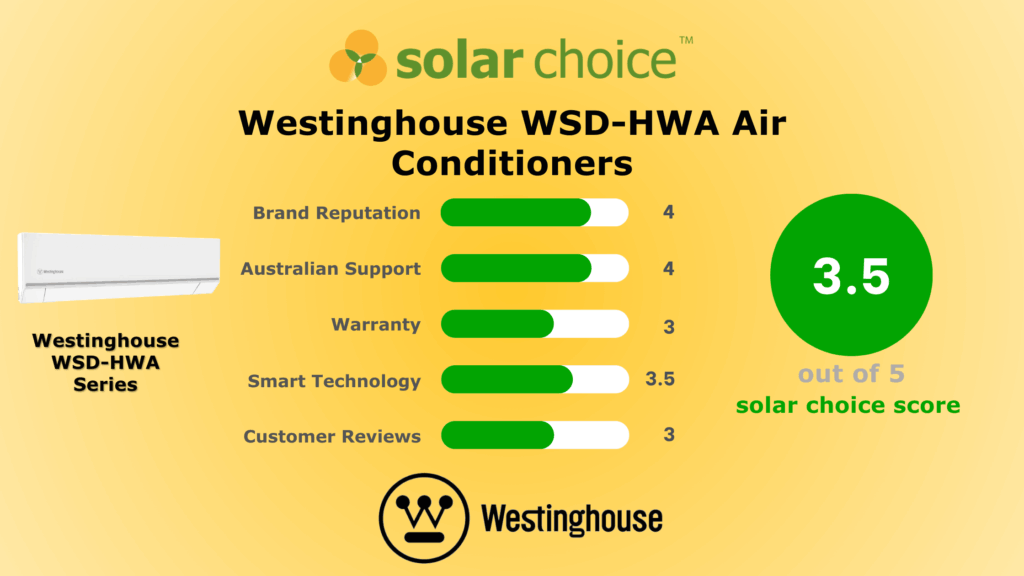
At a Glance: Westinghouse WSD-HWA Split Systems — Score 3.5 out of 5
Westinghouse scores 3.5 out of 5 on the Solar Choice Air Conditioner Brand Scorecard. Westinghouse offers a limited range of entry-level split systems designed for general household use, with straightforward features and relatively higher efficiency in the smaller models.
Brand Reputation & Reliability – 4 / 5
Westinghouse has operated in Australia for over 80 years and is known for dependable, domestic-grade appliances, including its split-system air conditioners.
Australian Presence & Support Infrastructure – 4 / 5
Westinghouse products are widely distributed through major Australian retailers and supported by national service agents, with spare parts available locally.
Warranty Strength & Transparency – 3 / 5
A 5-year parts and labour warranty applies across the WSD-HWA split-system range. Warranty terms are clearly published and align with Australian mid-market standards, but do not extend beyond the baseline coverage offered by many competitors
Innovation & Technology – 3.5 / 5
Wi-Fi control, 3D airflow, “Follow Me” temperature sensing and multi-stage air filtration are included, though the systems don’t extend into advanced smart-home or premium comfort features.
Customer Satisfaction & Review Consistency – 3 / 5
Consumer feedback is limited but generally positive for smaller models due to high efficiency. Performance consistency depends on installation quality.
Overall:
The WSD-HWA range includes a range of mid-priced split systems designed to provide reliable heating and cooling. Smaller models are generally more energy-efficient, while features and performance differ depending on size. The range is best suited to households looking for straightforward, everyday temperature control rather than premium design or advanced features.
Table of contents
Company Background
Westinghouse is an established global brand with more than a century of consumer-electronics history. In Australia, the company supplies appliances through major retailers and online platforms. The air-conditioning range is compact compared to specialist HVAC manufacturers, but Westinghouse focuses on offering competitively priced systems with essential functionality, positioned more as a general household appliance than a specialist HVAC solution.
For households comparing across brands, Westinghouse sits alongside other entry-level to mid-range domestic air-conditioning labels, offering functional performance without the complexity or additional cost of premium models.
Air Conditioner Range, Efficiency & Performance
Westinghouse’s residential split-system air conditioner range spans multiple series and capacities, covering small bedrooms through to large living areas. The lineup is designed to suit typical Australian homes with a focus on practical, everyday cooling and heating.
Across the range, models use inverter technology for stable temperature control and R32 refrigerant for improved efficiency and lower environmental impact. Features such as multi-stage air filtration and Wi-Fi control are included on many models.
Westinghouse WSD-HWA Series — Comparison Table
The Westinghouse WSD-HWA series is a reverse-cycle split-system range designed for everyday residential cooling and heating, with inverter technology and app-based control
| Capacity | Cooling / Heating | Efficiency | Indoor Noise | How it compares |
| 2.7 kW | 2.7kW / 3.5kW | 7 Stars Cool / 3.5 Stars Heat | 30–38 dBA | Highly efficient bedroom unit; quiet, cost-effective and suitable for small rooms. |
| 3.6 kW | 3.6kW / 4.4kW | 6 Stars Cool / 3.5 Stars Heat | 32–39 dBA | Suitable for mid-sized bedrooms or studies; balanced efficiency and airflow. |
| 5.1 kW | 5.1kW / 6.1kW | 4.5 Stars Cool / 4 Stars Heat | 37 – 45 dBA | Fits small–medium living rooms; efficiency drops compared with smaller units. |
| 7.3 kW | 7.3kW / 8.3kW | 4 Stars Cool / 3.5 Stars Heat | 41 – 49 dBA | Suitable for larger living spaces; standard mid-range performance. |
| 9.1 kW | 9.1kW / 10.4kW | 4.5 Stars Cool / 3 Stars Heat | 40-46 dBA | Large-area unit prioritising raw capacity over efficiency and sound levels. |
Westinghouse WSD-HWA-I Series — Comparison Table
The Westinghouse WSD-HWA-I Series is a reverse-cycle split-system range designed for everyday residential cooling and heating, with inverter technology, app control and solid efficiency in smaller sizes
| Model | Cooling / Heating Capacity | Efficiency Star Rating (Average Climate) | Indoor Noise | How It Compares |
|---|---|---|---|---|
| WSD27HWA-I | 2.7 kW / 3.5 kW | 6.0 Stars Cool / 3.0 Stars Heat | 30 – 38 dB | Very efficient for its size and well suited to small bedrooms or studies. |
| WSD36HWA-I | 3.6 kW / 4.4 kW | 5.5 Stars Cool / 3.0 Stars Heat | 32 – 59 dB | Balanced option for medium bedrooms, with strong cooling efficiency and low noise. |
| WSD51HWA-I | 5.1 kW / 6.1 kW | 4.0 Stars Cool / 3.0 Stars Heat | 37 – 45 dB | Suitable for small to medium living areas; efficiency and noise are typical for this capacity. |
How Much Do Westinghouse Split Systems Cost?
Westinghouse units are positioned in the mid-range of the residential air-conditioning market. Standard unit-only retail prices sit below many premium HVAC brands, while remaining higher than entry-level systems. Typical unit-only pricing is outlined below.
Estimated installed pricing (unit + standard installation):
- 2.7 kW: ~$2,400–$3,000
- 3.6 kW: ~$3,100–$3,400
- 5.1 kW: ~$3,600–$4,600
- 7.3 kW: ~$4,000–$5,000
- 9.1 kW: ~$4,500–$5,500
This excludes rebates you may be eligible for through state schemes like the NSW Energy Savings Scheme, VIC Energy Upgrade Discount and the SA RePS Scheme.
Installation cost varies depending on pipe length, wall structure, switchboard condition, and outdoor-unit placement.
Compare quotes from local, reputable Air Con installers
Westinghouse Warranty (Australia)
Product Warranty
Westinghouse provides a 5-year parts and labour warranty on its split-system air conditioners for residential use in Australia. This level of coverage is typical for appliance-focused brands but shorter than warranties offered by some specialist HVAC manufacturers.
What’s Covered
The warranty covers manufacturing defects in materials or workmanship during normal domestic use. Where a valid fault is confirmed, Westinghouse may repair or replace the affected component, or in some cases the entire unit, using an authorised service technician.
Claims and Exclusions
The warranty does not cover faults caused by incorrect or unlicensed installation, misuse, accidental damage, lack of maintenance, corrosion, electrical disturbances, pest damage or cosmetic damage. Use in commercial environments may also void coverage unless approved.
Owner Responsibilities
To remain eligible, the system must be installed by a licensed technician, correctly sized for the space, and maintained according to the user manual. Regular filter cleaning and proof of purchase are required for warranty claims.
Summary
Westinghouse offers a standard 5-year warranty appropriate for an entry-level appliance brand. The coverage outlines clear responsibilities for customers regarding installation and maintenance. However, the duration is shorter compared with specialist HVAC brands that provide extended system or compressor warranties. As with most air-conditioning warranties, long-term reliability will depend significantly on installation quality and routine upkeep.
For a more indepth look, refer to Westinghouse’s warranty guide.
Pros & Cons
| Pros | Cons |
|---|---|
| Strong energy efficiency in smaller models | Efficiency and noise performance are more average in larger sizes |
| Built-in Wi-Fi and practical comfort features included | Feature set does not extend into premium or advanced smart-home functions |
| Widely available with competitive mid-range pricing | Limited range depth compared with specialist HVAC manufacturers |
Final Verdict
Westinghouse split-system air conditioners offer straightforward, mid-range heating and cooling for Australian homes, with solid efficiency in smaller models and wide retail availability. Features such as inverter operation, Wi-Fi control and multi-stage filtration support everyday comfort.
Performance in larger sizes is more typical for the category, and the range does not extend into premium or advanced smart-home features. Overall, Westinghouse split systems are best suited to households seeking reliable, appliance-style air conditioning rather than specialist HVAC performance.
Compare quotes from local, reputable Air Con installers

- Smart Lifestyle Australia Air Conditioner Review - 5 February, 2026
- Bonaire Air Conditioner Review - 19 December, 2025
- Carrier Air Conditioner Review - 19 December, 2025



