Solar Choice has no reason to promote Tesla in this Tesla Powerwall 3 review and our battery articles are independent written and unbiased.
Thinking about installing a Tesla Powerwall in 2026? Here’s what you need to know. The Tesla Powerwall 3 has quickly become one of the top home battery systems in Australia, building on the success of the Powerwall 2.
In this expert Tesla Powerwall review, we break down the Powerwall 3 and how it compares with the old Powerwall 2, current Australian prices, installation costs, rebates, updated specs, warranty coverage, and—most importantly—whether getting a Tesla battery is still worth it in 2026.
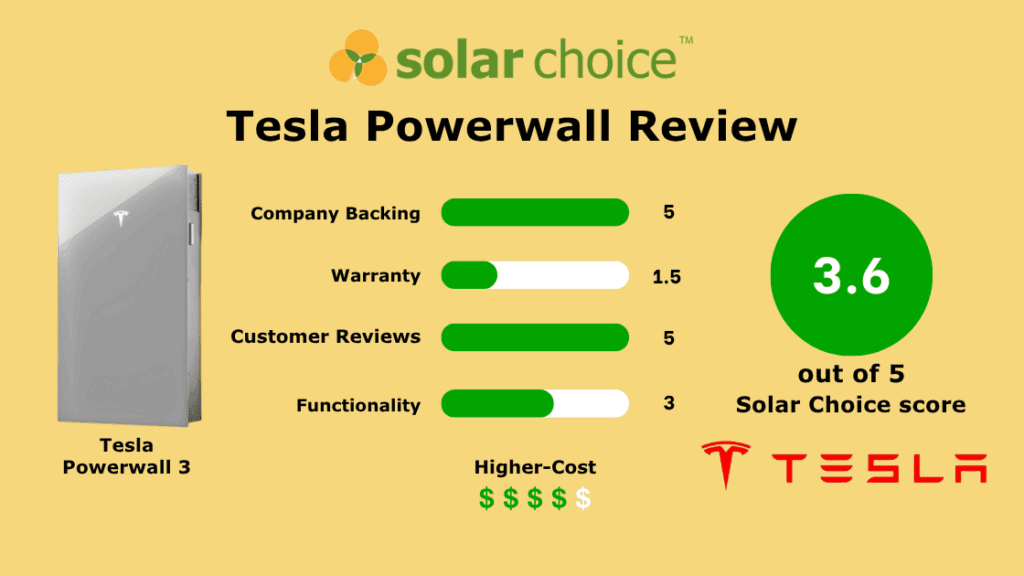
At a Glance: Tesla Powerwall 3 scores 3.6 out of 5
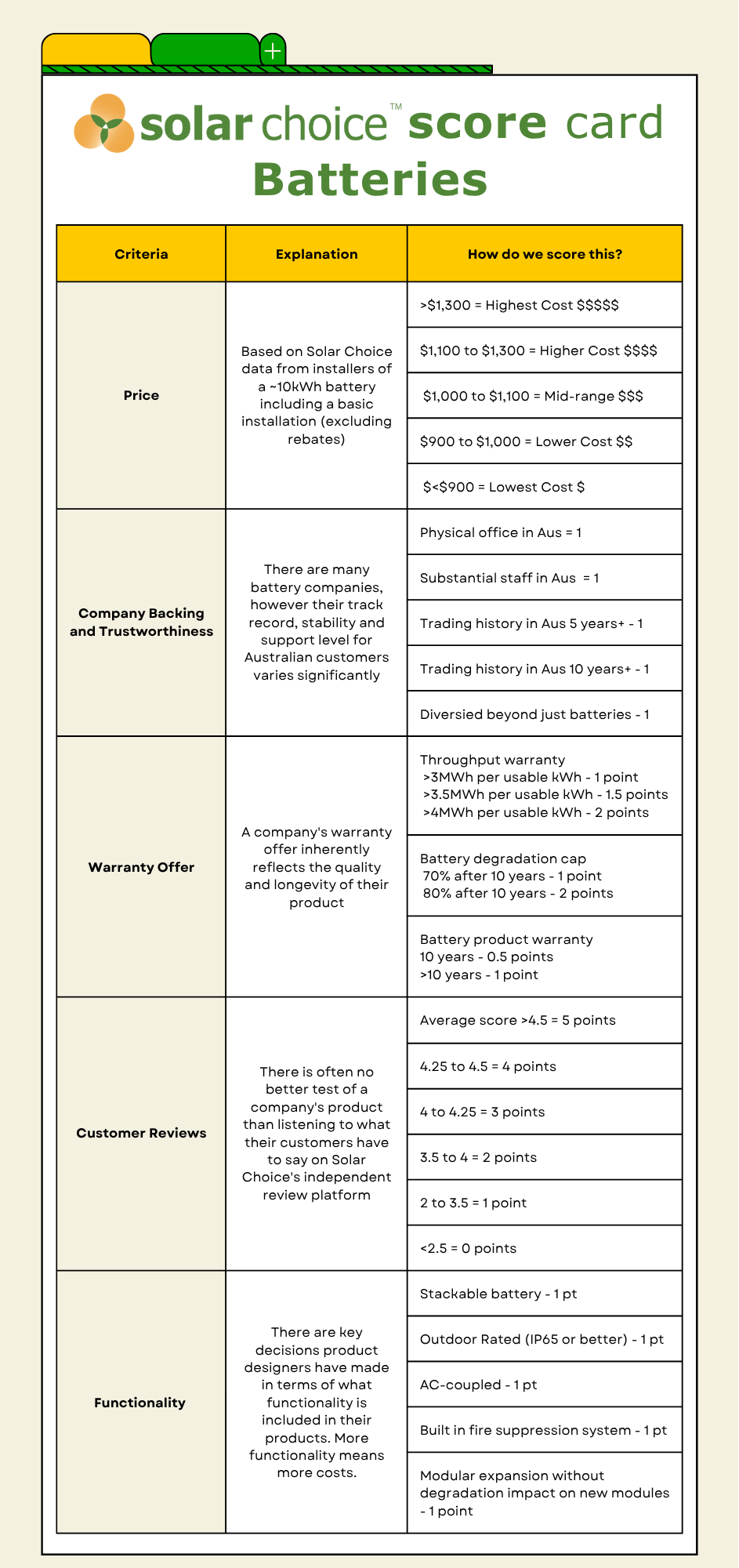
Scoring is based on our solar battery scorecard which is consistently applied to each brand and battery available on the Australian market.
$$$ Price: Based on data from Solar Choice’s network of solar installers, the average price for an installed Tesla battery is $1,129 per usable kWh. This places it in the higher-cost price range.
- Company Backing and Trustworthiness (5 out of 5): Tesla has been operating in the Australian market since 2015 and is backed by one of the world’s largest and most recognised energy companies. The company has more than 20 staff in Australia and a long-standing global presence, earning it a perfect score in this category.
- Warranty Offer (1.5 out of 5): Tesla offers a throughput warranty of 2.8MWh per usable kWh unless only used for basic functions. It also comes with a 10-year product warranty and a maximum degradation of 30%.
- Customer Reviews (5 out of 5): Tesla batteries have received outstanding feedback from verified customers, with an average score of 4.78 from 161 reviews on Solar Choice’s independent platform. This earns a perfect score under our customer review framework.
- Functionality (3 out of 5): Powerwall 3 is outdoor-rated and includes a built-in hybrid inverter, so it can work well in new solar + battery installs. It doesn’t have dedicated fire-suppression hardware, and it’s not modular. For capacity growth, it’s expandable: Tesla supports adding up to 4 Powerwall 3 units, and in some designs you can add Powerwall 3 Expansion units (up to 3 expansions, depending on configuration).
This score is based on Solar Choice’s battery scorecard methodology and reflects the Powerwall 3 hardware and warranty terms currently sold in Australia (including expansion options and current warranty limits).
Certain Powerwall 2 units were subject to an Australian recall in 2025. This does not indicate a problem with Powerwall 3, but homeowners should confirm product model and service support with their installer.
Overview and History of Tesla Powerwall
How Much Does The Tesla Powerwall Cost?
Tesla Powerwall 3 Price in Australia (2026)
A typical Powerwall 3 installation in Australia costs $15,813 installed, depending on switchboard upgrades, backup wiring and site complexity.
This installed price usually includes:
- The Tesla Backup Gateway
- Professional installation
- Delivery and required electrical components
On Tesla’s official website, the Powerwall 3 battery unit alone is listed at $13,250 (excluding installation and the gateway).
In Australia it’s common to see separate pricing for the battery and the Backup Gateway 2, with installation and switchboard work priced by the installer. Many Australian guides reference the Backup Gateway 2 at around $1,950 (incl. GST), and backup configuration.One size fits all: The Tesla Powerwall 3 comes in one size (13.5kWh) with a built in 10kW inverter which limits consumers ability to get the optimal battery size for their needs.
Tesla Powerwall 2 Price
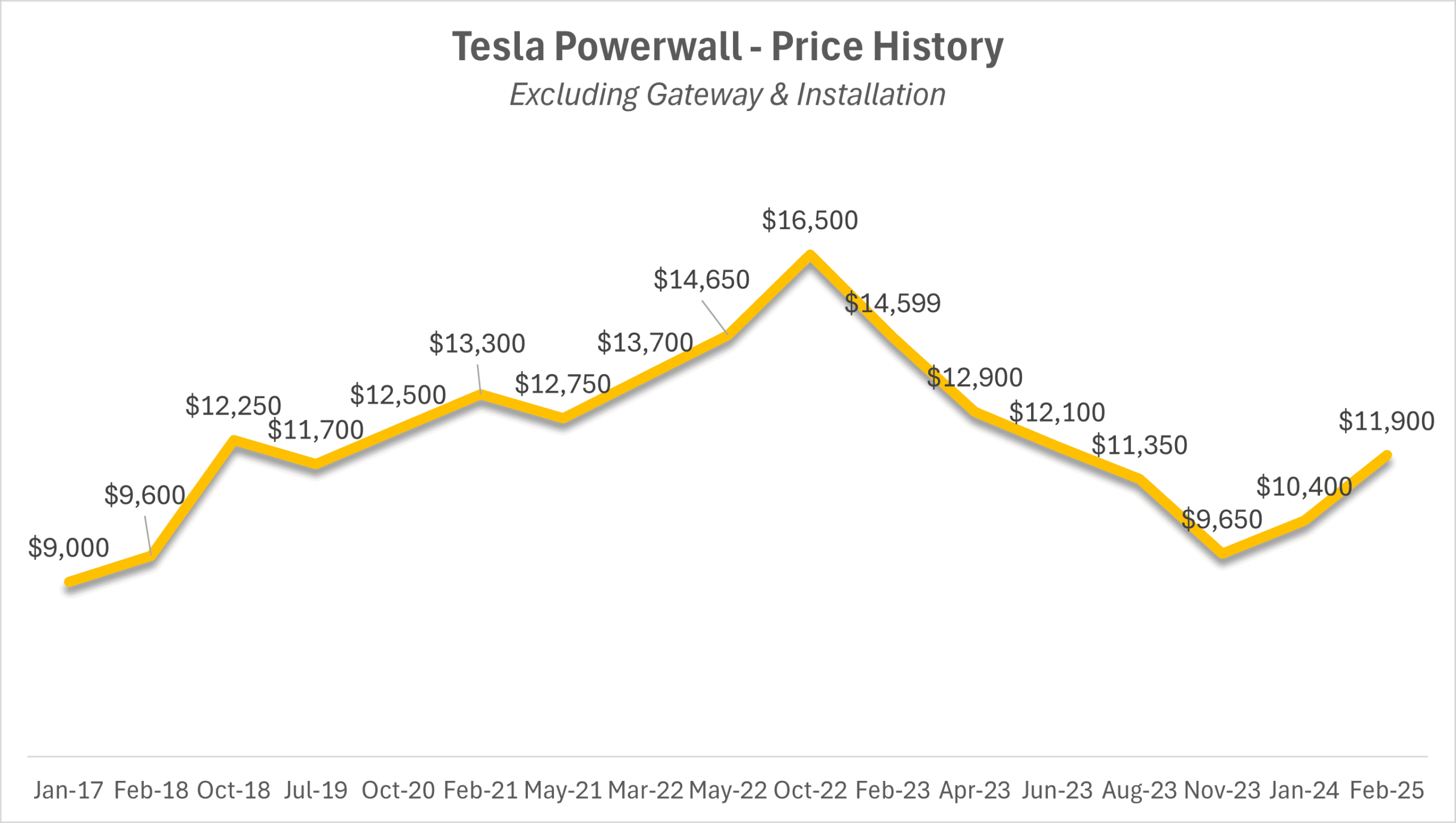
The fully installed Tesla Powerwall 2 typically cost between AUD $11,900 and $13,900. The price in started at just $9,000 in 2017, making it one of the most cost-effective batteries of its time. However, high demand and rising production costs pushed the wholesale cost up to $16,500 in 2022 before rebates reduced effective prices in 2023.
Tesla Battery Cost Per kWh
Based on installer pricing, the average installed cost of a Tesla Powerwall battery is $1,129 per usable kWh, which places it at the premium end of the residential battery market.
Tesla Powerwall Price Change History (excluding Gateway):
| Date | Wholesale Price | Change |
| 2017 | $9,000 | |
| 2018 – February | $9,600 | +$600 |
| 2018 – October | $12,250 | +$2,650 |
| 2019 – July | $11,700 | -$550 |
| 2020 – October | $12,500 | +$800 |
| 2021 – February | $13,300 | +$800 |
| 2021 – May | $12,750 | -$550 |
| 2022 – March | $13,700 | +950 |
| 2022 – May | $14,650 | +$950 |
| 2022 – October | $16,500 | +$1,850 |
| 2023 – February | $14,599 | -$1,901 |
| 2023 – April | $12,900 | -$1,699 |
| 2023 – June | $12,100 | -$800 |
| 2023 – August | $11,350 (after rebate) | -$750 |
| 2023 – November | $9,650 (after rebate) | -$1,700 |
| 2024 – January | $10,400 | +$750 |
| 2025 – February (PW3) | $11,900 | +$1,500 |
| 2026 – February | $13,250 | +$1,350 |
Tesla Powerwall 2 Discontinued? What It Means for Australian Homeowners
With the Tesla Powerwall 3 rollout, the Tesla Powerwall 2 has been discontinued in Australia.
For the most part the Powerwall 3 offers the same or better technical specifications to the Powerwall 2 including a larger built in PV inverter.
If you’re comparing options, see our guide to the Best Solar Batteries in Australia.
What if I already have a Powerwall 2?
If you already have a Powerwall 2: Tesla states you cannot add a Powerwall 3 to a Powerwall 2 system.
If you want more storage later, Powerwall 3 can scale — but it scales by adding more units, not by “topping up” the one battery you already have.
In Australia, Tesla supports systems with up to 4 Powerwall 3 batteries, and some designs can also add up to 3 Powerwall 3 Expansion units (so up to 7 units total, depending on the system layout)
So it seems that Tesla’s newer model is mainly focused on new solar and battery customers and was not designed with existing solar customers in mind.
The Chemistry of a Tesla Powerwall 3
Tesla Powerwall Backup Gateway
Compare solar and battery quotes from local installers now.
Tesla Powerwall 3 Pros & Cons
Pros
- Depth Of Discharge (DoD): Excellent specifications including 100% DoD.
- Retrofit Capability: Best for new solar + battery installs but retrofits are possible, but not always simple due to compatibility.
- High Power Output: The built in inverter can provide a continuous output of 11kW which can cover pretty much any combination of major household appliances.
Cons
- Expensive: One of the most expensive battery solutions on the market
- 3-phase homes: Each Powerwall 3 unit is single-phase, so backup is usually limited to selected circuits or one phase unless multiple units are installed.
- One size only: Powerwall 3 offers 13.5 kWh usable storage per unit. Continuous output is up to 11.04 kW per unit, but you cannot purchase a smaller capacity option.
Tesla Powerwall 3 Performance Specifications
| Specification | Tesla Powerwall 3 | Relevance to Homeowner |
|---|---|---|
| Usable Capacity | 13.5 kWh | Determines how much energy can be stored and used during non-solar hours. |
| Power Output (Continuous) | 11.04 kW | Indicates how many household appliances can be powered simultaneously. |
| Power Output (Peak) | Up to 11.04 kW per unit | Handles short bursts of high energy demand (e.g. motor start-up). |
| Built-in Inverter | Yes – 11 kW hybrid inverter | Simplifies installation and reduces cost by eliminating external inverter need. |
| Solar PV Input (DC Coupling) | Up to 20 kW (3 MPPTs) | Allows direct solar panel connection; ideal for new solar + battery installs. |
| AC Coupling Support | Yes – retrofit capable | Compatible with existing solar systems, preserving previous investments. |
| IP Rating | IP55 (enclosure), IP67 (battery/electronics) | Ensures safe, durable outdoor operation in all weather. |
| Battery Chemistry | Lithium Iron Phosphate (LFP) | More stable and safer than older lithium chemistries; lower fire risk. |
| Product Warranty | 10 years | Covers parts and labor defects for 10 years. |
| Performance Guarantee | 70% capacity retention after 10 years | Assures long-term performance – at least 70% capacity remains in year 10. |
| Cycle Life / Throughput Limit | Unlimited cycles (for solar/self-consumption use) otherwise 37.8MWh | Supports daily use without voiding warranty – ideal for typical household solar. |
| Fire Suppression | No dedicated suppression | No internal fire suppression, but safe design and chemistry mitigate fire risks. |
| Modularity | Expandable up to 4 units + future expansion packs | Allows future upgrades without replacing the entire system. |
| Operating Temperature Range | –20°C to 50°C | Operates reliably in extreme heat or cold – suitable for most Australian homes. |
| Installation Location | Indoor or Outdoor | Flexibility in mounting options to suit space availability. |
| Backup Gateway Required | Yes – Backup Gateway 2 | Required for monitoring, safety disconnects, and backup functionality. |
Tesla Powerwall Warranty for Australian Customers
Tesla Mobile App Functionality
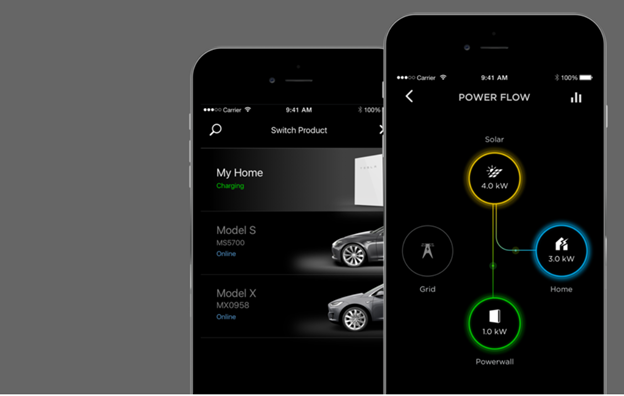
- Back-Up Only: The Back-Up Only feature is designed to store all available energy in the battery, ensuring that it remains fully charged. This feature helps to ensure uninterrupted power supply to the system during blackouts. If used with a Solar PV system of sufficient size, the battery can potentially last for weeks.
- Self-powered Mode: When using the Self-Powered mode, batteries are utilized to make the most of free energy generated from rooftops. This helps reduce energy bills by using energy from the grid only when necessary. Residential batteries help homeowners manage their evening and early morning power usage.
- Time-based Control: The Tesla Powerwall has an intelligent feature that enables it to charge when electricity is cheaper, and discharge power when it’s more expensive, but only if the owner has a time-based electricity charge from their retailer. The financial benefit of this feature depends on the tariffs of the electricity retailer and is usually not enough to justify the cost of the battery system alone.
Overall Verdict On Tesla Powerwall?
How Do I Get a Tesla Powerwall Battery?
Compare solar and battery quotes from local installers now.
Tesla Powerwall Costs With Australian Solar Battery Rebates
FAQ
In 2026, a Tesla Powerwall installed in Australia typically costs $12,000–$16,000 for a standard install (before state rebates or VPP incentives). Final price varies by state, switchboard upgrades, and backup wiring. Add-ons (extra circuits or gateway work) can push totals higher; rebates can reduce out-of-pocket cost.
In 2026, a Tesla Powerwall 3 installed in Australia typically totals $15,000–$17,000 for a standard job before state rebates or VPP credits. The range reflects switchboard/backup wiring, travel, and meter work. Where rebates apply, the out-of-pocket cost can drop materially; always quote with your address and load.
Runtime depends on load: hours = 13.5 kWh ÷ average kilowatts used. At 1 kW (lights, fridge, devices) expect ~13–14 hours; at 2 kW, ~6–7 hours. Back-up time shortens with large appliances/EV charging and extends if solar is recharging the battery during daylight.
Higher upfront cost than many rivals; as a DC-coupled, inverter-integrated unit, retrofits may need solar rewiring or are not possible. Whole-home backup may require extra electrical work; supply times can vary; and like all lithium batteries it degrades over time (covered by a 10-year warranty with use limits).

- The Top 5 Problems With Cheap Air Conditioning Quotes - 12 January, 2026
- Running Cost of Air Conditioners – Explained - 7 October, 2025
- Air Conditioner Rebate South Australia: What You Need to Know - 19 September, 2025
Reviews from Australians who have installed Tesla Batteries
Review left 6 years after system installed
I was very happy until they introduced this new optimal charging. It’s dreadful. Drains my battery of power I need
They never show up to installed after collecting the deposit
Tesla say they are providing a warranty but its not based on what is required by trading standards. They are expecting the installer to provide the warranty for them but where the problem is within the PW3 and is potentially a manufacting problem they shoudl ahev there own people. There is no way an installer has the expertise to carry out an onsite inspection for the unit & know what the fault is. Tesla do not have sufficient service back up to cover its products. I have been unable to get a phone number of a service centre in Queensland in order to speak to someone because the installer is refusing to return to site to investigate the problem. My other complaints are that the PW3 & Expansion Pack were not installed as per my diagram and that they did not provide an electrical diagram showing where the components are and how they are connected (i am told this is a legal requirement).
Installation Photos


Before the additional batteries just installed by Solar Bright, a year earler (Nov 2024) I bought my first Tesla Powerwall 3 and solar panels from another excellent supplier, Glenn at Solar BC, based on his recommendations for what best suited our needs I.E. they also supplied other brands and we went over those. After much interrogation, I agreed it was the better option for the system we were looking at. The PW3 “expansion packs” I.E. modular additional storage were not available until late 2025 and by then experience showed they'd be an advantage. The app etc have all been good, work well with my retailer's app.
Installation Photos


Powerwall became unresponsive. after a month. This was a bit suprising as no indication from the installer or Tesla manual on why this would happen. I resolved the issue ( it seems) following Tesla's troubleshooting instructions. It took about 12 hours from a simple restart of the battery to have it coming back online. I'm even not sure if the restart actually worked or it was something the battery does . There is little information available from the Tesla manual on why this happens.
Tesla works well - good to have paid the extra for blackout protection. However Tesla batteries are not fully compatible with Amber Electric as supply to the grid cannot be curtailed when Fit rates are negative. Even with a 27kWh battery size this is insufficient to soak up all energy generated by 6.6kW solar panels and then you are exporting at a negative fit with Amber - but not with say AGL.
Review left 2 years after system installed
Battery is great, monitoring app is intuitive.
Tesla Powerwall 3 (13.5 kWh) with a Expansion pack (13.5 kWh) , total 27 kWh. The unit and management 'app' are excellent and performing as per performance projections as supplied by Springers Solar. Only regret is not having installed a second Expansion pack to take the system to 40 kWh of energy storage.
Installation Photos

Whatever you plan, do not go with Tesla Power wall 3. I have now had a Tesla Power wall 3 for about 2 months now and only have trouble. Turning of not connecting, using power from the grid even though battery is at 100% discharging the Battery to the grid during the Day for 3 cent and recharging during the night from the Grid for 42cent and the Tesla support does not even contact me to explain what’s going on. For the amount of money, I had to pay I would expect better service and customer support from Tesla. Before you go this way there are much cheaper batteries on the market that work just as good but for half the Price and a great costumer support. One very upset Tesla costumer here, I would not go this way again if it were half the price.
So far so good the app keeps us updated and the 6kw system is charging the battery to it capacity for overnight use.
13.5 power wall 2 sourced just before phasing out when other providers could not
Unreal tech and great performance so far.
Installation Photos


Very happy with the battery so far, the app is simple to use. I would rather a computer program is my only complaint
The monitoring App is terrific and easy to understand.
We have 3 x Powerwall 2 batteries, with the earliest installed in 2018 and the 3rd and last one in July 2025. These are amazing batteries, that have always run trouble-free, and with the 3 now installed, we are running electricity bill free and always in credit with our electricity supplier.
The battery was installed yesterday and it is too early to determine quality, performance etc
Very happy with the battery performance and the Tesla app is easy to use and informative
Review left 3 years after system installed
Seems happy Virtual power plant algorithm Needs to be changed to better reflect my usage it will discharge before sundown only to top up with Sometimes leaves battery less than 90% Let me stress THAT Solarpro is not responsible for the VPP Virtual power plant and it’s completely out their control Ben has suggested some alternatives and I am progressing through the options I am currently considering adding more battery’s Ben listens and picks up the phone directly My rebates were made simple and with a minimum of fuss
If I could give Tesla and their Powerwall 3 zero stars I would. The PW3 battery hasn’t worked since day one. It keeps cutting off my solar supply inexplicably making my solar panels useless. It also refuses to self charge from the grid as advertised. After sales service from Tesla has been non existent. For a premium product and premium pricing Teslas product and service have been terrible. Not good enough
The battery performance is great and easy to change.