Note: Solar Choice is an independent comparison and review platform. We are not a retailer, installer or manufacturer and have no financial or other incentives to promote any product brand over another.
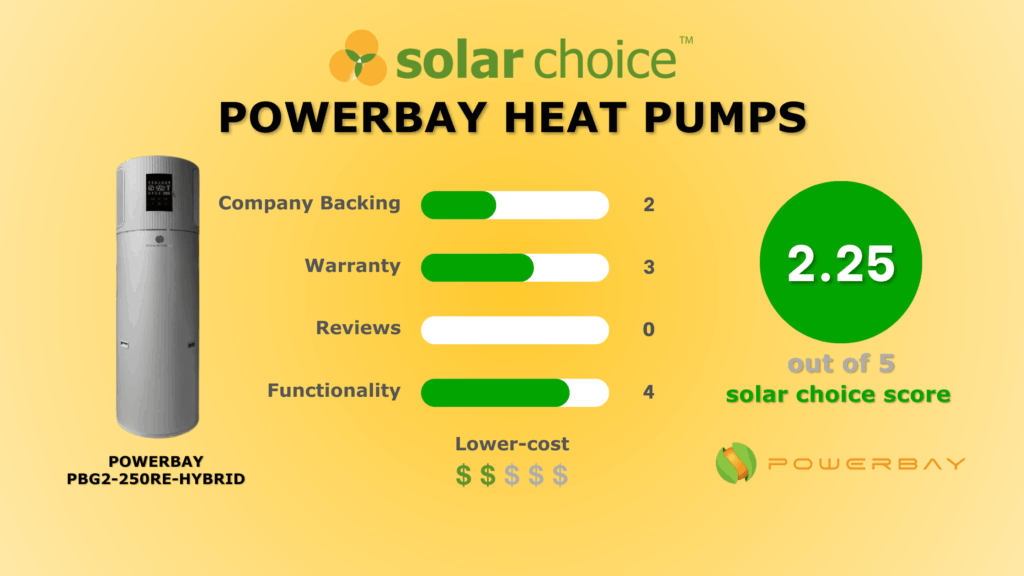
At a Glance: PowerBay Heat Pump Review Score: 2.25 Out of 5
Scoring is based on our heat pump scorecard, which is consistently applied across the heat pump hot water market in Australian.
$$ Price: PowerBay sits at the budget end of the market. Current retail pricing places the range in the Lower Cost category for Australian heat pump hot water systems, with the 300L model typically priced between $1,800 – $2,400 supply-only.
- 2/5 – Company Backing and Trustworthiness: PowerBay has an Australian presence, with offices listed in Queensland and Victoria, and a broader renewable energy product range that includes solar panels, batteries, EV chargers and pool pumps. However, it is still a relatively new brand in the Australian heat pump market and does not yet have the long public track record of more established names such as Rheem or Rinnai.
- 3/5 – Warranty Offer: The current Gen II range is marketed with a 5-year replacement warranty, which is reasonable for a lower-cost system but not class-leading. Earlier PowerBay models offered longer cylinder coverage, so the newer warranty is simpler, but not necessarily stronger.
- 0/5 – Customer Reviews: PowerBay does not currently appear on Solar Choice’s independent review platform, and independent review volume for its heat pumps is still very limited. That means there is not yet enough verified customer feedback to support a higher score.
- 4/5 – Functionality: PowerBay’s heat pumps offer a solid feature set for the price, including Wi-Fi app control, R290 refrigerant, Smart Grid functionality and weekly sterilisation. The older published datasheets also show competitive heating performance and efficiency figures.
Please note that the Solar Choice scorecard reflects our opinions only. Customers are encouraged to do their own research before buying.
Table of contents
- At a Glance: PowerBay Heat Pump Review Score: 2.25 Out of 5
- PowerBay Company Background
- PowerBay Heat Pump Range Available in Australia
- How Much Do PowerBay Heat Pump Hot Water Systems Cost?
- Can Rebates Reduce These Prices?
- PowerBay Heat Pump Warranty Terms and Conditions
- Pros and Cons
- Verdict: Are PowerBay Heat Pumps Worth It?
PowerBay Company Background
PowerBay (ABN 45 621 285 363) active since Aug 2017 (8.5 years) is an Australian renewable energy brand with offices listed in Queensland and Victoria. Beyond heat pumps, the company also sells solar panels, inverters, batteries, EV chargers and pool pumps, positioning itself as a broader home energy brand rather than a single-product importer.
That broader product mix is a positive, but PowerBay is still a newer name in the Australian heat pump market. Buyers are not looking at the same long-established service history they would get from more mature hot water brands. In practice, that makes PowerBay more of a value-focused emerging brand than a proven long-term incumbent.
For buyers, that means installer quality, warranty process clarity and after-sales support matter more than usual. If you are weighing PowerBay against more established options, see our guide to the best heat pump hot water systems in Australia.
PowerBay Heat Pump Range Available in Australia
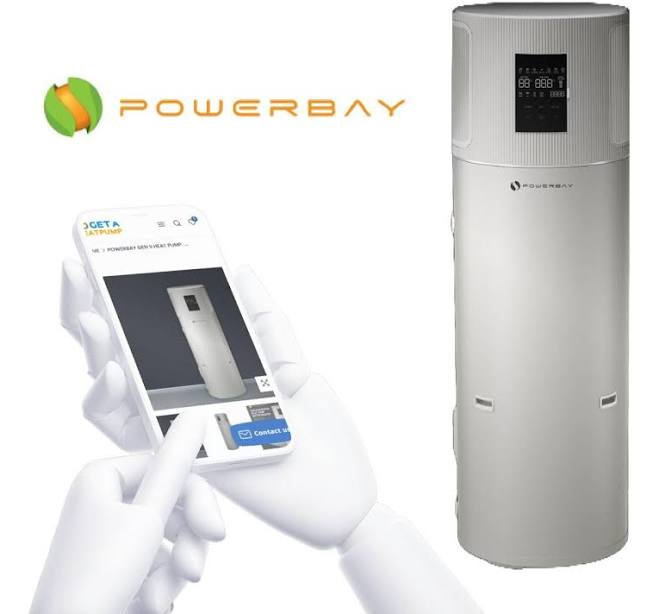
PowerBay’s heat pump range in Australia centres on integrated all-in-one systems, not split systems. The current public range focuses on the Gen II series, while older PB-200RE and PB-270RE models are still documented through legacy brochures, datasheets and warranty material.
Current Gen II range
| Model | Tank size | Best for | Warranty |
|---|---|---|---|
| PBG2-250RE-HYBRID | 250L | Mid-sized households | 5 years |
| PBG2-300RE-HYBRID | 300L | Families and higher hot water use | 5 years |
The current Gen II range is marketed around efficiency, app control and household convenience. PowerBay says the Gen II produces the equivalent of 4kW of heat from 1kW of electricity, offers Wi-Fi app control, supports weekly sterilisation, and includes Smart Grid-ready functionality.
Previous generation
| Model | Tank size | Best for |
|---|---|---|
| PBG2-250RE | 250L | Mid-sized households |
| PB-270RE | 270L | Families and higher hot water use |
Official PowerBay spec sheets and warranty documents
Current Gen II
Previous generation
- PB-200RE datasheet (PDF)
- PB-270RE datasheet (PDF)
- PB-270RE user manual (PDF)
- PB-200RE / PB-270RE warranty terms (PDF)
How Much Do PowerBay Heat Pump Hot Water Systems Cost?
PowerBay is one of the cheaper branded heat pump options currently visible in the Australian retail market.
| Model | Indicative supply price | Price tier |
|---|---|---|
| PowerBay 200L | $1,800 – $2,400 | $–$$ |
| PowerBay 300L Gen II | $1,900 – $2,500 | $$ Lower Cost |
At current retail pricing, there is only a small gap between the 200L and 300L units, which makes the 300L look like the stronger value buy for larger households. Either way, PowerBay is competing much more on upfront affordability than on premium brand trust.
Installed pricing will vary depending on:
- whether you are replacing electric, gas or solar hot water
- rebate eligibility in your state
- switchboard and electrical upgrade requirements
- plumbing changes, slab work, drainage and site access
If you want installed pricing rather than supply-only retail pricing, compare offers through our heat pump quote comparison tool:
Can Rebates Reduce These Prices?
Yes. PowerBay heat pumps are eligible for the same broad incentive framework that supports many heat pump systems in Australia. PowerBay’s own material references Federal STCs, Victorian VEECs and NSW ESCs, and the legacy brochures include STC-based rebate examples.
For buyers, the main takeaway is simple: because PowerBay starts from a relatively low ticket price, rebates can make the installed cost look even more attractive. That is one of the strongest parts of the value proposition.
For current state-by-state incentive settings, see our heat pump rebates guide.
PowerBay Heat Pump Warranty Terms and Conditions
Warranty is one of the more mixed parts of the PowerBay story. The current Gen II range is marketed with a 5-year replacement warranty, while the older PB-200RE and PB-270RE range offered longer tank coverage.
| Component | Gen II Range | PB-200RE / PB-270RE |
|---|---|---|
| Tank cylinder | 5 years | 8 years parts |
| Compressor / refrigeration components | 5 years | 5 years |
| Other components | 5 years | 5 years |
| Labour | 5 years | 5 years |
There are also important installation conditions. PowerBay states that a 500kPa pressure limiting valve is required for the Gen II replacement warranty, and installation must comply with the manufacturer’s requirements. In practice, that makes installation quality important to preserving warranty coverage.
For broader context on how this compares with the market, see our guide to the best heat pump hot water systems.
Pros and Cons
Pros
- Lower-cost pricing than many established competitors
- Broad feature set, including Wi-Fi app control and modern heat pump functionality
- Legacy datasheets show solid published specs, including COP 4.15 and R290 refrigerant
- Broad renewable energy product lineup, not just heat pumps
- Simple Gen II warranty structure
Cons
- Still a relatively new heat pump brand in Australia
- Very limited independent customer review depth
- Current Gen II public documentation is thinner than the older generation’s datasheets
- Newer warranty structure is not stronger on cylinder duration than the older range
Verdict: Are PowerBay Heat Pumps Worth It?
PowerBay is best understood as a budget-first heat pump brand.
The appeal is that the systems are relatively inexpensive, the feature list is respectable, and the brand has enough Australian presence to look more substantial than a no-name importer. For price-sensitive buyers, that will be enough to put PowerBay on the shortlist.
The trade-off is confidence. Compared with more established brands like Rheem, Rinnai, Reclaim or Sanden, PowerBay has a much shorter public track record, far less independent review data, and thinner technical documentation on the current generation. That does not mean the product is poor. It does mean there is less evidence available to justify a stronger score today.
For buyers who are highly price-sensitive and comfortable with a newer brand, PowerBay may represent reasonable value, especially once rebates are factored in. For buyers who place more importance on proven service history, stronger documentation and longer-established support networks, paying more for an established brand may still be the safer call.

- Scott Maynard | Polestar Australia: Premium EVs, V2G & What’s Next - 25 March, 2026
- Viessmann Vitocal Heat Pump Review | Independent Buyers Guide - 20 March, 2026
- Gareth Ridge | Zenobē: Electrifying Buses, EV Truck Fleets & Second‑Life Batteries - 26 February, 2026



