Note: Solar Choice is not affiliated with Fox ESS or any other battery manufacturer. Our reviews are independently written using technical documentation and industry analysis.
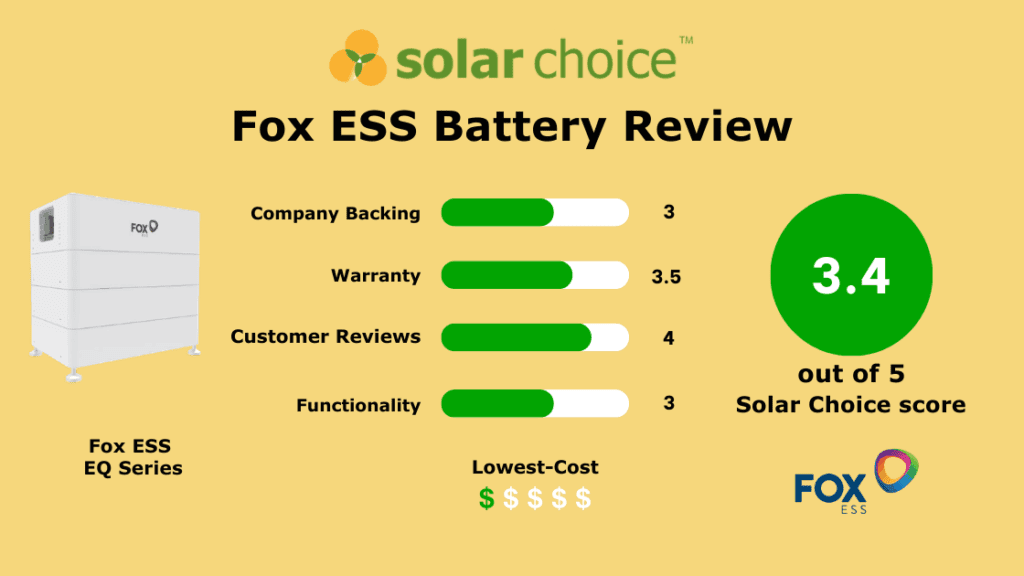
At a Glance: Fox ESS Batteries score 3.4 out of 5
Scoring is based on our solar battery scorecard, which is consistently applied to each brand and battery available on the Australian market. This scoring reflects Fox ESS’s residential battery systems including the EQ, EP & CQ6 series.
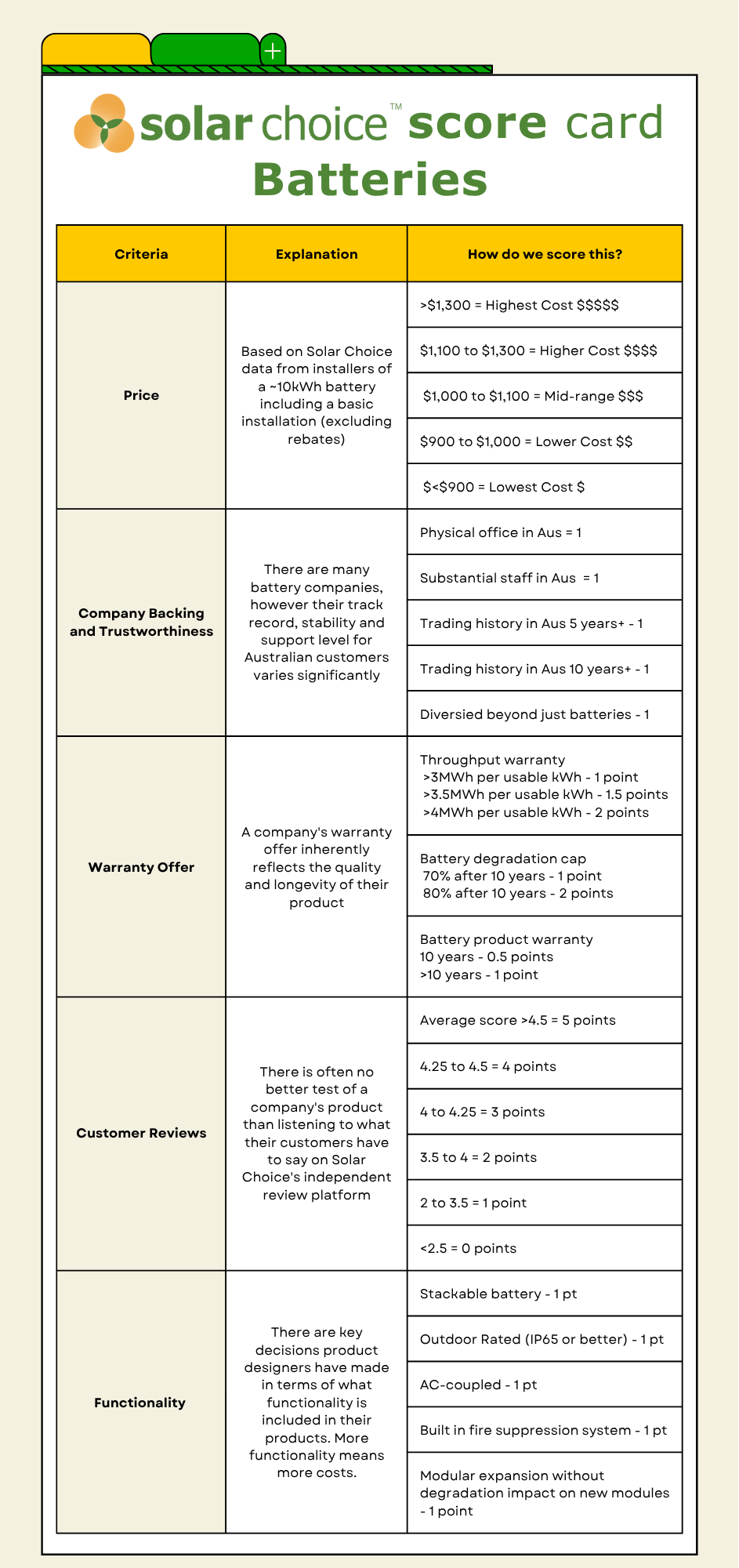
$ Price: Based on data from Solar Choice’s network of solar installers, the average price for an installed EQ & EP series Fox ESS batteries are ≈ $832 per usable kWh. This makes it one of the lowest-cost options available. CQ6 is new to market so we’ll update this figure once we have enough CQ6 installs/quotes to report a reliable average.
- Company Backing and Trustworthiness (3 out of 5): Fox ESS entered the Australian market around 2020 and launched its first battery in 2022. It has since expanded beyond batteries, selling inverters locally from 2022 and introducing EV chargers in 2024. Fox ESS also has a Victorian office with a local support team.
- Warranty Offer (3.5 out of 5): Fox ESS offers a 10-year product and performance warranty on the EP11 and EQ series, and a 12-year product and performance warranty on the newer CQ6 series. Performance cover is typically limited by either a minimum 70% end-of-warranty capacity or a minimum energy throughput limit (whichever comes first).
- Customer Reviews (4 out of 5): Based on verified customer reviews, Fox ESS holds an average rating of 4.28 from 192 reviews on Solar Choice’s independent platform. Mixed feedback results in a slightly lower score for customer reviews.
- Functionality (3 out of 5): Fox ESS batteries are IP65-rated and modular, which suits many homes, but they’re mostly DC-coupled so you typically need a compatible hybrid inverter (and retrofits can be more complex). EQ/EP lack built-in fire suppression and expansion can be constrained, while CQ6 improves safety with an integrated aerosol fire module, though compatibility and expandability still depend on the setup.
Please note that this score and review reflects our opinion only and we encourage readers to do their own research.
Overview of Fox ESS – Company History
Fox ESS is a Chinese energy technology manufacturer that began selling solar inverters in Australia in 2022 and introduced EV chargers locally in 2024.
While the company’s solar battery range remains relatively new in-market, it has expanded its Australian product portfolio to include hybrid inverters and EV charging solutions. The company is a subsidiary of Tsingshan Group, one of the largest stainless steel manufacturers globally, which has helped Fox ESS scale its operations across Asia, Europe, and Oceania.
Fox ESS first launched an Australian subsidiary in 2020, initially selling their solar inverter products. Their first battery was approved by the Clean Energy Council in 2022, meaning they are a relatively new-entrant to the solar and battery market. Fox ESS have now listed their local office in Springvale, Melbourne on their Australian website.
Fox ESS Battery Range and Options
Fox ESS provides a range of high-voltage, stackable lithium iron phosphate (LiFePO4) battery systems under the EQ,EP & CQ6 series which are all approved by the Clean Energy Council. These batteries are typically designed to integrate with Fox hybrid inverters, although some limited compatibility with third-party systems exists. Customers are advised to confirm third party compatibility.
EQ Series (DC-Coupled, Stackable System)
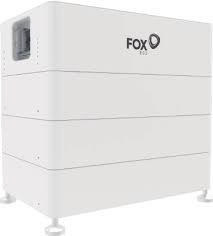
The EQ series is Fox’s main high-voltage modular battery platform. Each system consists of a CM (control module) and between 2–9 battery modules, each with a capacity of 4.66kWh. That means the solution can scale to just under 42kWh in one stack.
- DC-Coupled: Must be paired with a compatible Fox ESS hybrid inverter
- Depth of discharge: 100%
- Ingress protection: IP65, suitable for indoor/outdoor installations
- Cooling: Natural convection (fan-free)
Expansion is possible, but the warranty requires new modules to be within 0.5V of existing modules and recharged within the past 5 months, making post-installation upgrades technically feasible but logistically complex.
The batteries must be paired with a compatible Fox-ESS inverter and they have recently broadened their range of hybrid inverters up to 10kWh single-phase and 15kW three-phase.
EP Series (DC-coupled, Fixed Units)
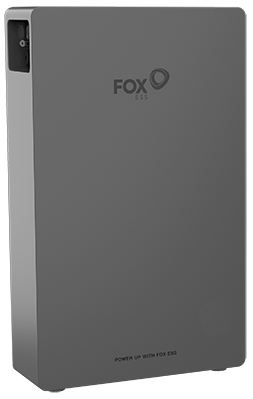
The EP series includes fixed-capacity wall-mounted batteries that combine battery modules and the battery management system (BMS) in a single enclosure.
- Key models: EP11 (10.36kWh) usable capacity
- DC-coupled: Must be paired with a compatible Fox ESS hybrid inverter
- DOD: 100%
- Operating range: -10°C to +55°C
The EP series may appeal to installers seeking simpler, space-saving systems. The EP Series is expandable by adding additional units in parallel which will require an additional junction box. This is a more costly and space-consuming approach than the stackable EQ series but may suit some homes.
CQ6 Series (Launched 2026)
Fox ESS launched the CQ6 high-voltage modular battery in Australia in January 2026 which is now their highest quality solution. It uses 5.99 kWh modules, although note our comment below as you might not be able to use that entire capacity. They are configurable from 2 to 14 modules per stack.
Key highlights for this new series:
- Scalability: up to 83.86 kWh per stack; Fox also states up to three stacks in parallel (up to 251.58 kWh) when paired with the H3 Plus inverter.
- Safety: Fox’s CQ-series manual describes a built-in aerosol fire extinguishing device module, thermally activated at 170°C.
- Efficiency / DoD: Fox’s AU launch announcement claims >95% round-trip efficiency and 100% depth of discharge, while the CQ-series manual lists 95% round-trip efficiency and 90% DoD. It’s recommended that buyers treat “usable capacity” claims as model/document specific and confirm on the final Australian datasheet / product manual your installer is using.
The CQ6 series is IP65 rated meaning it can be installed in outdoor areas. The battery can be paired with single phase inverters up to 10.5kW in rating and 3-phase inverters up to 30kW in rating.
Compare quotes from up to 7 installers in your area now.
How Much Does a Fox ESS Battery Cost?
Fox ESS batteries are among the most affordable on the Australian market. Based on data from Solar Choice’s installer network, the average installed cost for the EQ & EP Series batteries $832 per usable kWh, excluding rebates.
For example:
- A 10.4kWh EP11 system may cost $8,650–$9,200 installed
- A 18.64kWh EQ4800 stack with 4 battery modules might cost $15,000–$16,000 installed
Fox ESS has released the CQ6 high-voltage modular series, using 5.99kWh modules and configurable from 11.98kWh up to 83.86kWh per stack (and higher when stacked in parallel with compatible Fox inverters).
We have seen the A 23.9kWh Fox ESS CQ6 package publicly advertised between $8,500 & $9,000 installed (after rebates), including DC-coupled installation. However, we don’t yet have enough installer-network pricing data to publish representative installed CQ6 pricing ranges with the same confidence as EQ/EP, so quotes may vary (by state, site conditions, switchboard work, and inverter requirements) while the product is still early in-market.
As Fox ESS batteries are DC-coupled, homeowners would also need to buy a compatible Fox ESS hybrid inverter to connect the system. EP series expansion typically adds extra costs due to junction boxes and wiring Fox ESS batteries are most likely to be used when installing solar and batteries for the first time to avoid duplicating the inverter.
Federal Battery Rebate (STCs):
From 1 July 2025, eligible on-grid batteries installed with solar can receive an upfront discount via Small-scale Technology Certificates (STCs) under the Australian Government’s battery program rules. Eligibility is federal (state rebates are separate), and STCs are calculated on the battery’s usable capacity up to the first 50 kWh. The Clean Energy Regulator also notes proposed changes from 1 May 2026 which may alter support levels by system size.
For details and calculations, see Solar Choice’s guide to the Australian Government battery rebate and the battery rebate calculator
Fox ESS’s Warranty Offer For Australian Customers
Fox ESS warranties can be a bit confusing because they have two “limits” running at the same time:
- Time limit (years): how long the warranty lasts (e.g. 10 years for EP/EQ, 12 years for CQ6).
- Use limit (energy throughput): how much energy the battery is allowed to cycle in/out over its life. Think of this like a kilometre limit on a car warranty — if you “drive it” very hard every day, you can hit the usage limit before the years are up.
On top of that, the performance warranty is usually written as “70% capacity or throughput, whichever comes first.”
That means the warranty ends when either:
- the battery drops below 70% of its original usable capacity, or
- the battery has delivered its minimum warranted energy throughput, whichever happens first, assuming it’s used and installed according to the manual.
Fox ESS’s current Australian battery warranty policy states a 10-year product and performance warranty for the EQ4800 and EP11 series, and a 12-year product and performance warranty for the CQ6 series.
Warranty & Minimum energy throughput:
| ProductSeries | Warranty term | Nominal energy (kWh) | Minimum energy throughput (MWh) | Throughput per kWh (approx.) |
| EQ4800 | 10 years | 10.36 | 38.4 | 4.22 |
| EP11 | 10 years | 18.64 | 78.64 | 3.71 |
| CQ6 | 12 years | varies by stack size | varies by stack size | ~5.04 |
CQ6 throughput examples by stack size (12-year warranty):
| CQ6 configuration | Nominal energy (kWh) | Minimum energy throughput (MWh) |
| CQ6-L2 | 11.96 | 60.28 |
| CQ6-L4 | 23.92 | 120.56 |
| CQ6-L14 | 83.72 | 421.96 |
Fox ESS’s warranty terms include typical exclusions (e.g. improper installation and use). The warranty policy also recommends registering the product (it notes registration should be completed within 36 months of installation, and ideally within 6 weeks).
See the full 2026 warranty policy for Fox ESS batteries.
Fox ESS Battery Technical Specifications
| Feature | EQ4800 L4 (18.64kWh) | EP11 (10.4kWh) | CQ6 (high-voltage modular) |
| Battery Chemistry | LiFePO4 | LiFePO4 | LFP (LiFePO4) |
| Usable Capacity (kWh) | 18.64 | 10.36 | 11.98–83.86 (L2–L14 per stack) |
| Scalability | Modular (up to 42kWh) | 4 Units – requires additional hardware | 2–14 modules in series (per stack); up to 83.86kWh per stack |
| Depth of Discharge (DOD) | 100% | 100% | 100% |
| Max Discharge Power (kW) | Depends on inverter (up to 10kW single phase) | Depends on inverter (up to 10kW single phase) | Depends on inverter; battery Rated DC Power = 5.76–40.32kW (varies by stack size) |
| Round Trip Efficiency | >95% | >95% | >95% |
| IP Rating | IP65 | IP65 | IP65 |
| Cooling Method | Natural Convection | Natural Convection | Natural Convection |
| Installation | Stackable, floor mounted | Wall-mounted or floor mounted | Outdoor / indoor (stand); modular stack |
| Minimum Throughput | 4.1MWh per usable kWh | 3.7MWh per usable kWh | ≈5.04MWh per kWh |
| Operating Temperature (°C) | -10 to 55°C | -10 to 55°C | Charge: 0–55°C; Discharge: -10–55°C |
Important Notes:CQ6 technical values above are from EN-CQ6 Datasheet AU v1.2 (2025-11-18) (capacity range, DC power, voltage ranges, IP65, operating temps, DoD, efficiency, install location, scalability).
See the full 2026 warranty policy for Fox ESS batteries.
Pros and Cons of Fox ESS Batteries
| Pros | Cons |
| ✓ Competitive installed pricing (often <$850/kWh installed on EQ/EP, based on Solar Choice installer data) | ✗ Limited long-term Australian track record vs major incumbents (CQ6 is new in-market) |
| ✓ IP65 rated for outdoor/sheltered installs (EQ/EP/CQ6) | ✗ Expansion can be more complex than “plug-and-play”– (inverter limits, module matching and recommissioning can apply (especially on older EQ setups). CQ6 is designed to be easier, but final expandability depends on the exact model, inverter and installer configuration. |
| ✓ Modular options: EQ is stackable and CQ6 scales much larger per stack | ✗ Primarily DC-coupled / Fox ecosystem dependent: typically needs a compatible hybrid inverter; third-party compatibility varies |
| ✓ CQ6 adds built-in fire suppression (model-specific feature) | ✗ Customer reviews provide mixed feedback (despite a decent average rating). |
Conclusion: Our Verdict On Fox ESS Batteries
Fox ESS is a relatively new entrant to the market and has adopted an aggressive pricing strategy which they hope to win market share, so if you’re trying to keep upfront costs down these could be a good choice for your home. Their EQ and EP series batteries are scalable up to over 40kWh and can be linked with their expanded range of single and three phase hybrid inverters with up to 10.5kW capacity for single-phase installations.
The warranty terms on face value look competitive or better than some of the bigger brands offering greater minimum throughput than most brands on the market.
With the short company history and mixed feedback from customer reviews, the longevity and reliability of the Fox ESS batteries largely remains to be seen.
The key trade-off is that Fox ESS batteries are mostly DC-coupled, so you generally need a compatible hybrid inverter. That’s easy when you install solar + battery together, but retrofitting to an existing system could add cost if your inverter isn’t suitable.
The new CQ6 is Fox’s biggest 2026 improvement: larger modular sizing, a 12-year warranty, and added safety hardware (including built-in fire suppression, per Fox documentation). It’s promising, but still new in Australia, so again their long-term local track record is limited.
Read more product reviews from Solar Choice
Compare quotes from up to 7 installers in your area now.

- The Top 5 Problems With Cheap Air Conditioning Quotes - 12 January, 2026
- Running Cost of Air Conditioners – Explained - 7 October, 2025
- Air Conditioner Rebate South Australia: What You Need to Know - 19 September, 2025
Reviews from Australians who have installed Fox-ESS Batteries
BATTERY PERFORMANCE IS GREAT REPUTABLE BRAND
It is too soon to say. It appears to work well at this point.
Installation Photos

Happy at the moment everything is working great so far
The system (CQ6) has perforned very well considering no sun this last week.
Battery system is very good, functions as intended.
Installation Photos

Review left 9 years after system installed
Battery is adequate for our daily needs and solar charging capability. Goal is to reduce as close to zero grid imports rather than selling back to grid and this battery is doing that well. App is comprehensive as is remote control and mode setting.
So far I'm very happy with the battery's performance.
Installation Photos

I am happy with the app as it's easy to monitor.
Happy with battery coupled with Foxess inverter.
Everything is good thus far. However I think everyone wants to know if it lasts. Time will tell.
Battery capacity is excellent at 42kWh, and the system only uses one stack, so it doesn’t take up much space. The design also looks very clean and modern. So far the battery has completed about 75 cycles and the performance has been great. The system is stable and the monitoring through the app is easy. Very happy with the battery overall.
Installation Photos

Product quality seems good Performance seems good App is very informative The battery appeared off-line, according to the app, for about 6 hours around midnight one night. However, no data has been lost and the battery continued to cover the load during that time, and the connectivity problem seemed to fix itself.
Installation Photos

The battery installation is very neat, and seems to work just fine. It has been installed for 1 week now. I cannot comment its technical capabilities but the FoxESS app provides the information I need.
Installation Photos

Battery works great. App is easy to use. I was offered the CQ model with 12 year warranty and in built fire suppression, so very happy.
Battery function beautifully after set up. The app is amazing as it displays all the informations in regarding to how much the solar, battery and grid input and output.
I can see why Fox has become so popular. It works well and looks neat. Time will tell if the lack of internal heating impacts performance in Canberra's cold winters. Not sure about Fox's claims of 100% discharge being available but the app has a minimum of 10% setting. ESY Sunhome has a minimum of 5%. The ESY Sunhome battery does have a heater but I never saw any sign of it being used so I'm optimistic that the pergola/shelter is enough to 'keep baby warm'
Installation Photos

The battery I have was installed by Energy Bites the Fox ess battery seem to be performing well
Very happy with the battery performance and latest energy bill shows a huge reduction in energy usage The app is also effective and provides peace of mind
Installation Photos

Was the best quote out of 3, the app is simple to use and I love checking it to see how full my battery is!
Installation Photos

Battery seems like great bang for buck especially with the rebates,