Note: Solar Choice is independent from ReadySteadyPlug and is not affiliated with any EV charger manufacturer and has no incentive to promote any product over another.
ReadySteadyPlug at a Glance
What it is
ReadySteadyPlug (RSP) is a smart Level 1 (“trickle”) EV charging system that uses standard 230–240V power points in apartment and strata car parks. It adds metering, billing and load management on top of normal power outlets so buildings can share existing power fairly and safely.
Who it’s for
- Strata buildings and owners corporations wanting fair, user-pays EV charging
- Apartment residents who park in a basement or shared car park
- Developers planning “EV‑ready” multi‑unit buildings
Who it’s not for
- Standalone homes and townhouses with their own driveway or garage
- Drivers who regularly need very fast top‑ups (Level 2 or DC charging is better for that)
Key points
- Uses normal power points instead of expensive wall‑box chargers
- Designed for overnight or all‑day charging while cars are parked
- System monitors building load and automatically shares power between vehicles
- Each outlet is individually metered so users pay only for what they use
- Can be rolled out in stages and expanded as more residents buy EVs
Typical charging speed
- 10A outlet (~2.4 kW): about 10–15 km of range per hour
- 15A outlet (~3.6 kW): up to ~20 km of range per hour
If you need a deeper dive on EV charging options generally, see our EV charging hub and EV charger reviews compared.
Table of contents
Company Overview
ReadySteadyPlug (RSP) is an Australian startup offering a smart electric vehicle (EV) charging system tailored for strata‑managed apartment buildings. Based in Sydney, RSP’s team brings experience in both electrical engineering and EV ownership – the CEO has been driving EVs for many years – which has informed the product’s design.
The company is focused on solving the unique challenges of apartment EV charging:
- Avoiding costly infrastructure upgrades
- Providing fair, user‑pays billing for shared power
- Scaling as EV uptake grows in a building
RSP is a member of relevant strata and EV industry bodies, underscoring its focus on this niche.
At its core, ReadySteadyPlug embraces Level 1 “trickle” charging (using standard 230/240V power outlets) as a practical, cost‑effective solution for apartments. By using regular General Purpose Outlets (GPOs) instead of high‑capacity chargers, the RSP system can be installed for up to 80% less cost than typical Level 2 charging solutions in apartment buildings (according to RSP). This dramatically lowers the barrier for strata committees who may have balked at the five‑ or six‑figure price tags of traditional EV infrastructure upgrades.
RSP’s philosophy is that for the average driver, Australians drive only around 35 km per day on average overnight Level 1 charging is usually sufficient. Ten hours of charging while parked (for example, 8pm to 6am) can add roughly 150–200 km of range, easily covering typical daily needs. While Level 1 charging is slower than Level 2, RSP’s view is that this approach prioritises convenience and affordability over speed, and can also be gentler on EV batteries by charging at a lower rate.
What We Like About ReadySteadyPlug
The ReadySteadyPlug system has been designed to overcome key hurdles that strata managers, apartment residents, and property developers often face with EV charging.
1. Apartment‑friendly costs
First and foremost, we like how affordable and strata‑friendly the RSP solution is. By leveraging existing electrical infrastructure and standard outlets, it can often avoid major mains upgrades and dedicated high‑power circuits. That dramatically lowers upfront costs and makes it easier for bodies corporate to approve EV charging projects.
Rather than installing an expensive wall‑box charger for every bay, RSP focuses on shared backbone infrastructure (its distribution boards, metering and control hardware) and simple outlets at each parking space. This “lightweight” approach is a key reason why the company claims installations can be up to 80% cheaper than a comparable Level 2 solution.
2. Fair, transparent billing
We also appreciate the fairness and transparency built into RSP. Each EV owner pays only for the energy they use, thanks to individual metering on every outlet and automated billing via the cloud platform. This user‑pays model means non‑EV owners in the building don’t subsidise EV charging – a common pain point in apartments.
Strata managers can see real‑time and historical usage data for all EV chargers, which supports:
- Accurate cost recovery for common power
- Transparent reporting to the committee
- Easier conversations with residents about usage and costs
For residents, the ability to charge in their own parking space without manual reimbursements or bill‑splitting is a major plus.
3. Making the most of existing power
Another highlight is RSP’s focus on maximising existing electrical capacity with its dynamic load management. The system shares power between vehicles and monitors the building’s overall load to avoid overloads. This gives peace of mind to both residents and building managers: EV charging can be added without constantly tripping breakers or risking outages.
Unlike some simple Level 1 solutions that have no load management (and therefore require each charger to be on its own circuit or heavily limited), RSP actively balances and schedules charging to stay within limits set for the building. That can also help reduce demand peaks, which may lower demand‑related charges on the building’s electricity bill.
4. Scalable and “EV‑ready” for developers
For property developers and planners, ReadySteadyPlug offers a scalable and future‑proof way to make new projects EV‑ready. The system is modular and can be rolled out in stages:
- Install central infrastructure (distribution boards and cabling) during construction
- Fit off outlets only where buyers or residents need them initially
- Add more outlets and users over time as EV uptake increases
Because RSP uses open‑standard components (a weatherproof power outlet at each space), there’s no vendor lock‑in for residents. EV owners can use any compatible portable EVSE (charging cable) they already have or prefer, instead of being tied to a single proprietary charger.
If, in future, a particular resident genuinely needs a faster Level 2 charger, the underlying RSP infrastructure can support upgrading that bay with additional wiring and hardware. The system is therefore more of an EV‑ready backbone than a single fixed configuration.
For a broader planning view, see our EV charging for apartments and strata guide.
Key Features
Level 1 ‘Trickle’ Charging (Up to 15A)
ReadySteadyPlug is a Level 1 charging solution, meaning it delivers AC power at regular household voltage (230–240 V) and moderate current to charge EVs. In practice, each RSP outlet is typically on a 10 amp or 15 amp circuit:
- 10A (~2.4 kW): roughly 10–15 km of driving range per hour of charging
- 15A (~3.6 kW): up to ~20 km of driving range per hour
This is much slower than a dedicated 7 kW+ Level 2 charger, but it’s sufficient for many apartment drivers whose cars sit parked overnight or all day while they work. Eight to ten hours of charging can provide 80–200+ km of range depending on the vehicle, which covers typical daily needs for most Australians.
One fringe benefit of trickle charging is improved battery longevity. Fast charging stresses batteries more, whereas slow charging generates less heat and is gentler on the cells. RSP emphasises that its slower charging is “preferred by EV batteries,” helping minimise range degradation over time.
Most EVs come with a basic Level 1 portable charger, often limited to 8A. RSP supports up to 15A charging for those who upgrade to a faster portable EVSE cable. If your vehicle didn’t come with a 15A‑capable charger, one can generally be purchased for a few hundred dollars from third‑party suppliers.
Dynamic Load Management
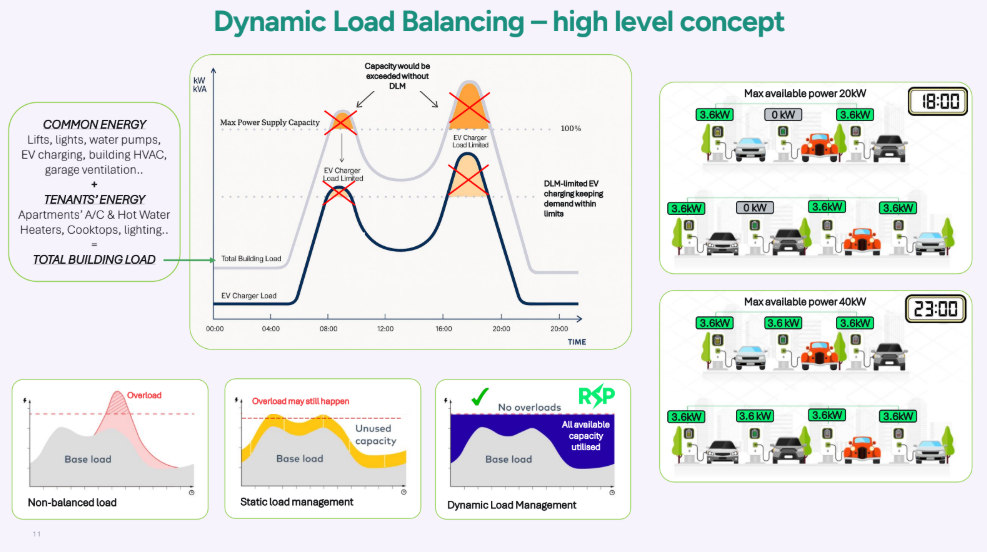
A standout feature of ReadySteadyPlug is its intelligent Dynamic Load Management (DLM) system.
Instead of simply turning outlets on and off, the RSP controller:
- Continuously monitors the building’s electrical load in real time
- Tracks the combined draw of all EV outlets
- Adjusts EV charging power to keep total demand below pre‑set limits
If multiple cars are charging and the combined draw is approaching a limit (for example, nearing the capacity of the mains or a sub‑board), RSP will automatically:
- Temporarily throttle charging rates, and/or
- Pause some vehicles’ charging sessions (managed queuing)
Once demand drops or capacity frees up (say other loads in the building decrease, or a car finishes charging), the system resumes charging for those that were paused.
This dynamic approach means you don’t necessarily need a separate circuit for every EV charger, and you don’t have to set extremely conservative limits. By contrast, some Level 1 products have no ability to actively share load between outlets – they simply assume worst‑case usage on each circuit.
Because RSP measures the overall mains and sub‑mains, not just the EV circuits, it can make better decisions about how much spare capacity is actually available. That helps squeeze the most charging out of existing infrastructure while avoiding overloads and expensive upgrade work.
Modular EV Distribution Board (EVDB)
The hardware backbone of the ReadySteadyPlug system is its Electric Vehicle Distribution Board (EVDB).
Key points:
- Each EVDB acts as a smart sub‑board dedicated to EV supply
- It houses metering, control electronics, communications and circuit protection
- A single EVDB can support multiple outlets (typically 6–24 sockets)
- Larger complexes can install multiple EVDBs across different parts of the car park
Because each EVDB and outlet is relatively low‑cost, strata can roll out EV charging incrementally – for example, starting with one EVDB and a handful of bays, then adding more boards and outlets as needed.
The EVDB connects to ordinary 240 V GPO outlets at the parking spaces. There is no proprietary wall‑box charger per car. Each bay has a weatherproof socket (much like an outdoor power point) wired back to the EVDB, which handles all the smart functions centrally.
Benefits of this design:
- Any licensed electrician can install and maintain the hardware
- Parts like cable, conduit, breakers and outlets are standard, off‑the‑shelf items
- Residents use their own portable EVSE, avoiding vendor lock‑in
- If an outlet needs replacement, it’s simple and inexpensive
Instead of having many separate “smart chargers” each with their own communications, the EVDB centralises networking. One communication hub connects all outlets to the cloud platform. If a fault occurs, a technician can access the EVDB cabinet rather than working at multiple parking spaces.
Metering and Billing System
Each ReadySteadyPlug outlet is individually metered, and all usage data flows into RSP’s cloud‑based billing platform.
This allows for:
- User‑pays billing: every kWh is associated with a specific user or apartment
- Flexible payment models: prepaid (pay‑as‑you‑go via the app) or post‑paid via strata invoicing
- No cross‑subsidy: payments for charging go back to the owners corporation or common account to cover electricity costs
The platform can handle multiple tariff rates (for example, peak vs off‑peak). This means drivers can be charged different rates depending on when they charge, which encourages shifting usage into cheaper off‑peak periods. The load‑scheduling features can support this by queuing or pausing sessions to line up with cheaper times, where the building’s tariff structure allows.
Both drivers and building managers can access real‑time and historical data:
- Drivers can see their recent sessions, energy used and costs
- Strata managers can see site‑wide consumption, per‑outlet usage and export reports
This level of transparency is a major step up from informal arrangements (like plugging into common power on trust) and is comparable to what you’d expect from a professional EV charging network.
How Much Does ReadySteadyPlug Cost?
ReadySteadyPlug positions its solution as up to 80% cheaper than installing an equivalent Level 2 system across the same number of bays, and our EV charging price index shows a typical Level 2 home charger on its own is usually around $1,100 to $2,000 or more (before installation). Exact project costs will vary with the building’s layout, electrical capacity and number of bays being serviced.
There are two main reasons for this:
- Lighter electrical requirements
Operating at Level 1 power levels means RSP can often use existing spare capacity and avoid major upgrades to mains, transformers or switchboards. By contrast, high‑power Level 2 roll‑outs can trigger substantial infrastructure work. - Cheaper hardware per bay
A weatherproof 15A outlet is far cheaper than a smart Level 2 wall‑box. Even after you factor in RSP’s shared control hardware and metering, the per‑bay cost is generally much lower when spread across multiple outlets.
RSP’s modular approach also means buildings don’t need to “over‑build” infrastructure from day one. You can start with a small cluster of outlets for early EV adopters and invest further only as demand grows.
Ongoing costs
There will usually be an ongoing service fee linked to the cloud platform and billing system. The exact model (site fee, per‑user fee or margin on energy) should be confirmed with ReadySteadyPlug when obtaining a quote.
Whatever the structure, ongoing costs should be considered alongside:
- Fuel savings for EV drivers compared with petrol or diesel
- Administrative time saved for the strata (billing and reporting are largely automated)
For context on EV charger and installation pricing more broadly, see our home EV charger cost guide.
Pros and Cons
Pros
- Low cost and minimal upgrades: designed to use existing power infrastructure; marketed as up to 80% cheaper than comparable Level 2 roll‑outs.
- Scalable and modular: start with a few outlets and expand as needed without ripping out earlier work.
- Compatible with all EVs: uses standard outlets – no proprietary charger required as long as the EV can trickle charge.
- Simple electrical work: any licensed electrician can install the EVDBs and outlets using familiar components.
- Fair, user‑pays billing: each user is metered; platform supports time‑of‑use pricing and automated reporting.
- Protects building power: dynamic load management reduces the risk of overloads and helps make the most of existing supply.
- Battery‑friendly charging: slower charging is generally gentler on EV batteries than frequent high‑power fast charging.
Cons
- Slow charging speed: only around 10–20 km of range per hour; not suitable for frequent fast turnarounds.
- Long dwell time required: works best when vehicles are parked for many hours (overnight or full work days).
- Limited throughput in very high‑demand sites: if a large number of residents all need charging every night, the system may need to queue or rotate sessions.
- User‑supplied cable required: drivers need their own portable EVSE; upgrading from a basic 8A cable to a faster 15A unit is an extra cost.
- Newer market entrant: as a relatively young company, RSP’s long‑term track record is still building, though it uses standard electrical components.
- Not for standalone homes: the benefits of shared billing and load management don’t apply to single‑dwelling houses, where a simple home charger is usually better.
Platform and Software
The brains of the ReadySteadyPlug system sit in its cloud‑based software platform, which serves both EV drivers and site administrators.
For EV drivers
- Each parking‑bay outlet is registered and labelled (often with a QR code)
- Drivers can:
- Scan the QR code to open a mobile web page for that outlet, or
- Use the RSP mobile app (iOS/Android) for a smoother experience
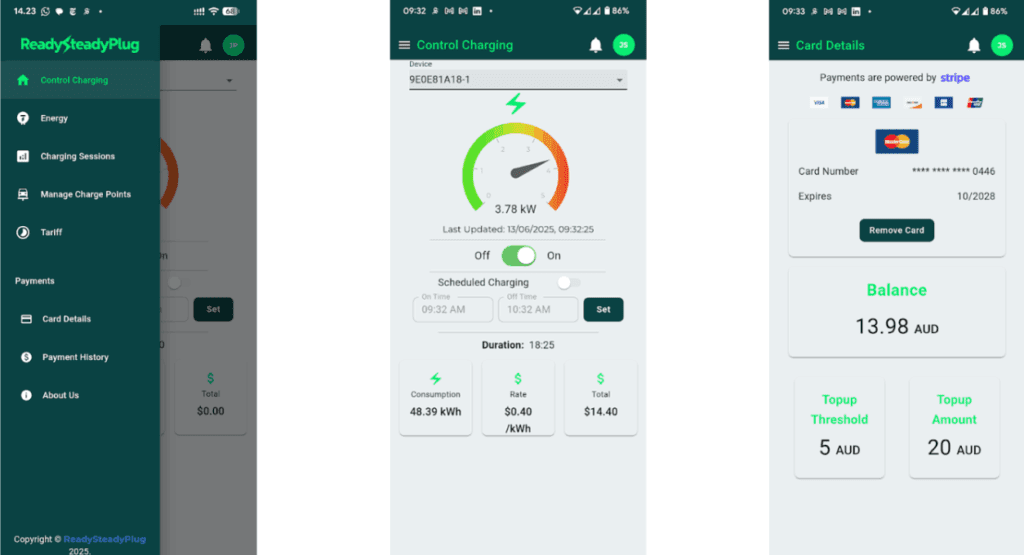
- From there they can add payment details, start/stop charging, and view session data
Charging is as simple as:
- Plugging in your portable EVSE to the socket and your car
- Scanning the QR code or opening the app
- Tapping Start
The app and portal show:
- Current charging status and power level
- Energy delivered and estimated cost
- Charging history across past sessions
Where enabled, drivers can also schedule charges (for example to prioritise off‑peak periods).
For strata managers and site admins
The management portal provides:
- A live view of all outlets (idle, charging, fault, etc.)
- Per‑user and per‑outlet consumption data
- Downloadable reports for billing and committee meetings
- Tools to configure tariff structures and load limits
Admins can set, and later adjust:
- Maximum total current for the EV system
- Priority rules for different outlets if needed
- Time‑of‑use tariffs where supported by the building’s retailer plan
Security and access control are handled via the platform – only authorised accounts can start charges on a given outlet, so one resident cannot use another’s bay without permission.
Even if the internet connection drops, the EVDB hardware can enforce safety limits locally. Data then syncs back to the cloud once connectivity is restored.
Installation
One of ReadySteadyPlug’s strengths is its relatively straightforward installation compared with high‑power alternatives.
Typical steps
- Site assessment
A qualified electrician or RSP partner reviews:- Existing switchboard capacity and main supply
- Car park layout and cabling routes
- Likely number and location of initial EV bays
- Design and approvals
A design is prepared showing EVDB locations, cable routes and outlet positions. The strata committee reviews this alongside quotes and, where needed, any grant applications. - Hardware installation
- EVDBs are mounted in an electrical room or on a suitable wall
- Conduits or cable trays are run to selected parking bays
- Weatherproof 10/15A outlets (with isolators if required) are installed near each bay
- Commissioning
- Circuits from outlets are terminated in the EVDB with appropriate protection
- The EVDB is connected to supply (for example via a three‑phase breaker)
- Communications (4G or site internet) are configured
- Outlets and user accounts are registered in the cloud platform
In many cases, a modest RSP installation can be completed within a short on‑site window, especially where no mains upgrade is required. Future expansion is straightforward: additional outlets can be added to spare EVDB capacity, or a new EVDB can be installed and linked into the system.
Some states and territories (such as NSW) offer grants for apartment EV charging infrastructure. A shared, metered system like RSP is often well‑aligned with the intent of these programs, since it benefits multiple residents rather than a single bay. Strata committees should check current EV and electrification rebates and speak with their electrician or consultant when planning a project.
Warranty and Service
The ReadySteadyPlug hardware is built largely from proven electrical components – industrial‑grade outlets, breakers and meters – combined with RSP’s own control and communications hardware.
While detailed warranty terms should be confirmed with RSP at the time of quoting, you can reasonably expect:
- Standard electrical component warranties from manufacturers
- A defined warranty period for RSP’s control electronics
Because the system is monitored via the cloud platform, many issues (for example, communication drop‑outs or abnormal power readings) can be detected remotely. In the event of a fault, RSP or its installation partner can assist in diagnosing the problem and, where needed, arrange on‑site service. The system is designed to fail safe – if communication is lost, charging will not continue unchecked.
A cloud‑connected architecture also allows ReadySteadyPlug to roll out firmware and software updates over time. As EV charging patterns, tariffs and building requirements evolve, existing customers can benefit from improvements without replacing hardware.
An additional form of “future‑proofing” is that RSP does not rely on proprietary wall‑box hardware in each bay. If, in a worst‑case scenario, the company were no longer around in future, the building would still have usable cabling and outlets that could be re‑purposed or re‑controlled by another system.
Is ReadySteadyPlug Right for Me?
Best fit scenarios
ReadySteadyPlug is particularly well‑suited to:
- Strata apartments and mixed‑use buildings with shared car parks
- Buildings with limited spare electrical capacity where full Level 2 roll‑outs are impractical
- Sites where cars are parked for many hours (overnight, full work days)
- Developers wanting to advertise projects as EV‑ready without major extra spend
If you’re a strata manager or committee member, RSP offers a low‑impact way to start providing EV charging that:
- Treats users fairly through metered billing
- Protects common power infrastructure
- Can grow with EV adoption in the building
When ReadySteadyPlug may not be ideal
RSP is less suitable if:
- You own a standalone house or townhouse – a dedicated home charger will usually be simpler and faster
- Your use case involves very high daily driving distances and you frequently need rapid top‑ups
- You’re running a fleet or public rapid‑charging site, where DC fast chargers or high‑power Level 2 units are more appropriate
For general home‑charger options, see our complete EV home charger guide.
Solar Choice’s View
In our view, ReadySteadyPlug is a thoughtful response to a very real problem: how to provide fair, practical EV charging in apartment buildings without triggering huge electrical upgrades.
By accepting the slower speed of Level 1 charging and layering on smart control, metering and billing, RSP lowers the barrier for apartment dwellers to own an EV and charge at home. It won’t replace fast charging on road trips or for heavy‑duty fleet use, but it doesn’t need to. For what it sets out to do – apartment EV charging that is affordable, scalable and fair – ReadySteadyPlug is a compelling option.
As always, Solar Choice recommends:
- Getting a professional assessment of your building’s electrical capacity
- Comparing a few different apartment EV charging solutions
- Considering grants and incentives that may apply in your state
Importantly, Solar Choice has no business affiliation with ReadySteadyPlug – our assessment comes from an independent perspective. We’ve observed that RSP is addressing a clear gap in the market for apartment EV charging. The company’s solution stands out by combining simple hardware (standard power points) with smart features like dynamic load management and cloud billing that are more commonly seen in high‑end systems. In the rest of this review, we’ll look at RSP’s features and where it may – and may not – be a good fit.

- Gareth Ridge | Zenobē: Electrifying Buses, EV Truck Fleets & Second‑Life Batteries - 26 February, 2026
- EVs After 2025: No Turning Back — What’s Coming in 2026 - 27 January, 2026
- QLD Solar Rebate for Renters: Landlords & Tenants Guide - 6 January, 2026



